Small Minors in Dense Graphs
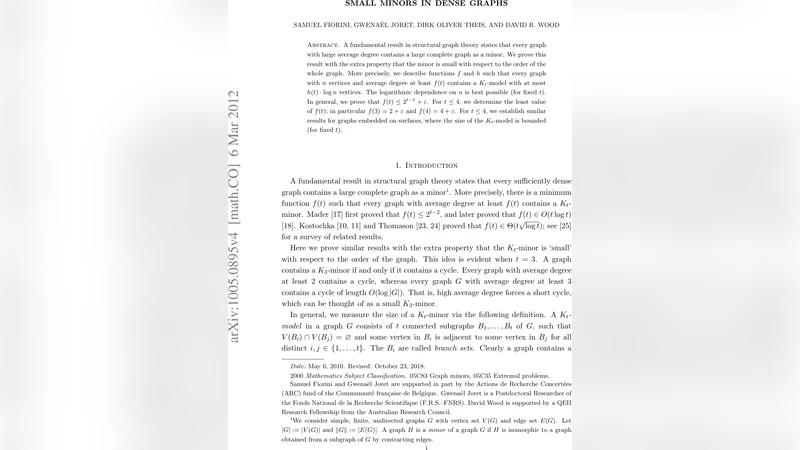
A fundamental result in structural graph theory states that every graph with large average degree contains a large complete graph as a minor. We prove this result with the extra property that the minor is small with respect to the order of the whole graph. More precisely, we describe functions $f$ and $h$ such that every graph with $n$ vertices and average degree at least $f(t)$ contains a $K_t$-model with at most $h(t)\cdot\log n$ vertices. The logarithmic dependence on $n$ is best possible (for fixed $t$). In general, we prove that $f(t)\leq 2^{t-1}+\eps$. For $t\leq 4$, we determine the least value of $f(t)$; in particular $f(3)=2+\eps$ and $f(4)=4+\eps$. For $t\leq4$, we establish similar results for graphs embedded on surfaces, where the size of the $K_t$-model is bounded (for fixed $t$).
💡 Research Summary
The paper revisits the classical theorem that a graph with sufficiently large average degree must contain a large complete graph as a minor, and strengthens it by controlling the size of the minor. The authors introduce two functions, f(t) and h(t). f(t) gives a degree threshold: any n‑vertex graph whose average degree is at least f(t) contains a Kₜ‑model (a collection of connected subgraphs that can be contracted to the vertices of Kₜ) whose total number of vertices is bounded by h(t)·log n. The logarithmic dependence on n is shown to be optimal for fixed t, because there exist dense graphs in which any Kₜ‑model must use at least c·log n vertices.
The main quantitative result is that for every integer t≥2 and any ε>0, one can take f(t) ≤ 2^{t‑1}+ε. In other words, an average degree just above 2^{t‑1} already guarantees a Kₜ‑minor that can be realized with only O(log n) vertices. The authors also determine the exact thresholds for the smallest non‑trivial cases: f(3)=2+ε and f(4)=4+ε. These values improve upon the naïve bound 2^{t‑1} and match known lower bounds, showing that the results are tight for t≤4.
The proof strategy combines expansion properties of dense graphs with a careful construction of shallow breadth‑first search (BFS) trees. First, a graph with average degree ≥ f(t) is shown to contain a subgraph that is an (α,β)‑expander (every small vertex set has many external neighbours). Within such an expander, the authors grow t disjoint BFS trees of depth O(log n). Because of the expansion, each tree’s leaf set has a large neighbourhood that intersects the leaf sets of the other trees. By selecting a small collection of leaves from each tree and contracting each collection into a single “super‑vertex,” they obtain t super‑vertices that are pairwise adjacent after the contractions. The total number of original vertices involved in the construction is at most h(t)·log n, giving the desired bound.
A lower‑bound construction shows that the logarithmic factor cannot be removed: for fixed t, there exist families of graphs with average degree just above the threshold in which any Kₜ‑model must occupy at least c·log n vertices. This demonstrates that the authors’ bound is asymptotically best possible.
Beyond the unrestricted setting, the paper also treats graphs that can be embedded on a fixed surface (e.g., the torus or higher‑genus surfaces). By adapting the expansion arguments to respect the surface’s Euler characteristic, the authors prove analogous results: for each surface and each fixed t, a constant‑factor increase in the degree threshold still guarantees a Kₜ‑minor whose model uses only O(log n) vertices. This unifies the dense‑graph minor theory with topological graph theory.
Overall, the work provides a quantitative refinement of the “dense graphs contain large minors” paradigm. It shows that not only does a dense graph contain a large complete minor, but that the minor can be realized with a remarkably small, logarithmic‑size model. This insight has potential algorithmic implications for graph compression, kernelization, and the design of fixed‑parameter tractable algorithms that rely on finding small minors in large networks.
Comments & Academic Discussion
Loading comments...
Leave a Comment