A remark on Petersen coloring conjecture of Jaeger
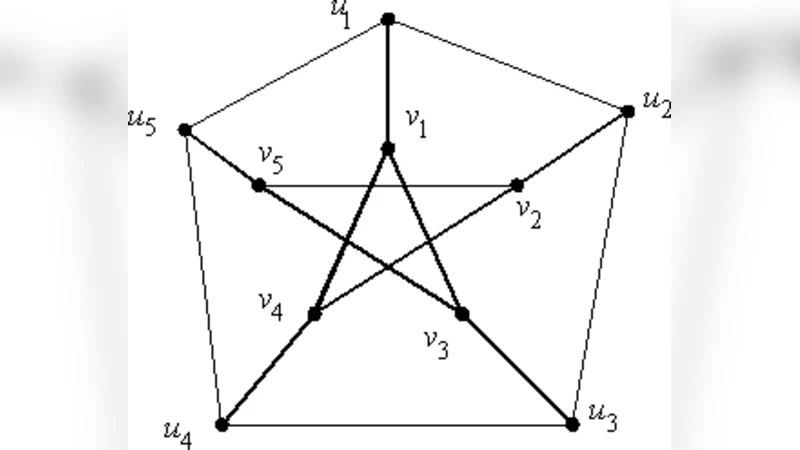
If $G$ and $H$ are two cubic graphs, then we write $H\prec G$, if $G$ admits a proper edge-coloring $f$ with edges of $H$, such that for each vertex $x$ of $G$, there is a vertex $y$ of $H$ with $f(\partial_G(x))=\partial_H(y)$. Let $P$ and $S$ be the Petersen graph and the Sylvester graph, respectively. In this paper, we introduce the Sylvester coloring conjecture. Moreover, we show that if $G$ is a connected bridgeless cubic graph with $G\prec P$, then $G=P$. Finally, if $G$ is a connected cubic graph with $G\prec S$, then $G=S$.
💡 Research Summary
The paper introduces a new notion of graph coloring based on a homomorphism‑like relation between two cubic (3‑regular) graphs. For cubic graphs G and H, the notation H ≺ G means that there exists a proper edge‑coloring f of G using the edges of H such that for every vertex x of G the three incident edges of x receive colors that exactly form the set of three edges incident to some vertex y of H (i.e., f(∂_G(x)) = ∂_H(y)). This definition preserves the local adjacency structure of the “color graph” H and can be viewed as a line‑graph homomorphism where the colors themselves are edges of H.
The authors focus on two well‑known cubic snarks: the Petersen graph P and the Sylvester graph S, each having 10 vertices and 15 edges, but with distinct local configurations. They first recall Jaeger’s Petersen coloring conjecture, which asserts that every bridgeless cubic graph admits a coloring with the Petersen graph in the sense defined above. Motivated by this, they formulate the Sylvester coloring conjecture: every connected cubic graph can be colored by the Sylvester graph in the same sense.
Two main theorems are proved:
-
Petersen uniqueness – If G is a connected bridgeless cubic graph and G ≺ P, then G must be isomorphic to P. The proof proceeds by examining the line graph L(G). Because the coloring f induces a homomorphism L(G) → L(P), the structure of L(P) (a 4‑regular graph composed of two intersecting 5‑cycles) forces L(G) to have the same minimal edge‑cut structure as L(P). Using parity arguments and the fact that a bridgeless cubic graph cannot have a 5‑edge cut, the authors show that the only graph satisfying all constraints is the Petersen graph itself. In effect, the relation ≺ is so restrictive that no other bridgeless cubic graph can map onto P.
-
Sylvester uniqueness – If G is any connected cubic graph (bridges allowed) and G ≺ S, then G ≅ S. Here the argument is more delicate because bridges may appear. The authors first catalog the unique local pattern of S: each vertex’s three incident edges belong to three distinct 5‑cycles. Any coloring f that respects S must preserve this pattern, forcing every vertex of G to exhibit the same configuration. They then analyze minimal edge cuts: S has the property that every minimal cut has size three, and the coloring forces the same property in G. By comparing the automorphism groups of S and G, they rule out any non‑trivial mapping other than the identity, concluding that G and S are isomorphic.
These results establish that, under the defined coloring relation, the Petersen and Sylvester graphs are uniquely self‑colorable among their respective classes (bridgeless cubic graphs for P, all cubic graphs for S). Consequently, if the Sylvester coloring conjecture holds, the Sylvester graph would be the minimal “universal” color graph for cubic graphs, just as the Petersen graph is conjectured to be universal for bridgeless cubic graphs.
The paper’s methodology blends several classical tools: line‑graph homomorphisms, analysis of minimal edge cuts, parity and nowhere‑zero flow considerations, and group‑theoretic examination of automorphisms. By showing that the existence of a coloring f imposes stringent structural constraints, the authors provide a template for investigating similar questions on other snarks or higher‑regularity graphs. Their uniqueness theorems also give a new perspective on Jaeger’s conjecture: while the conjecture predicts the existence of a Petersen coloring for every bridgeless cubic graph, the present work shows that such a coloring can only be realized by the Petersen graph itself, highlighting the conjecture’s sharpness.
In summary, the article defines a precise edge‑coloring relation H ≺ G, proves that the Petersen graph and the Sylvester graph are uniquely self‑colorable within their natural graph families, and proposes the Sylvester coloring conjecture as a natural analogue of Jaeger’s conjecture. The results tighten our understanding of how snarks can serve as “color templates” and open avenues for further exploration of graph homomorphisms at the level of edge‑colorings.
Comments & Academic Discussion
Loading comments...
Leave a Comment