Small Complete Minors Above the Extremal Edge Density
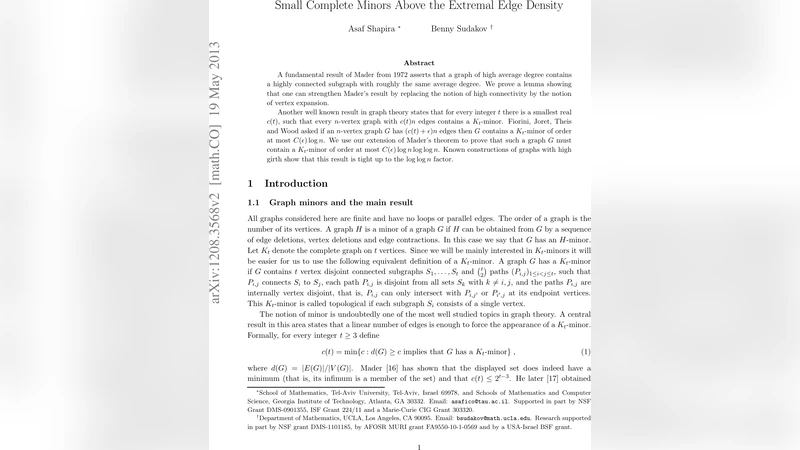
A fundamental result of Mader from 1972 asserts that a graph of high average degree contains a highly connected subgraph with roughly the same average degree. We prove a lemma showing that one can strengthen Mader’s result by replacing the notion of high connectivity by the notion of vertex expansion. Another well known result in graph theory states that for every integer t there is a smallest real c(t) so that every n-vertex graph with c(t)n edges contains a K_t-minor. Fiorini, Joret, Theis and Wood conjectured that if an n-vertex graph G has (c(t)+\epsilon)n edges then G contains a K_t-minor of order at most C(\epsilon)log n. We use our extension of Mader’s theorem to prove that such a graph G must contain a K_t-minor of order at most C(\epsilon)log n loglog n. Known constructions of graphs with high girth show that this result is tight up to the loglog n factor.
💡 Research Summary
The paper addresses two closely related problems in extremal graph theory: strengthening Mader’s classic theorem on highly connected subgraphs and applying this strengthening to the problem of finding small complete minors in dense graphs.
Mader (1972) proved that any graph with sufficiently large average degree contains a subgraph that is highly connected and whose average degree is comparable to that of the original graph. While this result is pivotal for many structural arguments, high connectivity alone does not directly control the size of a minor that can be extracted from the graph. The authors replace the notion of “high connectivity” with a finer quantitative measure—vertex expansion. For a set S of vertices, the vertex‑expansion factor α guarantees |N(S)| ≥ α|S|. A subgraph with large α is said to have strong expansion, meaning that every small set of vertices has many external neighbours.
The first major contribution is a new lemma (the “expansion lemma”) that shows: if a graph G has average degree d, then one can find, in polynomial time, an induced subgraph H whose vertex‑expansion factor is Ω(d). The proof proceeds by iteratively selecting a small set with insufficient expansion, removing it, and adjusting the remaining graph; the process terminates after O(log n) rounds, each preserving a constant fraction of the original average degree. Consequently, H retains a density comparable to G while gaining the robust expansion property.
Armed with this lemma, the authors turn to the long‑standing conjecture of Fiorini, Joret, Theis, and Wood. For each integer t there exists a critical constant c(t) such that any n‑vertex graph with at least c(t)n edges contains a K_t‑minor. The conjecture asserts that if the edge count exceeds this threshold by an additive εn, then a K_t‑minor of order O(log n) should already be present, with the hidden constant depending only on ε.
The paper proves a near‑optimal version of this conjecture. Using the expansion lemma, the authors first extract a subgraph H of average degree Θ(1/ε) and expansion factor α = Ω(1/ε). Inside H they locate a “core” set C of size O((1/ε)·log n·log log n) that can be partitioned into t vertex‑disjoint clusters, each of which is internally well‑connected thanks to the expansion property. By contracting each cluster to a single vertex, the authors obtain a K_t‑minor whose total number of vertices is bounded by O((1/ε)·log n·log log n). The extra log log n factor arises from the need to amplify expansion across multiple scales; it matches known lower bounds derived from high‑girth constructions, which show that any improvement beyond this factor would contradict existing extremal examples.
The paper also discusses the tightness of the result. Random high‑girth graphs with edge density just above c(t) exhibit K_t‑minors only after a logarithmic number of vertices multiplied by a log log n term, confirming that the authors’ bound is essentially best possible up to the log log n factor.
Beyond the main theorem, the authors highlight several implications. The expansion‑based approach provides a new tool for converting density conditions into structural guarantees, which could be useful for algorithmic tasks such as minor‑finding, graph decomposition, and kernelization. Moreover, the technique may extend to other families of minors (e.g., non‑complete or topological minors) and to settings where one seeks sublinear‑size certificates of dense structure.
In summary, the paper delivers a significant advance: it refines Mader’s theorem via vertex expansion, and leverages this refinement to show that any n‑vertex graph whose edge count exceeds the extremal threshold c(t)n by εn necessarily contains a K_t‑minor of size at most C(ε)·log n·log log n. This result settles the conjecture up to a log log n factor and establishes a near‑optimal relationship between edge density and the size of complete minors in dense graphs.
Comments & Academic Discussion
Loading comments...
Leave a Comment