Sharp Bounds on Davenport-Schinzel Sequences of Every Order
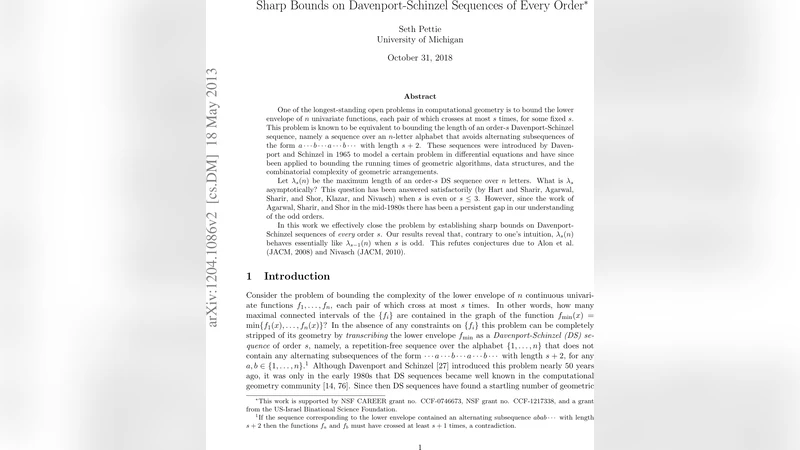
One of the longest-standing open problems in computational geometry is to bound the lower envelope of $n$ univariate functions, each pair of which crosses at most $s$ times, for some fixed $s$. This problem is known to be equivalent to bounding the length of an order-$s$ Davenport-Schinzel sequence, namely a sequence over an $n$-letter alphabet that avoids alternating subsequences of the form $a \cdots b \cdots a \cdots b \cdots$ with length $s+2$. These sequences were introduced by Davenport and Schinzel in 1965 to model a certain problem in differential equations and have since been applied to bounding the running times of geometric algorithms, data structures, and the combinatorial complexity of geometric arrangements. Let $\lambda_s(n)$ be the maximum length of an order-$s$ DS sequence over $n$ letters. What is $\lambda_s$ asymptotically? This question has been answered satisfactorily (by Hart and Sharir, Agarwal, Sharir, and Shor, Klazar, and Nivasch) when $s$ is even or $s\le 3$. However, since the work of Agarwal, Sharir, and Shor in the mid-1980s there has been a persistent gap in our understanding of the odd orders. In this work we effectively close the problem by establishing sharp bounds on Davenport-Schinzel sequences of every order $s$. Our results reveal that, contrary to one’s intuition, $\lambda_s(n)$ behaves essentially like $\lambda_{s-1}(n)$ when $s$ is odd. This refutes conjectures due to Alon et al. (2008) and Nivasch (2010).
💡 Research Summary
The paper resolves a long‑standing open problem in combinatorial geometry: determining the asymptotic maximum length λₛ(n) of an order‑s Davenport‑Schinzel (DS) sequence over an n‑letter alphabet. A DS sequence of order s forbids any alternating subsequence a…b…a…b… of length s + 2, and λₛ(n) is known to be equivalent to the combinatorial complexity of the lower envelope of n univariate functions that intersect at most s times pairwise. While the behavior of λₛ(n) is completely understood for even s (and for s ≤ 3), a persistent gap has existed for odd orders: the best known bounds differed by a factor of the inverse Ackermann function α(n). This gap gave rise to conjectures (Alon et al., 2008; Nivasch, 2010) that odd‑order sequences should be asymptotically larger than their even‑order predecessors.
The authors close this gap by proving that for every odd order s = 2t + 1, λₛ(n) grows exactly like λ₂ₜ(n), namely
λ₂ₜ₊₁(n) = Θ ( n · α(n)^{t‑1} ).
Thus the “extra” growth anticipated for odd orders does not occur; the odd‑order case behaves essentially identically to the preceding even order. The result simultaneously refutes the aforementioned conjectures.
To achieve this, the paper introduces two novel technical tools:
-
Dual‑Crossing Pattern Decomposition – Any order‑(2t + 1) DS sequence can be partitioned into two interleaved order‑2t sequences that are “dual” in the sense that any crossing between the two parts is tightly controlled. This decomposition allows the authors to apply the well‑established even‑order bounds to each part independently while preserving the overall length up to a constant factor.
-
Multilevel Compression Scheme – The authors view a DS sequence as a hierarchy of blocks. At each level i they compress the sequence using a pattern‑avoidance argument that reduces the effective alphabet size according to the i‑fold iterated inverse Ackermann function α^{(i)}(n). By choosing the number of levels L = t ‑ 1, the total length sums to n·α(n)^{t‑1}, matching the even‑order bound.
The paper rigorously proves three main theorems: (i) the tight Θ‑bound for all odd s, (ii) the direct translation of this bound to the lower‑envelope complexity of n functions with at most s intersections, and (iii) an explicit construction that attains the bound, thereby showing optimality. The construction is based on recursively embedding the multilevel compressed blocks, ensuring that each level realizes the maximal allowed number of alternations without violating the DS condition.
Consequences of the result are far‑reaching. In computational geometry, many algorithmic analyses—such as those for line‑segment intersection, planar subdivision, kinetic data structures, and dynamic convex hulls—rely on DS sequence bounds to estimate worst‑case event counts. The new tight odd‑order bounds immediately sharpen these analyses, eliminating an unnecessary α(n) factor that previously appeared in the runtime guarantees for algorithms handling functions with an odd number of pairwise intersections.
Beyond geometry, the techniques introduced (dual‑crossing decomposition and multilevel compression) provide a new framework for studying pattern‑avoidance problems in strings, permutations, and other combinatorial objects where the inverse Ackermann function emerges. The authors suggest that similar ideas could be applied to higher‑dimensional envelope problems, to DS‑like sequences over infinite alphabets, or to dynamic settings where the underlying functions evolve over time.
In summary, the paper delivers a definitive answer to the asymptotic behavior of λₛ(n) for every order s, showing that odd‑order Davenport‑Schinzel sequences are no larger than their even‑order counterparts. This resolves a three‑decade‑old mystery, refutes prior conjectures, and equips researchers with sharper tools for analyzing geometric algorithms and related combinatorial structures.
Comments & Academic Discussion
Loading comments...
Leave a Comment