Distributed MAC Protocol Supporting Physical-Layer Network Coding
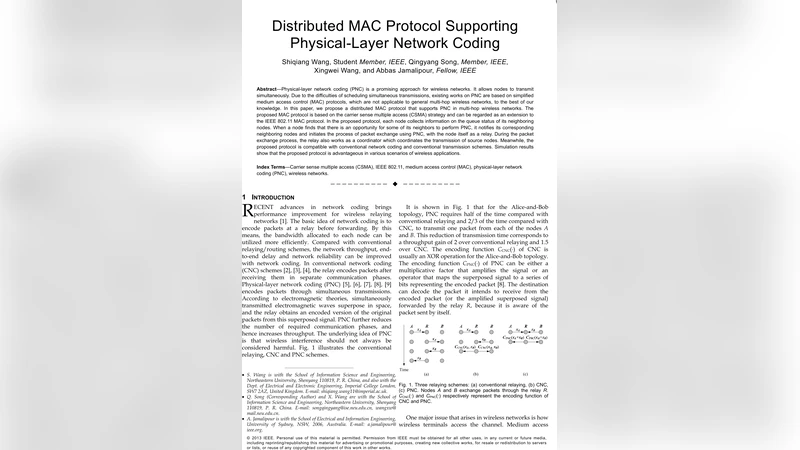
Physical-layer network coding (PNC) is a promising approach for wireless networks. It allows nodes to transmit simultaneously. Due to the difficulties of scheduling simultaneous transmissions, existing works on PNC are based on simplified medium access control (MAC) protocols, which are not applicable to general multi-hop wireless networks, to the best of our knowledge. In this paper, we propose a distributed MAC protocol that supports PNC in multi-hop wireless networks. The proposed MAC protocol is based on the carrier sense multiple access (CSMA) strategy and can be regarded as an extension to the IEEE 802.11 MAC protocol. In the proposed protocol, each node collects information on the queue status of its neighboring nodes. When a node finds that there is an opportunity for some of its neighbors to perform PNC, it notifies its corresponding neighboring nodes and initiates the process of packet exchange using PNC, with the node itself as a relay. During the packet exchange process, the relay also works as a coordinator which coordinates the transmission of source nodes. Meanwhile, the proposed protocol is compatible with conventional network coding and conventional transmission schemes. Simulation results show that the proposed protocol is advantageous in various scenarios of wireless applications.
💡 Research Summary
The paper presents a distributed medium‑access‑control (MAC) protocol, called PNC‑MAC, that extends the IEEE 802.11 CSMA/CA mechanism to support physical‑layer network coding (PNC) in multi‑hop wireless networks. Traditional PNC research has largely relied on centrally scheduled TDMA, which is unsuitable for ad‑hoc or WLAN environments. To bridge this gap, the authors embed a small amount of queue‑status information into data and ACK frames, allowing each node to maintain up‑to‑date knowledge of its one‑hop neighbours’ pending packets. When a relay node detects that two of its neighbours have packets destined for each other (a bidirectional flow), it initiates a PNC exchange using a three‑step handshake: RTS‑PNC (containing the addresses of the two source/destination nodes), CTS from each source, and a coordination frame (CO‑PNC) that conveys timing compensation. The coordination frame ensures that the two sources transmit with a controlled offset: the shorter packet starts first, while the longer packet’s header is sent later in a bit‑reversed order. This offset guarantees that the relay can decode both headers before the overlapping portion is processed by the PNC encoder.
The relay then applies a chosen PNC mapping (the authors use the denoise‑and‑forward (DNF) method in simulations) to the superposed signal, generates a coded packet, and broadcasts it to both sources. Each source, knowing its own original packet, extracts the intended packet from the coded transmission and acknowledges receipt. An ACK‑PNC frame informs the relay which packets were successfully delivered, prompting removal of those packets from the sources’ queues.
The protocol also defines robust fallback mechanisms. If either source reports “no packet” in its CTS (due to outdated queue information) or if any control frame is lost, the relay automatically switches to conventional relaying or to conventional network coding (CNC) using XOR, ensuring that the network never stalls because of a missed PNC opportunity. The design is compatible with various PNC implementations (AF, DNF, DF) and can operate with different synchronization requirements; coarse synchronization suffices for amplify‑and‑forward, while tighter alignment is needed for synchronous DNF.
Performance evaluation through extensive simulations (varying node density, traffic load, hop count, and link distances) shows that PNC‑MAC achieves 30‑70 % higher throughput and 20‑50 % lower end‑to‑end delay compared with standard 802.11 DCF. The gains are most pronounced in scenarios with many bidirectional flows, where PNC can replace two separate transmissions with a single coded exchange. When PNC opportunities are scarce, the protocol gracefully falls back to CNC or ordinary relaying, limiting performance degradation.
The authors acknowledge limitations: the need for accurate timing estimation at the relay, the restriction to coding exactly two packets (extension to larger coding groups would require more sophisticated scheduling and buffer management), and the dependence on the underlying physical‑layer PNC method’s robustness to synchronization errors. Nonetheless, the work provides a concrete, implementable MAC framework that brings the theoretical benefits of physical‑layer network coding into realistic, distributed wireless networks, laying groundwork for future research on scalable, coding‑aware MAC designs.
Comments & Academic Discussion
Loading comments...
Leave a Comment