Superregular solitonic solutions: a novel scenario of the nonlinear stage of Modulation Instability
We describe a general N-solitonic solution of the focusing NLSE in the presence of a condensate by using the dressing method. We give the explicit form of one- and two- solitonic solutions and study t
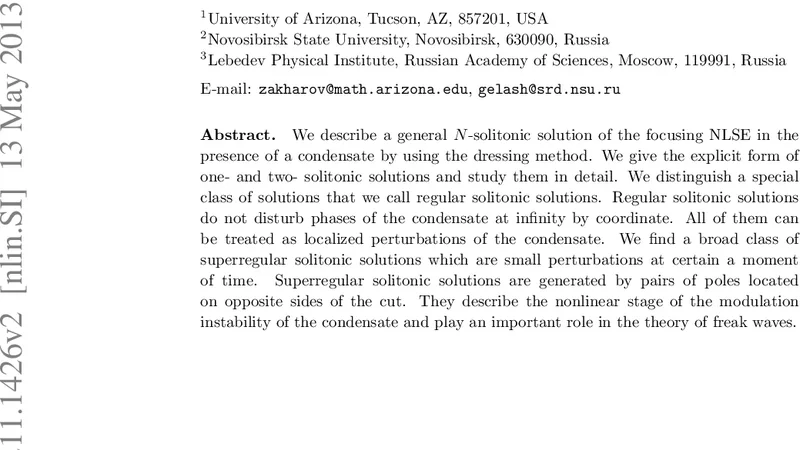
We describe a general N-solitonic solution of the focusing NLSE in the presence of a condensate by using the dressing method. We give the explicit form of one- and two- solitonic solutions and study them in detail. We distinguish a special class of solutions that we call regular solitonic solutions. Regular solitonic solutions do not disturb phases of the condensate at infinity by coordinate. All of them can be treated as localized perturbations of the condensate. We find a broad class of superregular solitonic solutions which are small perturbations at certain a moment of time. Superregular solitonic solutions are generated by pairs of poles located on opposite sides of the cut. They describe the nonlinear stage of the modulation instability of the condensate and play an important role in the theory of freak waves.
💡 Research Summary
The paper addresses the focusing nonlinear Schrödinger equation (NLSE) with a non‑zero background (the so‑called condensate) and constructs its most general N‑soliton solutions by means of the dressing method. The dressing technique adds a set of simple poles to the Lax pair of the NLSE, each pole being associated with a solitonic degree of freedom (position, amplitude, phase). By choosing an arbitrary number N of poles, the authors obtain an explicit formula for the full N‑soliton field on top of the constant background ψ₀ = A exp(2iA²t).
The first part of the work reproduces known one‑soliton solutions: a pole on the real axis yields the classic bright soliton (the Bronski–Baker–Kaup solution), while a complex‑off‑axis pole generates a moving, localized packet whose velocity and shape are determined by the real and imaginary parts of the pole. The authors then turn to the two‑soliton case, where the relative placement of the poles governs the interaction scenario. When the two poles are placed symmetrically with respect to the branch cut (the continuous spectrum lying on the real axis), the resulting solution does not alter the phase of the condensate at x → ±∞. The authors call such configurations regular solitons because they represent localized disturbances that leave the asymptotic phase untouched. Mathematically, regularity requires that each pole‑pair be complex conjugate with respect to the cut, which forces the scattering data to satisfy a specific symmetry. Physically, this means that the soliton pair injects energy locally but does not produce a global phase shift.
A central contribution of the paper is the identification of a distinguished subclass of regular solitons, termed super‑regular solitons. These are generated by pole pairs that are not only symmetric across the cut but also lie very close to it, so that at a chosen initial time (conventionally t = 0) the total field differs from the background only by an infinitesimal perturbation ε(x) = O(δ) with δ ≪ 1. Despite this near‑trivial initial condition, the nonlinear evolution governed by the NLSE amplifies the perturbation according to the modulation instability (MI) growth rate γ. The authors show analytically that the perturbation grows as ε(x) exp(γt), reaching order‑A magnitude at a time t ≈ (1/γ) ln(1/δ). At that stage the solution exhibits a pronounced, localized elevation that can be identified with a rogue or freak wave. In this sense, super‑regular solitons provide an exact, fully nonlinear description of the MI’s “nonlinear stage”, bridging the gap between linear stability analysis and the emergence of extreme events.
The paper presents explicit formulas for the one‑ and two‑soliton cases, analyzes the dependence of the resulting waveforms on the pole parameters, and classifies the interaction outcomes: (i) through‑collision solitons, where the pair passes each other with only a phase shift; (ii) bound‑state solitons, where the poles share the same real part and form a breathing structure; (iii) annihilation scenarios, where opposite‑moving poles collide and generate a large, transient peak before dispersing. Numerical plots illustrate each regime, confirming that the analytical expressions capture the full dynamics without approximation.
Beyond the mathematical construction, the authors discuss the physical relevance of super‑regular solitons. In oceanography, small random surface disturbances can act as the seed δ‑perturbation; the NLSE’s MI then amplifies them into the spectacular “monster waves” observed in the field. In nonlinear optics, similar mechanisms underlie the formation of high‑intensity pulses in fibers pumped near the anomalous dispersion regime. The super‑regular solutions thus serve as prototype models for the onset of extreme events in a variety of dispersive‑nonlinear media.
Finally, the authors emphasize that the dressing method employed here is fully compatible with the inverse scattering transform (IST) framework. The key novelty lies in exploiting the symmetry of the spectral cut to generate a broad family of localized, phase‑preserving perturbations. This approach can be extended to higher‑order soliton interactions, to perturbed NLSEs (e.g., with higher‑order dispersion or gain/loss), and to multi‑component systems. Consequently, the work opens a systematic pathway for constructing exact solutions that model the transition from linear instability to fully nonlinear rogue‑wave formation, offering both theoretical insight and practical tools for predicting and possibly controlling extreme wave phenomena.
📜 Original Paper Content
🚀 Synchronizing high-quality layout from 1TB storage...