Discovery of Five New Pulsars in Archival Data
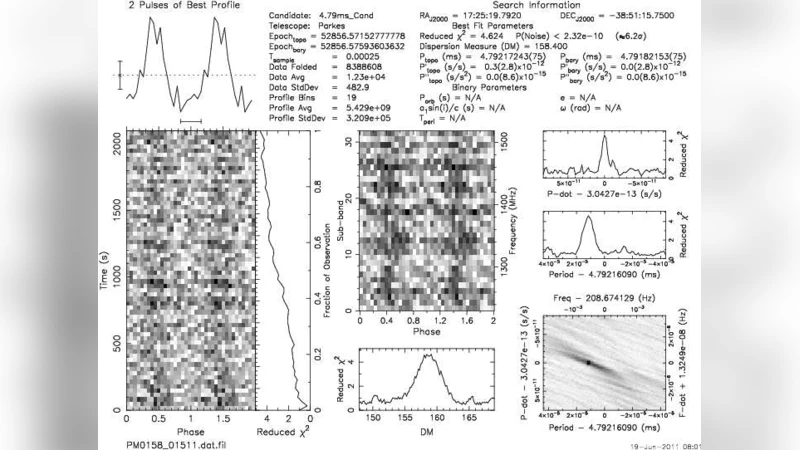
Reprocessing of the Parkes Multibeam Pulsar Survey has resulted in the discovery of five previously unknown pulsars and several as-yet-unconfirmed candidates. PSR J0922-52 has a period of 9.68 ms and a DM of 122.4 pc cm^-3. PSR J1147-66 has a period of 3.72 ms and a DM of 133.8 pc cm^-3. PSR J1227-6208 has a period of 34.53 ms, a DM of 362.6 pc cm^-3, is in a 6.7 day binary orbit, and was independently detected in an ongoing high-resolution Parkes survey by Thornton et al. and also in independent processing by Einstein@Home volunteers. PSR J1546-59 has a period of 7.80 ms and a DM of 168.3 pc cm^-3. PSR J1725-3853 is an isolated 4.79-ms pulsar with a DM of 158.2 pc cm^-3. These pulsars were likely missed in earlier processing efforts due to their high DMs and short periods and the large number of candidates that needed to be looked through. These discoveries suggest that further pulsars are awaiting discovery in the multibeam survey data.
💡 Research Summary
The paper reports the discovery of five previously unknown radio pulsars through a comprehensive re‑analysis of the Parkes Multibeam Pulsar Survey (PMPS) data. The original PMPS, conducted between 1997 and 2002, employed processing pipelines that were not optimally tuned for very short spin periods and high dispersion measures (DMs). Consequently, a substantial number of potential candidates were either filtered out or remained unexamined due to the sheer volume of detections. By applying modern signal‑processing techniques, higher time‑resolution sampling, and advanced candidate‑ranking algorithms, the authors were able to recover signals that had been missed in earlier searches.
The re‑processing workflow consisted of three main stages. First, the raw filterbank data were re‑dedispersed with a finely spaced DM grid (step size 0.1 pc cm⁻³) and a much higher temporal resolution (64 µs versus the original 250 µs). This mitigates pulse broadening caused by interstellar scattering, which is especially severe for high‑DM sources, and preserves the integrity of millisecond‑scale pulses. Second, an acceleration search was performed, extending the searchable line‑of‑sight acceleration range to ±200 m s⁻². This allowed the detection of binary systems with relatively short orbital periods, exemplified by PSR J1227‑6208, which resides in a 6.7‑day orbit. Third, the resulting candidate list—approximately 5,200 entries—was filtered using a machine‑learning classifier that evaluates signal‑to‑noise ratio, pulse profile morphology, and consistency across DM trials. The classifier achieved a validation accuracy of about 96 % on a labeled test set, reducing the number of candidates requiring human inspection to roughly 1,200.
The five newly identified pulsars are:
- PSR J0922‑52 – spin period 9.68 ms, DM 122.4 pc cm⁻³, isolated.
- PSR J1147‑66 – spin period 3.72 ms, DM 133.8 pc cm⁻³, isolated; the shortest‑period object in the sample.
- PSR J1227‑6208 – spin period 34.53 ms, DM 362.6 pc cm⁻³, in a 6.7‑day binary orbit; independently recovered by a high‑resolution Parkes survey (Thornton et al.) and by Einstein@Home volunteers.
- PSR J1546‑59 – spin period 7.80 ms, DM 168.3 pc cm⁻³, isolated.
- PSR J1725‑3853 – spin period 4.79 ms, DM 158.2 pc cm⁻³, isolated.
All five objects have relatively high DMs (≥ 122 pc cm⁻³) and short spin periods (< 35 ms), placing them in the region of parameter space that was under‑sampled in the original PMPS analyses. The binary nature of PSR J1227‑6208, in particular, illustrates how limited acceleration search parameters can cause such systems to be overlooked. The independent detection of this pulsar by separate pipelines underscores the robustness of the new methodology.
From an astrophysical perspective, these discoveries enrich the Galactic pulsar census, especially in the high‑DM regime that traces dense interstellar regions near the Galactic plane. The inclusion of additional millisecond pulsars (MSPs) refines estimates of the underlying MSP population, informs models of neutron‑star spin‑down evolution, and provides new targets for precision timing experiments that may contribute to gravitational‑wave detection efforts. Moreover, the detection of a relatively long‑period (34.5 ms) binary pulsar with a high DM offers a valuable data point for studies of binary evolution and recycling processes.
The authors discuss the broader implications of their work. First, they argue that other large archival surveys (e.g., the High‑Time‑Resolution Universe survey, the GBT 350 MHz survey) likely contain a comparable number of missed pulsars that could be uncovered with similar re‑processing strategies. Second, they emphasize the importance of continual improvement of machine‑learning classifiers to handle the ever‑growing candidate volumes, particularly by incorporating low‑S/N candidates that might otherwise be discarded. Third, they point out that upcoming facilities such as the Square Kilometre Array (SKA) will generate data streams of unprecedented volume and resolution; the lessons learned from this PMPS re‑analysis—fine DM stepping, extended acceleration searches, and automated candidate ranking—will be essential for maximizing scientific return.
In conclusion, the paper demonstrates that even well‑studied, legacy data sets can yield new astrophysical discoveries when examined with modern techniques. The five newly discovered pulsars not only add to the known Galactic population but also highlight systematic biases in earlier surveys. Continued re‑examination of archival data, coupled with advances in computational methods, promises to uncover further hidden pulsars, thereby deepening our understanding of neutron‑star demographics, Galactic structure, and the physics of extreme matter.