On the structure of finite level and omega-decomposable Borel functions
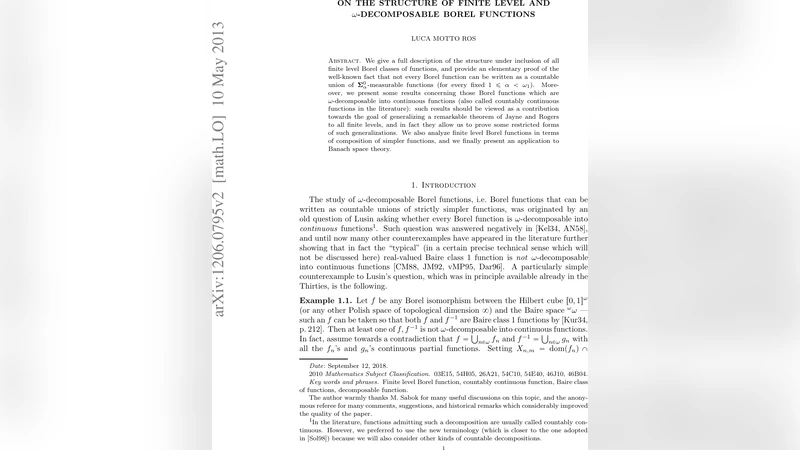
We give a full description of the structure under inclusion of all finite level Borel classes of functions, and provide an elementary proof of the well-known fact that not every Borel function can be written as a countable union of \Sigma^0_\alpha-measurable functions (for every fixed 1 \leq \alpha < \omega_1). Moreover, we present some results concerning those Borel functions which are \omega-decomposable into continuous functions (also called countably continuous functions in the literature): such results should be viewed as a contribution towards the goal of generalizing a remarkable theorem of Jayne and Rogers to all finite levels, and in fact they allow us to prove some restricted forms of such generalizations. We also analyze finite level Borel functions in terms of composition of simpler functions, and we finally present an application to Banach space theory.
💡 Research Summary
The paper investigates two intertwined themes concerning Borel measurable functions: the fine‑grained hierarchy of finite‑level Borel classes and the phenomenon of ω‑decomposability (i.e., representation as a countable union of continuous functions).
First, the authors introduce a systematic notation for the finite levels of the Borel hierarchy. For each countable ordinal α with 1 ≤ α < ω, they define the class 𝔅_α as the intersection of Σ⁰_α‑measurable and Π⁰_α‑measurable functions. By focusing on inclusion of function classes rather than the usual Wadge reducibility of sets, they obtain a lattice‑like structure: 𝔅_α ⊂ 𝔅_{α+1} for every finite α, and the inclusion is strict. The strictness is demonstrated by constructing explicit indicator functions of sets that lie in Π⁰_{α+1} \ Σ⁰_α, thereby showing that no collapse occurs at any finite stage. Moreover, the collection {𝔅_α : α < ω} forms a complete partial order under inclusion, and the authors describe its maximal chains, antichains, and the role of minimal non‑trivial Borel functions within each level.
The second major contribution is an elementary proof of the classical fact that a fixed Borel class does not generate all Borel functions via countable unions. Specifically, for any fixed α (1 ≤ α < ω₁), the family of Σ⁰_α‑measurable functions is not sufficient to cover every Borel function when one allows only countable unions of such functions. The proof avoids deep descriptive‑set‑theoretic machinery and instead uses a diagonalisation argument based on a carefully chosen hierarchy of sets whose characteristic functions have strictly higher Borel rank.
Having established this limitation, the authors turn to ω‑decomposability, which is synonymous with “countably continuous” or “σ‑continuous” in the literature. They revisit the celebrated Jayne–Rogers theorem, which characterises Σ⁰_2‑measurable functions that are ω‑decomposable as precisely those that are the pointwise limit of a sequence of continuous functions. The paper’s ambition is to extend this characterisation to all finite levels. While a full generalisation remains open, the authors obtain several restricted versions:
-
Regularity Condition – If a Σ⁰_α‑measurable function additionally admits an Fσ (or Gδ) decomposition of its domain into pieces on which it is continuous, then it is ω‑decomposable.
-
Level‑Reduction Condition – Suppose f ∈ 𝔅_α and there exists a countable partition {A_n} of the domain with each A_n ∈ 𝔅_β for some β < α such that the restriction f|_{A_n} is continuous. Then f is ω‑decomposable. This yields a hierarchy of sufficient conditions that mirror the original Jayne–Rogers theorem but apply to any finite α.
The paper also analyses finite‑level Borel functions through the lens of composition. It shows that any function in 𝔅_α can be expressed as a countable composition of a Σ⁰_α‑measurable map followed by a Π⁰_α‑measurable map, possibly after taking pointwise limits. This decomposition is reminiscent of the classical factorisation of Borel sets into analytic and co‑analytic parts, but here it is applied to functions. The authors prove that for every f ∈ 𝔅_α there exist sequences {g_n}⊆Σ⁰_α and {h_n}⊆Π⁰_α such that
f(x) = lim_{n→∞} g_n(h_n(x))
for all x. This representation provides a constructive pathway to understand the complexity of Borel functions in terms of simpler building blocks.
Finally, the authors connect these descriptive‑set‑theoretic insights to Banach space theory. They consider linear operators T : X → Y between Banach spaces that are Borel measurable. When T is ω‑decomposable, the paper shows that T is automatically weakly continuous; in many cases it even becomes compact or completely continuous. The key observation is that ω‑decomposability forces the operator to respect the weak topology on bounded sets, thereby bridging a gap between purely measurable properties and topological/functional analytic regularity. This application illustrates how the fine structure of Borel functions can have concrete consequences in functional analysis.
In summary, the article delivers a comprehensive description of the inclusion lattice of finite‑level Borel function classes, furnishes an elementary proof of the non‑universality of Σ⁰_α‑measurable unions, advances the theory of ω‑decomposable functions by providing several finite‑level analogues of the Jayne–Rogers theorem, offers a composition‑based factorisation of Borel functions, and finally demonstrates the relevance of these results to the theory of Banach space operators.