Polynomial-time homology for simplicial Eilenberg-MacLane spaces
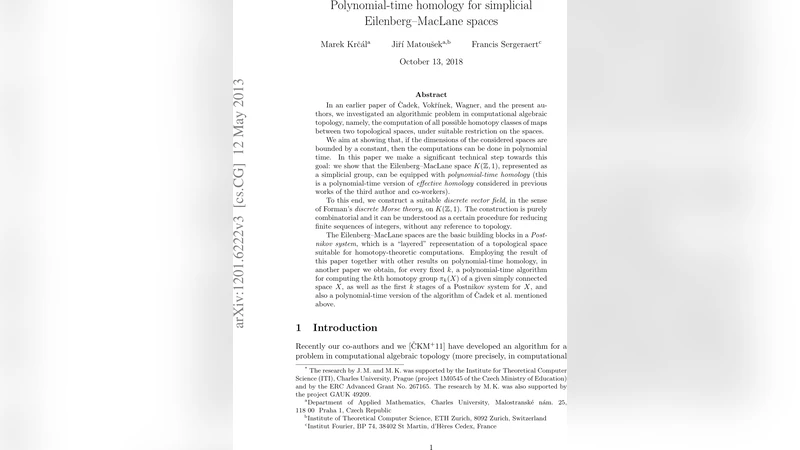
In an earlier paper of Cadek, Vokrinek, Wagner, and the present authors, we investigated an algorithmic problem in computational algebraic topology, namely, the computation of all possible homotopy classes of maps between two topological spaces, under suitable restriction on the spaces. We aim at showing that, if the dimensions of the considered spaces are bounded by a constant, then the computations can be done in polynomial time. In this paper we make a significant technical step towards this goal: we show that the Eilenberg-MacLane space K(Z,1), represented as a simplicial group, can be equipped with polynomial-time homology (this is a polynomial-time version of effective homology considered in previous works of the third author and co-workers). To this end, we construct a suitable discrete vector field, in the sense of Forman’s discrete Morse theory, on K(Z,1). The construction is purely combinatorial and it can be understood as a certain procedure for reducing finite sequences of integers, without any reference to topology.The Eilenberg-MacLane spaces are the basic building blocks in a Postnikov system, which is a “layered” representation of a topological space suitable for homotopy-theoretic computations. Employing the result of this paper together with some other results on polynomial-time homology, in another paper we obtain, for every fixed k, a polynomial-time algorithm for computing the k-th homotopy group pi_k(X) of a given simply connected space X, as well as the first k stages of a Postnikov system for X, and also a polynomial-time version of the algorithm of Cadek et al. mentioned above.
💡 Research Summary
The paper addresses a central algorithmic challenge in computational algebraic topology: enumerating all homotopy classes of maps between two spaces under suitable restrictions. While earlier work by Cádek, Vokrinek, Wagner and collaborators introduced the problem and provided effective homology methods, those approaches did not yield polynomial‑time algorithms because the underlying chain complexes could be arbitrarily large. To overcome this barrier the authors introduce the notion of “polynomial‑time homology,” a refinement of effective homology in which the reduction from a large simplicial chain complex to a small, computable model can be performed in time bounded by a polynomial in the size of the input.
The technical core of the paper is a construction of a discrete vector field on the simplicial Eilenberg–MacLane space K(ℤ,1). K(ℤ,1) is modeled as a simplicial group whose n‑simplices correspond to finite integer sequences (a₁,…,a_n) with the usual boundary operator. The authors define two combinatorial matching rules—forward reduction (merging adjacent entries of the same sign) and backward reduction (removing a sign‑change pivot)—that together form a discrete Morse vector field in the sense of Forman. They prove that this field is acyclic: no non‑trivial closed V‑paths exist, so the associated Morse complex consists solely of the critical cells. Crucially, the matching can be computed by simple integer‑sequence manipulations that require only O(log M) bit operations per step, where M bounds the absolute values of the input integers. Consequently, the entire reduction from the original chain complex of K(ℤ,1) to its Morse complex runs in time O(N^c) for some constant c, where N is the number of simplices. The resulting Morse complex reproduces the known homology of K(ℤ,1) (π₁≅ℤ, higher homology trivial), confirming correctness.
Having established polynomial‑time homology for K(ℤ,1), the authors combine this result with previously developed polynomial‑time reductions for other basic building blocks (e.g., K(ℤ,n) for n≥2) to obtain a full algorithmic pipeline for fixed‑dimension simply‑connected spaces X. By constructing the Postnikov tower of X layer by layer, each layer being a fibration with fiber a K(π_i, i) space, they can compute the homotopy groups π_k(X) for any fixed k and the first k stages of the Postnikov system in polynomial time. This yields, as a corollary, a polynomial‑time version of the algorithm originally described by Cádek et al. for enumerating homotopy classes of maps between bounded‑dimension spaces.
The paper concludes with several avenues for future work. Extending the discrete vector field construction to Eilenberg–MacLane spaces with non‑abelian or more general coefficient groups is an open problem. Implementing the algorithms in existing computational topology software (such as Kenzo) and optimizing the hidden constants in the polynomial bounds are practical next steps. Finally, the authors suggest investigating whether similar Morse‑theoretic reductions can be applied to more complex simplicial models that arise in higher‑dimensional homotopy theory, potentially broadening the scope of polynomial‑time computations in algebraic topology.
Comments & Academic Discussion
Loading comments...
Leave a Comment