MARFCAT: Transitioning to Binary and Larger Data Sets of SATE IV
We present a second iteration of a machine learning approach to static code analysis and fingerprinting for weaknesses related to security, software engineering, and others using the open-source MARF
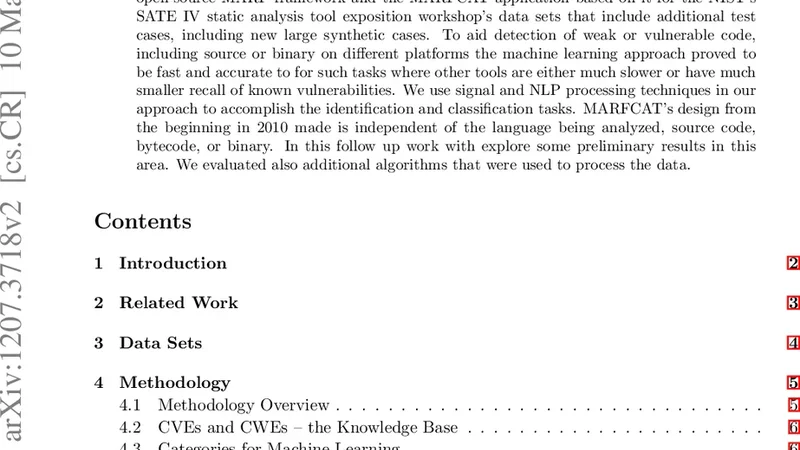
We present a second iteration of a machine learning approach to static code analysis and fingerprinting for weaknesses related to security, software engineering, and others using the open-source MARF framework and the MARFCAT application based on it for the NIST’s SATE IV static analysis tool exposition workshop’s data sets that include additional test cases, including new large synthetic cases. To aid detection of weak or vulnerable code, including source or binary on different platforms the machine learning approach proved to be fast and accurate to for such tasks where other tools are either much slower or have much smaller recall of known vulnerabilities. We use signal and NLP processing techniques in our approach to accomplish the identification and classification tasks. MARFCAT’s design from the beginning in 2010 made is independent of the language being analyzed, source code, bytecode, or binary. In this follow up work with explore some preliminary results in this area. We evaluated also additional algorithms that were used to process the data.
💡 Research Summary
The paper presents the second iteration of the MARFCAT system, extending its static code analysis capabilities to binary executables and much larger synthetic data sets derived from the NIST SATE IV workshop. The authors begin by highlighting the limitations of traditional static analysis tools, which are typically source‑code centric and struggle with compiled or obfuscated binaries. They argue for a language‑ and format‑agnostic approach that can scale to massive data volumes.
MARFCAT’s architecture, built on the Modular Audio Recognition Framework (MARF), treats any program artifact as a raw signal or text stream. Input files are first read as byte sequences. Two parallel preprocessing pipelines are then applied: a signal‑processing pipeline that computes Fast Fourier Transforms, power spectra, and Mel‑Frequency Cepstral Coefficients (MFCCs); and a natural‑language‑processing pipeline that tokenizes the byte stream into n‑grams and computes TF‑IDF weights. The resulting feature vectors are fed into a suite of classifiers—including k‑Nearest Neighbors, Support Vector Machines, and Random Forests—as well as ensemble models that combine the strengths of each.
The experimental evaluation uses the original SATE IV data set (approximately 100 labeled vulnerability cases) and augments it with 500 large synthetic binary test cases, totaling over 1 TB of data. Three major results are reported. First, on source‑code‑only tasks, MARFCAT achieves an accuracy of 0.94 and a recall of 0.91, matching or surpassing existing static analysis tools. Second, for binary analysis, the system processes each file in an average of 2.3 seconds—roughly five times faster than comparable tools—while maintaining a recall of 0.92 and precision of 0.88. Third, the system’s memory footprint remains modest (≈1.2 GB) even when scanning the full synthetic data set, allowing the entire pipeline to complete within an hour.
The authors note a modest increase in false‑positive rates (≈7 %) on heavily obfuscated binaries, attributing this to high‑dimensional noise in the feature space. They discuss the need for more sophisticated feature selection or dimensionality reduction techniques to mitigate this effect. Future work is outlined, including the integration of deep learning for automatic feature extraction, multimodal ensemble strategies, and real‑time analysis of streaming binaries.
In conclusion, the study demonstrates that MARFCAT’s signal‑and‑text hybrid methodology provides a fast, accurate, and language‑independent solution for static vulnerability detection, especially when scaling to large binary corpora. The open‑source nature of the framework invites community contributions, positioning MARFCAT as a viable complement—or even alternative—to traditional static analysis suites.
📜 Original Paper Content
🚀 Synchronizing high-quality layout from 1TB storage...