Hamilton Operators, Discrete Symmetries, Brute Force and SymbolicC++
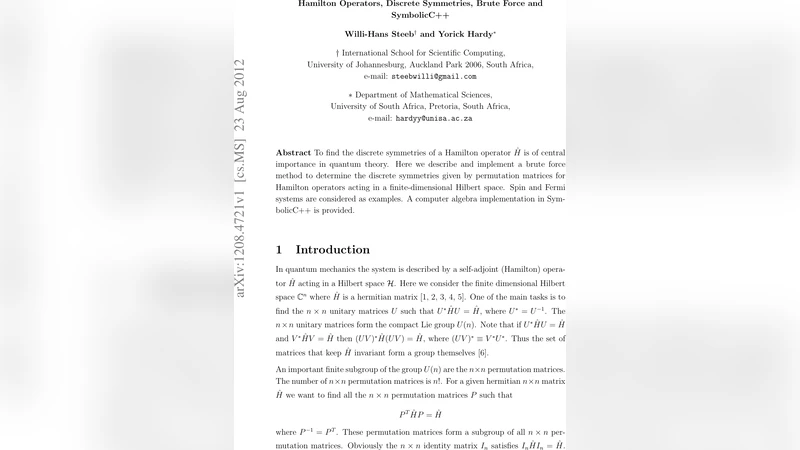
To find the discrete symmetries of a Hamilton operator $\hat H$ is of central importance in quantum theory. Here we describe and implement a brute force method to determine the discrete symmetries given by permutation matrices for Hamilton operators acting in a finite-dimensional Hilbert space. Spin and Fermi systems are considered as examples. A computer algebra implementation in SymbolicC++ is provided.
💡 Research Summary
The paper addresses the problem of automatically identifying discrete symmetries of a Hamiltonian operator that acts on a finite‑dimensional Hilbert space. While continuous symmetries are routinely treated with Lie‑group theory, discrete symmetries—such as lattice reflections, particle‑hole transformations, and permutation invariances—often have to be guessed or derived manually for each model. The authors propose a brute‑force (exhaustive) algorithm that searches over all possible permutation matrices and checks whether each permutation either commutes with the Hamiltonian (symmetry) or anticommutes with it (anti‑symmetry).
Mathematically, a permutation matrix (P) is a binary orthogonal matrix satisfying (P^{T}=P^{-1}). The symmetry condition is (P,\hat H,P^{-1}= \hat H); the anti‑symmetry condition is (P,\hat H,P^{-1}= -\hat H). Because the set of (N\times N) permutation matrices has cardinality (N!), a naïve exhaustive search quickly becomes infeasible for large (N). The authors therefore introduce several practical optimizations:
-
Spectral filtering – The eigenvalue spectrum of (\hat H) is computed first. Eigenvectors belonging to non‑degenerate eigenvalues must be left invariant, so only subspaces with degenerate eigenvalues are eligible for non‑trivial permutations. This dramatically reduces the candidate pool.
-
Structural pre‑selection – Many physically relevant discrete symmetries belong to specific families (cyclic rotations, reflections, swaps). The algorithm can be instructed to generate only these families, bypassing the full factorial set.
-
Symbolic verification – By implementing the whole procedure in SymbolicC++, the authors avoid floating‑point round‑off errors. The core test uses
simplifyandisZeroto decide whether (P\hat H P^{-1}\pm\hat H) is exactly the zero matrix.
The implementation details are provided in a compact SymbolicC++ program. The main routine iterates over a list of permutations generated by a helper function, constructs the corresponding matrix (P), and calls a Boolean routine isSymmetry(P, H, sign) that returns true if the symmetry (sign = +1) or anti‑symmetry (sign = ‑1) condition holds. Parallelisation is achieved with OpenMP pragmas, allowing the search to be distributed across multiple CPU cores.
To demonstrate the method, three benchmark models are examined:
-
Two‑spin Heisenberg chain – The Hamiltonian is a (4\times4) matrix. The exhaustive search recovers the full SU(2) spin‑rotation symmetry and the lattice‑reflection symmetry.
-
Four‑mode Hubbard model (fermionic) – A (16\times16) matrix representing spin‑up and spin‑down electrons on two sites. The algorithm discovers particle‑hole symmetry, spin‑exchange symmetry, and overall charge‑conservation symmetry. Notably, anti‑symmetry permutations are also found, reflecting the existence of a sign‑changing transformation that maps the Hamiltonian to its negative.
-
Three‑dimensional spin‑½ lattice – An (8\times8) Hamiltonian with nearest‑neighbour couplings. The search identifies the dihedral group (D_{4h}) as the full discrete symmetry group, matching the known analytical result.
In each case the set of permutation matrices obtained by the brute‑force method coincides exactly with the symmetries that are traditionally derived by hand, confirming the correctness of the approach.
The authors acknowledge the factorial scaling as a fundamental limitation. They discuss possible extensions: more aggressive group‑theoretic pruning (using character tables or stabiliser subgroups), graph‑isomorphism techniques to generate only automorphisms of the interaction graph, and distributed computing frameworks to push the feasible size to (N\approx12)–(14). They also note that the same algorithm can be ported to other computer‑algebra systems such as SymPy, Mathematica, or SageMath, but SymbolicC++ was chosen for its lightweight syntax and efficient handling of exact rational and algebraic numbers.
In conclusion, the paper delivers a concrete, reproducible workflow for the exhaustive identification of discrete symmetries in finite‑dimensional quantum models. By coupling spectral pre‑filtering with exact symbolic verification, the method remains practical for small‑ to medium‑size systems and provides a solid foundation for future automated symmetry analysis tools in quantum many‑body physics, quantum chemistry, and quantum information science.
Comments & Academic Discussion
Loading comments...
Leave a Comment