Influences of Excluded Volume of Molecules on Signaling Processes on Biomembrane
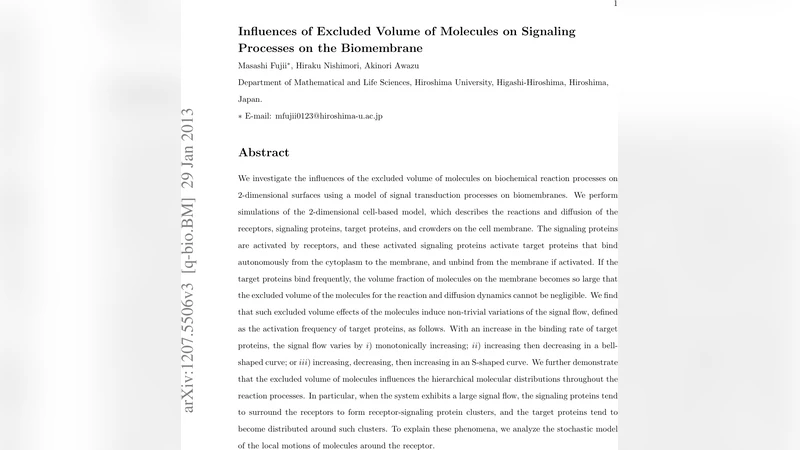
We investigate the influences of the excluded volume of molecules on biochemical reaction processes on 2-dimensional surfaces using a model of signal transduction processes on biomembranes. We perform simulations of the 2-dimensional cell-based model, which describes the reactions and diffusion of the receptors, signaling proteins, target proteins, and crowders on the cell membrane. The signaling proteins are activated by receptors, and these activated signaling proteins activate target proteins that bind autonomously from the cytoplasm to the membrane, and unbind from the membrane if activated. If the target proteins bind frequently, the volume fraction of molecules on the membrane becomes so large that the excluded volume of the molecules for the reaction and diffusion dynamics cannot be negligible. We find that such excluded volume effects of the molecules induce non-trivial variations of the signal flow, defined as the activation frequency of target proteins, as follows. With an increase in the binding rate of target proteins, the signal flow varies by i) monotonically increasing; ii) increasing then decreasing in a bell-shaped curve; or iii) increasing, decreasing, then increasing in an S-shaped curve. We further demonstrate that the excluded volume of molecules influences the hierarchical molecular distributions throughout the reaction processes. In particular, when the system exhibits a large signal flow, the signaling proteins tend to surround the receptors to form receptor-signaling protein clusters, and the target proteins tend to become distributed around such clusters. To explain these phenomena, we analyze the stochastic model of the local motions of molecules around the receptor.
💡 Research Summary
This paper investigates how the excluded‑volume effect of membrane‑bound molecules influences biochemical signaling on a two‑dimensional surface. The authors construct a cell‑based lattice model that explicitly represents four species: receptors (R), signaling proteins (S), target proteins (T) that bind autonomously from the cytoplasm, and inert crowders (C) that occupy space without participating in reactions. Each lattice site can hold at most one particle, thereby enforcing hard‑core exclusion. The reaction scheme is as follows: an external ligand activates a receptor (R → R*); an active receptor activates a neighboring signaling protein (R* + S → R* + S*); an active signaling protein activates a bound target protein (S* + T → S* + T*); and an activated target protein detaches from the membrane (T* → release). Diffusion is modeled as stochastic hops to adjacent empty sites, and all reaction steps occur with prescribed probabilities.
The key control parameter is the binding rate of target proteins to the membrane (k_on). By varying k_on, the authors modulate the surface occupancy (volume fraction) and thus the strength of the excluded‑volume effect. Simulations are run for millions of Monte‑Carlo steps until a steady state is reached, and the primary observable is the “signal flow” J, defined as the frequency of target‑protein activation events that lead to detachment.
Three distinct regimes of J versus k_on emerge. (i) At low surface occupancy, J increases monotonically with k_on because crowding is negligible and more targets simply provide more substrate for activation. (ii) At intermediate occupancy, J follows a bell‑shaped curve: initially J rises as more targets bind, but beyond a critical k_on the system becomes crowded, diffusion slows, and active signaling proteins are displaced from receptors, reducing activation efficiency. (iii) At high occupancy, J displays an S‑shaped trajectory: after an initial decline, a further increase in k_on restores J. The authors attribute this recovery to a crowding‑induced re‑localization of signaling proteins around receptors, forming compact receptor‑signaling clusters that trap targets in their vicinity, thereby enhancing the probability of re‑activation.
Spatial analysis reveals that in the high‑J regime the membrane exhibits hierarchical organization. Active receptors and signaling proteins aggregate into clusters, while target proteins preferentially accumulate around these clusters. This pattern arises because excluded‑volume constraints limit the accessible configurations, driving the system toward a locally ordered state that minimizes collision penalties while preserving reaction pathways.
To rationalize these observations, the authors develop a stochastic “local‑motion” model. They treat the vicinity of a receptor as a one‑dimensional random walk with reflecting boundaries imposed by neighboring particles. By incorporating the probabilities of hopping, binding, and unbinding, they derive a master equation for the occupation probabilities of each species around the receptor. Analytical and numerical solutions reproduce the three J‑behaviour regimes and predict the conditions under which clustering emerges. The model shows that the effective diffusion coefficient of signaling proteins decreases sharply with increasing crowding, while the effective reaction rates become non‑linear functions of local occupancy.
The study concludes that excluded‑volume effects are a decisive factor in membrane signaling, capable of generating non‑linear signal‑flow responses and spatial self‑organization that are invisible to mean‑field kinetic models. These findings have practical implications: by tuning membrane protein density or by introducing synthetic crowders, one could modulate signaling strength in a predictable way, offering new strategies for drug targeting, synthetic biology, and the design of biomimetic membranes. Future work is suggested to validate the predictions experimentally, to extend the framework to multi‑pathway networks, and to incorporate three‑dimensional cytoplasmic coupling for a more comprehensive picture of cellular signal transduction.
Comments & Academic Discussion
Loading comments...
Leave a Comment