Lie algebras and Higher torsion in p-groups
We study exceptional torsion in the integral cohomology of a family of p-groups associated to p-adic Lie algebras. A spectral sequence E_r^{*,*}[g] is defined for any Lie algebra g which models the Bockstein spectral sequence of the corresponding gro…
Authors: Jonathan Pakianathan, Nicholas Rogers
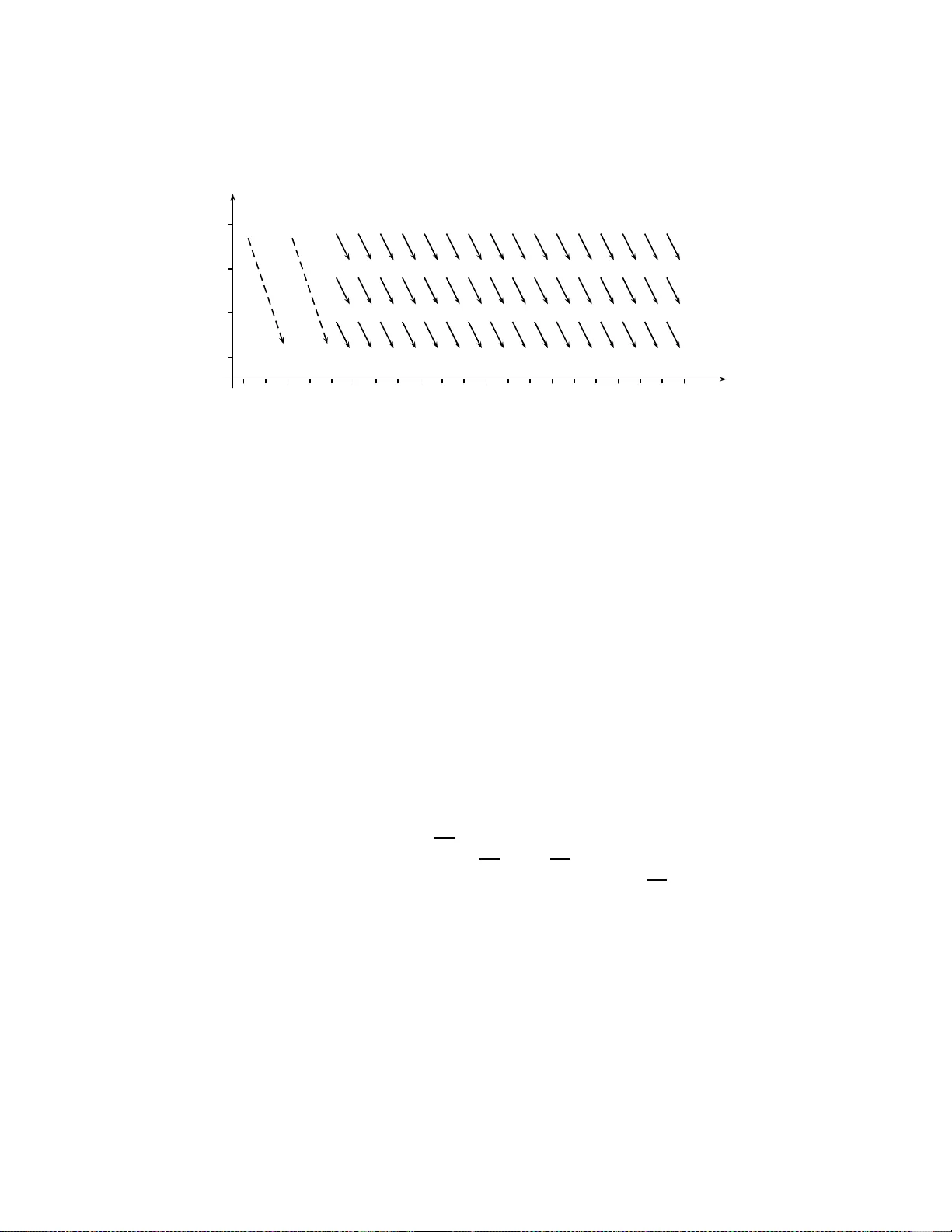
Lie algebras and Higher T orsion in p-groups Jonathan P akianathan and Nicholas F. Rogers No v em b er 21, 2018 Abstract The primary aim of this pap er is to study exceptional torsion in the integ ral cohomolo gy of a family of p -groups associated t o p -adic Lie alg e- bras. A sp ectral sequen ce E ∗ , ∗ r [ g ] is defined for any Lie algebra g whic h mod els the Bo c kstein spectral sequence of the corresp onding group in chara cteristic p . This sp ectral sequence is then studied for complex semisimple Lie alge- bras like sl n ( C ) and the results there are transferred t o the corresponding p -group via the intermedia ry arithmetic Lie algebra d efined o ver Z . The results obtained t his wa y for a fixed Lie algebra sc heme like sl n ( − ) hold in a range in th e corresp onding Bo c kstein sp ectral sequence for all but finitely many p rimes dep ending on the chosen range. Over C , it is sh o wn that E ∗ , ∗ 1 [ g ] = H ∗ ( g , U ( g ) ∗ ) = H ∗ (Λ B G ) where U ( g ) ∗ is the (filtered) dual of the u niv ersal env eloping algebra of g equipp ed with the du al adjoint action and Λ B G is the free lo op space of the clas- sifying space of an asso ciated compact, connected real form Lie group G to g . When passing to characteris tic p , in the corresp onding Bo c kstein spec- tral sequence, a char 0 to c har p phase transition is observe d. F o r example, it is shown that the algebra E ∗ , ∗ 1 [ sl 2 [ F p ]] requires at least 17 generators unlike its characteri stic zero counterpart which only req u ires tw o. Keywor ds: Lie algebra, cohomology , p -group, free lo op space, Bo c kstein sp ectral sequence. 2010 Mathematics Subje ct Classific ation. Primary: 20J06, 17B56; S ec- ondary: 17B50, 55T05. Con ten ts 1 In tro duction 2 2 The Classifying Sp ectral Sequence E [ g ] and Universal Co e ffi - cien t Argumen ts 9 3 Computation of Dual Casim irs and In v arian t Theory 13 4 Computation of E ∗ , ∗ r [ g ] where g is a comple x si mple Lie algebra 17 1 5 Exp onen t theory for finite p -g roups 25 6 Non-ab elian Lie algebra of dimensi on 2 29 7 W eigh t Stratification of the Sp ectral Se quence E ∗ , ∗ r 32 8 Witt Lie alge bras and Algebraic de Rham Cohom ology 34 9 Computation of E ∗ , ∗ 1 [ sl 2 ( F p )] 44 10 Bounds on the exceptional torsi on in congruence subgroups 48 11 Comm en ts o n M o dular F orms and Orthogonal Steenro d Struc- tures 49 11.1 Mo dular F or ms . . . . . . . . . . . . . . . . . . . . . . . . . . . . 49 11.2 Orthogo na l Steenro d Struc tur es. . . . . . . . . . . . . . . . . . . 49 12 Ac kno wledg men ts 50 A Construction of the Alg ebraic Sp ectral Sequence E [ g ] 50 A.1 Different ials . . . . . . . . . . . . . . . . . . . . . . . . . . . . . . 53 A.2 The sp ectral sequence . . . . . . . . . . . . . . . . . . . . . . . . 56 1 In tro duction Let k b e a P ID throughout this pap er (in a lot of cases w e’ll b e using a field but sometimes we need k = Z o r other decent rings and still use the term a lgebra through abuse of notation). By a k -Lie a lgebra g w e mean a free k - mo dule equipp e d with a bilinear bracket [ − , − ] : g ⊗ k g → g satisfying the Jaco bi ident ity: [[ x, y ] , z ] + [[ y , z ] , x ] + [[ z , x ] , y ] = 0 for all x, y , z ∈ g . W e refer to the dimension of g as the r ank of the underlying free k -mo dule, and will usually assume this is finite unless otherwise sp ecified. Lie algebr as a r ise in a v arie t y of contexts: ov er R as the tange nt space at the ident ity o f a L ie group or as the collection of smo oth vector fie lds o n a s mooth manifold, over Q as the ra tional homo to p y Lie algebr a of a spa ce, ov er Z as the Lie algebr a a s socia ted to the descending central serie s of a residually nilp otent group and ov er the p - a dic in tegers Z p or finite fields in the theor y of pro- p groups (see [DS]) and p -gro ups resp ectively . F o r bas ic fac ts on Lie alg ebras and their c o homology us ed in this pap er s ee [Bo] or [GG]. F or the basic facts on the cohomolog y o f g roups used in this pap e r see [Be] or [B]. Due to our primary motiv a tion le t us give a few more details o n the corr e- sp ondence b et ween p -gro ups and Lie alge br as. Co ns ider the formal power ser ies for e x in Q [[ x ]], i.e., e x = P ∞ n =0 x n n ! , it is a trivial for malit y to chec k e 0 = 1 and e − x e x = 1 and that if x a nd y commute then e x + y = e x e y . Howev er working in the (completed) free a sso ciativ e a lgebra ov er Q on tw o v a riables o ne finds 2 that if x a nd y don’t commute, then one has the fundamental Baker-Campbell- Hausdorff identit y: e x e y = e x + y + 1 2 [ x,y ]+ 1 12 [ x, [ x,y ]] − 1 12 [ y , [ x,y ]]+ ... = e x + y + I where I is an infinite sum of iterated bra c kets o f x and y with rationa l co effi- cients a nd where [ a, b ] = ab − b a . Due to this, whenever Q ⊆ k , we can asso ciate a formal gr o up e g to every k -Lie algebr a g . When k = C and the usua l Eu- clidean metric is used, the defining series converge and one r ecov ers the cla ssical “Exp onential-Log” corresp ondence betw een Lie alg ebras and Lie gr oups. Over the p -adic integers Z p with the p -adic metric, and p an o dd prime, e px can be shown to conv erge for every x ∈ Z p . Thus if we let g = gl n ( Z p ) be the Lie alg ebra of n × n , p - adic matrices with the bra c ket [ A , B ] = AB − BA , one has that e p g is a group. In fact since e p A ≡ I mo d p , it is not ha rd to show that e p g is the group of p -adic matrices whic h are c ongruent to the identit y matrix mo d p , which is calle d the p -c ongruence subgro up Γ gl n of GL n ( Z p ). (See exp onential-log co rresp ondence in [Ro]). F rom this formal group, one c a n form a tow er of finite p -g r oups Γ g ,k = e p g mo d p k +1 for k = 1 , 2 , 3 , . . . for which e p g is the in verse limit. It is not har d to see that Γ g , 1 is elementary ab elian and can b e identified natura lly with the residue Lie a lgebra of the p -adic Lie algebr a g i.e., g /p g = g ⊗ F p . In fa c t e p A = I + p A mo d p 2 so e p A mo d p 2 corres p onds to A mo d p . A little more a na lysis shows that we hav e a central short exact sequence 0 → g ⊗ F p → Γ g , 2 → g ⊗ F p → 0 . and so Γ g , 2 = Γ g mo d p 3 is a p -gro up given by a central extension of an ele- men tary ab elian p -g roup by itself. More genera lly , for p o dd, one can show given a n y F p -Lie algebra L (whether it lifts to the p -adics o r not) there exists a unique p -p ow er ex a ct sequence 0 → L → G ( L ) → L → 0 where G ( L ) is a p -g roup o f order p 2 dim( L ) . In fact the cons tr uction L → G ( L ) is part of a cov ariant functor from the categor y of F p -Lie algebr a s to the category of p -groups. (See [BP]). F or p = 2 cer tain phenomena inv olving quadra tic forms arise and the corre s pondence needs to b e mo dified (see [PY1] and [PY2]). Due to this, throughout this pa p er, p deno tes an o dd prime. In [BP] it was s ho wn that if n is the dimens io n of L , then H ∗ ( G ( L ) , F p ) ∼ = Λ ∗ ( L ∗ ) ⊗ P ol y ( L ∗ ) ∼ = Λ( x 1 , . . . , x n ) ⊗ F p [ y 1 , . . . , y n ] where L ∗ is the dual of L . Here Λ ∗ ( V ) denotes the exter io r alg e br a on the vector spac e V where V is given g r ading 1 while P oly ( V ) = F p [ V ] denotes the po lynomial algebra o n V where V is given gra ding 2. F urthermore the differential provided by the Bo c kstein β was shown in [BP] to be the sa me a s the different ial that ma k es this alg ebra into the Kos zul reso lu- tion computing H ∗ ( L , P ol y ( ad ∗ )) where ad ∗ is the dual adjoint repre s en tation 3 of L on L ∗ and the action of L is extended to P oly ( ad ∗ ) b y de c la ring it to a c t via deriv ations. Thu s the β -cohomo lo gy of these p -gro ups was shown to be H ∗ ( L , P ol y ( ad ∗ )) and this is interesting as this cohomolo gy gives the 2nd pa ge of the Bo ckstein sp ectral seq uence used to analyze the integral cohomolog y H ∗ ( G ( L ); Z ). Ex- plicitly if we deco mpose the polyno mial algebra P ol y ( ad ∗ ) into its ho mogeneous comp onen ts (Ho dge dec ompositio n) P ol y ( ad ∗ ) = ⊕ ∞ n =0 S n we hav e B ∗ 2 = ∞ M n =0 H ∗ ( L , S n ) and so the higher to rsion in the integral c o homology of the p - group G ( L ) is reflected in these Lie alg ebra coho mology groups . In fact an analysis o f the in tegral coho mology of G ( sl 2 ( F p )) using these techn iques was used to provide a co un terexample in [Pk] to a conjecture o f Adem (see [A]) at o dd primes. In this pa p er, we study a fundamental differential graded algebra (dga ) as- so ciated to any Lie alg ebra L given by the K oszul reso lutio n whose underlying algebra is Λ ∗ ( L ∗ ) ⊗ P ol y ( L ∗ ) with a differential such that the cohomolog y cal- culates H ∗ ( L , P ol y ( ad ∗ )). While our motiv ation is to ca lculate hig her tors io n in the in tegral coho mology of p -groups and hence primarily concer ns Lie alge- bras ov er F p , our ba sic technique is to relate these Lie alg ebras to Lie algebr as defined o ver Z and to then compare these to the corresp onding Lie algebras defined ov er Q or C w her e classical re sults can be app ealed to. This tra nslates then to results whic h hold for “all but finitely many primes” when studying the corres p onding p -g roups. This philosophy was motiv ated by pre v ious work with A. Adem in [AP], though the implemen tation is q uite different here. The dga w e construct E [ L ] = Λ ∗ ( L ∗ ) ⊗ P oly ( L ∗ ) comes equipp ed with a sp ectral sequenc e that is cons tructed in the app endix and functions in some sense as an algebr a ic classifying complex for the co -Lie algebra L ∗ m uch like E G do es for a Lie group G . Int eres tingly enough, this seemingly spe cialized dga ca rries a lot of structure. Over fields of c haracter istic z e r o and for nondeg e ne r ate Lie algebras (Killing form no ndeg enerate), one has an isomo rphism of L -modules betw een ad and ad ∗ . F urthermore using the Poincare-Bir k off-Witt theorem one can identify P oly ( ad ) with U ( L ) as filtered mo dules a nd P oly ( ad ∗ ) with the filtered dual U ( L ) ∗ as graded mo dules where U ( L ) is the universal env eloping algebra of L equipp ed with the adjoint action. (Throughout this pap er U ( L ) and its filtered dual U ( L ) ∗ will alw ays b e equipped with the adjoint a ction and not the left or rig h t tr anslation action! The filter ed dual consists of functionals on the filtered universal env eloping alg ebra with suppor t in one o f the filtratio n levels, i.e., functionals that v anish on elements o f high enoug h ”degre e ”. This is analogous to the graded dual construction. Note it is a prop er subspace of the vector spa ce dua l as it do es not allow for functiona ls which do not v anish on elements of ar bitrarily hig h ”degre e”.) Th us E [ L ] a s a dga is nothing other than the ca nonical Koszul complex computing H ∗ ( L , U ( L ) ∗ ). In this context it 4 is impor tan t to po in t out that ov er fields of characteristic zero, H ∗ ( L , U ( L ) ∗ ) can be identified with the coho mology o f the free lo op space of B G in the ca s e that G is a compac t, connected Lie group with Lie a lg ebra a real form for L as we will see in this pap er in the case that G is semisimple as a b ypro duct o f our analysis of this sp ectral sequence. The cohomology of the free lo op space Λ M on a manifold M ha s b een an ob ject of intense study in the last deca de due to the existence of a “ string m ultiplication” intro duced by Cha s a nd Sulliv an (See [CS]) and the structure of a Bata lin-Vilk ovisky a lgebra with string theoretic in terpreta tions, (see [GW], [Ma]). F urthermore H 0 ( L , U ( L )) consists of the central elements of U ( L ), the so called “Casimir ring ” which is very imp ortant in the repr esen tation theory of L . W e will see tha t their dua l elements, the “ dual Casimirs” in H 0 ( L , U ( L ) ∗ ) play an imp ortant role in the highe r torsion of p -gr o ups. As o ne of the main to ols of this pap er, we constr uc t a sp ectral se q uence whose E 0 term is this dga and whose E ∞ term is the coho mology of a po in t which gives a lot of str uc tur e to the underlying dg a. Though this sp ectral sequence is defined o ver any co efficient k , over F p it models the asso ciated Bo ckstein Spec tr al sequence o f the corresp onding p -group mentioned ab ov e. More pre- cisely we show that the ( E 0 , d 0 ) term of this sp ectral sequence is iden tical to the ( B 1 , β ) term of the Bo ckstein sp ectral seq uence o f the p -group G ( L ). Though bo th sp ectral seq uences converge to the cohomolog y of a p oin t, it is unknown if the higher pages co incide. Nevertheless, using the s tructure theo rems av a ilable for b oth sp ectral sequences , a nd that the first one can b e used to compare the situation for the F p -Lie alge br a with that of corr espo nding integral and com- plex Lie algebra s, o ne can obtain res ults. Thr oughout this pap e r ( E r , d r ) will alwa ys r e fer to the algebraic sp ectral sequence constr uc ted in the app endix a nd ( B r , β r ) will denote the Bo ckstein spe c tr al s equence of the group G ( L ) in the case tha t L is a F p -Lie algebra . The s pectra l sequence E r carries a lot of information, indeed even ov er C it can be used to recover Haris h-Chandra’s calcula tion of the Ca s imir ring of sl 2 ( C ) among many other re s ults. (W e discuss the physical relev a nce of this within the pap er.) In this intro duction w e q uo te just this cla ssical corollar y for simplicity to sho w the main frame of the arguments. In some of these sta tements the “Ho dge decomp osition” P oly ( ad ∗ ) = ⊕ ∞ n =0 S n of the p olynomial algebra int o its homogeneous comp onents is used a nd S 0 alwa ys denotes the base ring k with trivial L action. Theorem 1. 1 (Harish-Cha ndra calcula tion for sl 2 ( C )) . H ∗ ( sl 2 ( C ) , P ol y ( ad ∗ )) ∼ = H ∗ ( sl 2 ( C ) , U ( sl 2 ( C )) ∗ ) ∼ = Λ ∗ ( u ) ⊗ C [ κ ] wher e κ = H 2 + E F ∈ H 0 ( sl 2 ( C ) , S 2 ) is (a nonzer o sc alar multiple) of the Kil ling form (an example of a “dual Casimir” element) and u ∈ H 3 ( sl 2 ( C ) , S 0 ) is the volume form. κ is dual t o the c entr al Casimir element H 2 + 2 E F + 2 F E in H 0 ( sl 2 , U ( sl 2 )) which c orr esp onds to “total angular moment u m squ ar e d” in spin systems. 5 Recall that a Ca simir element is an element in the center of U ( L ) or equiv- alently a n ad-inv ariant element of U ( L ). A dual Casimir element is an ad- inv ariant elemen t of the filtere d dua l U ( L ) ∗ . As men tioned b e fore, this ca lculation whe n use d in conjunction with the sp ectral se quence we constr uc t can b e used to der iv e r e sults for the corre spond- ing Lie algebr as sl 2 ( F p ) after passing thro ugh sl 2 ( Z ). T o state these r esults let us note that for F p -Lie alg ebras L we hav e ( E 0 , d 0 ) = ( B 1 , β ) = Λ ∗ ( L ∗ ) ⊗ P ol y ( L ∗ ) where ( B r , β r ) is the Bo c kstein sp e c tral sequence of the p - group G ( L ). W e will call the p olynomial degree of a ho mogeneous element of this algebra its “Ho dge degree”. This leads to the following: Theorem 1.2 (Higher to rsion in G ( sl 2 ( F p ))) . L et G ( sl 2 ( F p )) b e the kernel of the r e duction homomorphism S L 2 ( Z /p 3 Z ) → S L 2 ( F p ) . Then if B ∗ denotes the Bo ckstein sp e ctr al se quenc e for G ( sl 2 ( F p )) we have: E ∗ , ∗ 1 = B ∗ 2 = H ∗ ( sl 2 ( F p ) , P ol y ( ad ∗ )) ∼ Λ ∗ ( u ) ⊗ F p [ κ ] wher e ∼ denotes isomorphism in the r ange of Ho dge de gr e e ≤ N for al l but finitely many primes p (dep ending on N ). F urthermor e B ∗ 3 is finite dimens ional and we have B ∗ 3 ∼ Λ ∗ ( u ) ⊗ F p [ κ ] . In p articular though B ∗ 3 is alw a ys fi n ite dimensional, t her e is no fixed b ound on its dimens ion that holds for all primes p . Let us try to explain this in a less technical manner . F or a finite p -gro up G let exp ( G ) b e the exp onent of G , i.e., the smalles t p ositive integer n such that g n = e for all g ∈ G . Let ¯ H ∗ ( G, Z ) deno te the r educed integral coho mo logy of G a nd e ( G ) denote its exp onent. Let e ∞ ( G ) denote the asymptotic e x ponent of G , i.e ., the sma llest po sitiv e integer such that e ∞ ( G ) ¯ H ∗ ( G, Z ) is finite. It is known that exp ( G ) e ∞ ( G ) e ( G ) | G | and there exist G s uch that e ∞ ( G ) 6 = e ( G ). (See [Pk]). When e ∞ ( G ) 6 = e ( G ), we can define the highest dimension of an element in the finite g raded group e ∞ ( G ) ¯ H ∗ ( G, Z ) as the “exceptional dimension” of G . Thus all to rsion elements of exceptionally high o r der lie at or b elow the ex ceptional dimensio n of G . Corollary 1.3. F or al l o dd primes p , e ∞ ( G ( sl 2 ( F p ))) = p 2 while e ( G ( sl 2 ( F p ))) = p 3 . Mor e over by the c alculations ab ove, for any N , for al l but a finite numb er of primes p , t he exc eptional dimension of G ( sl 2 ( F p )) is bigger than N . Thu s for every o dd prime there ar e exceptional elements of or der p 3 in the reduced in tegra l cohomo logy of G ( sl 2 ( F p )), but there is no bo und o n the exc ep- tional dimensio n that ho lds for a ll primes. Th us by suitable choice of pr imes p , one ca n find elements of order p 3 in a s high a dimension a s one likes. How ever, for any fixed prime p , as ymptotically the exp onen t of the integral coho mology of G ( sl 2 ( F p )) is always p 2 . 6 F or details on these calculations and their implications a more thorough and leisurely dev elopment can be found in the pap er itself. The basic idea is as follows: (1) F or every simple Lie a lgebra ov er C , a Cartan-Ser re basis can b e taken to extract a cor r espo nding integral Lie algebra. The algebraic sp e ctral sequences for these can b e compared and, throug h characteristic zero tech niques, compu- tations of the required dual Casimirs can be done. (2) Since each piece in the Ho dge decomp osition of the dga o f the corres p onding int egr al Lie alg ebra is o f finite t yp e, when lo oking at a ch unk corresp onding to terms with Ho dge degree N or less , one can use the universal co efficien t theo- rems to say that for all but a finite num b er of primes, the co r resp onding dga ov er F p will lo ok similar to the one ov er C . (3) In every ca se though there is a breakdown in the dga over F p when the Ho dge degree b ecomes clos e to p − 1 and there is g enerally a phase transition betw een characteristic zero behaviour and characteristic p b ehaviour. (4) In many cases we find that the “exceptiona l torsion” is cre a ted by the par t which c o rresp onds to the characteris tic zero c a se and the transition to c har a c- teristic p kills this exceptiona l to rsion and is signa led by a div ided p ow er issue in the dga for the integral Lie algebr a . F or example for s l 2 we prove the key ident ity κ p − 1 2 u = 0 in the F p -dga as the left hand side of the identit y is p times a gener ator in the cor resp onding Z -dga. Detailed pictures of the algebr aic spec- tral se q uence are av aila ble in the pap er to show how this identit y helps c ause a “phase-tra nsition” be tw een the char 0 and char p b ehaviour in the case o f sl 2 . In the pap er, all semis imple Lie algebras are studied, inc luding s l n for n > 2, and the exceptional Lie alg ebra g 2 . These ar e studied over C , Z and finite fields. Over C one finds the behaviour of E ∗ , ∗ r [ g ] is like that of E G which mo tiv ates us calling it the “cla ssifying sp ectral sequence for the Lie a lgebra” in general. Theorem 1.4 . (Complex semisimple Lie algebr as) F or any c omplex s imple Lie algebr a g with c orr esp onding c omp act form g R and c omp act c onne cte d Lie gr oup G with Lie algebr a g R we have: E ∗ , ∗ 1 [ g ] = H ∗ ( g , U ( g ) ∗ ) ∼ = H ∗ ( G, C ) ⊗ H ∗ ( B G, C ) ∼ = H ∗ (Λ B G, C ) . wher e Λ B G denotes the fr e e lo op sp ac e of the classifying sp ac e B G . F or example, for g = sl n ( C ) one has E ∗ , ∗ 1 = H ∗ ( sl n , U ( sl n ) ∗ ) ∼ = H ∗ ( S U ( n ) , C ) ⊗ H ∗ ( B S U ( n ) , C ) ∼ = H ∗ (Λ B S U ( n ) , C ) ∼ = Λ ∗ ( u 3 , . . . , u 2 n − 1 ) ⊗ C [ c 2 , . . . , c n ] ∼ = Λ ∗ ( u 3 , . . . , u 2 n − 1 ) ⊗ C [ σ 2 , . . . , σ n ] wher e c i ar e the universal Chern classes and σ i ar e the adjo int invariant p oly- nomial functions on sl n given by the elementary symmetric funct ions on the eigenvalues expr esse d in terms of the c o efficients of the matrix. T his invari- ant the ory pictur e is use d to obtain these r esults and is ex plaine d c ompletely 7 in the r elevant se ctions of the p ap er. In gener al, ther e ar e 3 c or e pictur es for E ∗ , 0 1 = H 0 ( g , U ( g ) ∗ ) discusse d in this pictur e, (a) as elements dual to c entr al elements in U ( g ) , i.e., as dual Casimirs, ( b) as adjoi nt invariant p olynomial functions on g and (c) as t he c ohomolo gy algebr a H ∗ ( B G, C ) . As a final ex ample, for g = sp 2 n ( C ) one has E ∗ , ∗ 1 = H ∗ ( sp 2 n ( C ) , U ( sp 2 n ( C )) ∗ ) ∼ = H ∗ (Λ B S p ( n ) , C ) ∼ = Λ ∗ ( u 3 , u 7 , . . . , u 4 n − 1 ) ⊗ H ∗ ( P 1 , P 2 , . . . , P n ) wher e P i ar e t he universal Pontryagin classes. In gener al, ( E ∗ , ∗ 0 [ g ] , d 0 ) is a fr e e gr ade d c ommutative dga whose c ohomolo gy is that of the fr e e lo op sp ac e of B G . (However it is not a Sul livan algebr a as it fails to satisfy the n ilp otency c ondition.) As men tioned ab ov e, each of these res ults over C yield a picture for the sp ectral se quence of the asso ciated Lie a lg ebra ov er F p and hence the Bo c kstein sp ectral sequenc e of the corresp onding p -g roup, at least for low Hodg e degree and for all but finitely many primes . This is discus sed in detail in the pap er, as is the b e ha viour of higher pa ges of the s pectra l seq uence. Over C , these results a re probably , by and large, repack aging of classical results in the cohomo lo gy of Lie gr oups and their classifying spaces, inv ariant theory and Casimir theory into a sp ectral sequence, but we go through the pro cess in detail in the pa per as we need the sp ectral s e quence for our work in p -gro ups . When working in pr ime characteristic, co mputations b ecome much more difficult and a “weigh t stratifica tion” is requir ed. If R is a system of ro ots for the semisimple Lie algebra g with ro ot lattice Λ( R ), we show tha t there is a decomp osition of the sp ectral seq uence by weigh t which is very helpful for computations of asso ciated Lie algebr a s in prime characteristic: Theorem 1.5. (Weight Stra tific ation) L et g b e a c omplex semisimple Lie al- gebr a. L et g Z b e a c orr esp onding inte gr al Lie algebr a (always exists by Cartan- Serr e b asis). We c an t hen get a c orr esp onding Lie algebr a g k over any ring of definition k . The r o ot de c omp osition of g induc es a weight de c omp osition of sp e ctr al se- quenc es: E ∗ , ∗ r [ g k ] = M α ∈ Λ( R ) E ∗ , ∗ r [ α ] wher e Λ ( R ) is the r o ot lattic e of g and is a fr e e ab elian gr oup of r ank e qual to the r ank of g , i.e., the dimension of a Cartan sub algebr a of g . In addition we show that if k is a fi eld of char acteristic zer o then the E 1 -p age and b eyond only has c ontributions fr om the weight 0 t erm while for a field of char acteristic p , the “ p olynomial line” E ∗ , 0 1 has c ont ributions only fr om weights which ar e zer o mo dulo p . In sections 8 and 9, using a DeRham complex and D-module langua ge to- gether with the w eight s tratification mentioned ab ov e, explicit mo d p calcula- 8 tions are p erformed for the sp ectral sequence E ∗ , ∗ r [ sl 2 ( F p )] and the “almos t all” cav eat is removed in a range of Ho dge degrees: Theorem 1. 6. ( s l 2 ( F p ) -c omputation) E ∗ , ∗ 1 [ sl 2 ( F p )] = H ∗ ( sl 2 ( F p ) , P ol y ( ad ∗ )) ∼ Λ ∗ ( u ) ⊗ F p [ κ ] wher e ∼ indic ates isomorphism for all o dd primes in the r ange of Ho dge de gr e es strictly less than p − 1 . Thus for al l o dd primes p , the char acteristic 0 to p phase tr ansition do es not o c cur b efor e Ho dge de gr e e p − 1 for the Lie algebr a scheme sl 2 ( − ) . (F or p = 2 t he br e akdown o c curs imme diately at Ho dge de gr e e 0 .) However a char 0 to char p phase tr ansition o c curs at H o dge de gr e e p − 1 and it is shown that one ne e ds minimal ly 17 gener ators to gener ate H ∗ ( sl 2 ( F p ) , P ol y ( ad ∗ )) thr ough Ho dge de gr e e p . (se e se ction 9 for details on these gener ators and the algebr a). It fol lows trival ly that H ∗ ( sl 2 ( Z ) , P ol y ( ad ∗ )) has p -torsion for every prime p and henc e c annot b e a finitely gener ate d ring. F rom this it follows that the exceptiona l dimensio n (maximal dimension for which exceptional high order tor sion exists) for the p gro ups G ( sl 2 ( F p )) is greater than o r eq ual to 2 p − 2 for all o dd primes p . As a byproduct of the analy sis of the sp ectral sequence, the following exa ct sequence is obtained for s l 2 = sl 2 ( F p ) and i ≥ p − 2: 0 → H 3 ( sl 2 , S i ) → H 2 ( sl 2 , S i +1 ) → H 1 ( sl 2 , S i +2 ) → H 0 ( sl 2 , S i +3 ) → 0 , where S i is the mo dule of homo geneous, degr e e i p olynomials on s l 2 equipp e d with the dual adjoint a ction. Finally while many of the techniques apply to solv able (or nilpotent) Lie algebras also, w e conc e ntrate on se misimple Lie algebr as in this pap er, post- po ning the discussion for nilpo tent Lie alg ebras such as those which would aris e from torsion-fr ee, pro - p , finite index, subgroups of the Morav a Stabilizer gro up to another time. 2 The Classifyi ng Sp ectral Sequence E [ g ] and Univ ersal Co efficien t Argument s Asso ciated to any k -Lie algebra g is a sp ectral seque nce ( E [ g ] s,t r , d r ), constructed in the app endix. W e call t the exter ior deg ree and s the Ho dge o r p olynomial degree and 2 s + t the total degree. This is a first quadra n t spectr al s e quence and o ften we will plot the Ho dge degr ee along the x -a xis and either the exterior degree t or the total degree 2 s + t along the y -axis. The r eader is encour aged to draw such a diagr am w he n following the arg umen ts. Often we will surpres s g explicitly fr om the notation when it is unders too d. This sp ectral seque nce has the following prop erties: 9 (1) As a k -a lgebra E ∗ , ∗ 0 = Λ ∗ ( g ∗ ) ⊗ k [ g ∗ ]; i.e., it is the tenso r pr oduct o f the exterior algebra on the dual o f g with the p olynomial alge br a o n the dual of g . If s denotes the natural isomorphism Λ 1 ( g ∗ ) → P ol y 1 [ g ∗ ] = g ∗ , then w e can write E ∗ , ∗ 0 = Λ ∗ ( g ∗ ) ⊗ k [ s ( g ∗ )] as a bigr aded a lgebra where g ∗ is given bigrading ( s, t ) = (0 , 1) while s ( g ∗ ) is given bigrading ( s, t ) = (1 , 0). Note how ever that gr aded commutativit y of the dga is deter mined by tota l degree a nd that the elements s ( g ) hav e even total degree as required for them to generate a po lynomial algebra. Explicitly , if { e 1 , . . . , e n } is a k -basis for g a nd { x 1 , . . . , x n } the ca nonical dual basis for g ∗ determined b y x i ( e j ) = δ i,j , and we se t y i = s ( x i ), then E ∗ , ∗ 0 = Λ ∗ ( x 1 , . . . , x n ) ⊗ k [ y 1 , . . . , y n ] . (2) E ach page of the sp ectral sequence is a dga over k such that d r : E s,t r → E s + r ,t − (2 r − 1) r i.e., the r th differential ra ises the Ho dge degr e e b y r and reduces the ex terior degree by (2 r − 1), and hence raises tota l deg ree by 1. The differential d r is a deriv ation with resp ect to the induced algebr a structure; i.e., d r ( αβ ) = d r ( α ) β + ( − 1 ) | α | αd r ( β ) , where α, β a re homo geneous elements o f E ∗ , ∗ r and | α | deno tes the total deg ree of α . Of cours e as usual E ∗ , ∗ r +1 = H ∗ ( E ∗ , ∗ r , d r ). (3) The differen tial d 0 is induced naturally as follows. It is the unique deriv ation on E ∗ , ∗ 0 such that d 0 : Λ 1 ( g ∗ ) → Λ 2 ( g ∗ ) is min us the dual o f the Lie-brack et [ − , − ] : Λ 2 ( g ) → g a nd d 0 : s ( g ∗ ) → s ( g ∗ ) ⊗ Λ 1 ( g ∗ ) is the dual of the Lie-bra c ket follow ed by I den tity ⊗ s − 1 . More explicitly if c k ij are the structure constants of g with r espect to the k -basis { e 1 , . . . , e n } , { x i } is the dual basis to { e i } , and y i = s ( x i ), then d 0 ( x i ) = − X j dim( g ) we hav e d r = 0 and so E ∗ , ∗ m = E ∗ , ∗ ∞ once m > dim( g )+1 2 . F urthermore a s shown in the app endix, E s,t ∞ = ( k if s = t = 0; 0 otherwise. (7) E [ − ] ∗ , ∗ defines a co n trav aria n t functor from the catego ry o f k -Lie algebras to the category of k -differential graded algebra spectra l seque nce s. In other words, if θ : g → h is a map of k -Lie algebras then it is not hard to s ho w that θ ∗ : h ∗ → g ∗ commutes with the dua l Adjoint actio n in the sens e that if we make h ∗ a g -mo dule using θ then θ ∗ is a g - module ma p. It is then a routine exercise to chec k that the algebra map induced from θ , Λ ∗ ( h ∗ ) ⊗ k [ s ( h ∗ )] → Λ ∗ ( g ∗ ) ⊗ k [ s ( g ∗ )] , commutes with d 0 and d 1 and hence induces a morphism of sp ectral se q uences ( E [ h ] ∗ , ∗ r , d r ) → ( E [ g ] ∗ , ∗ r , d r ). (8) The construction E [ − ] ∗ , ∗ is natural with r espect to extension of scalars. In 11 other words if k → K is a ho momorphism o f rings b et ween tw o PIDs and g is a k -Lie algebr a then g ⊗ k K is naturally a K -Lie algebr a and ( E [ g ⊗ k K ] ∗ , ∗ 0 , d 0 ) = ( E [ g ] ∗ , ∗ 0 ⊗ k K , d 0 ⊗ k I d ) as K - dga’s. Th us if K is flat ov er k (this is needed to avoid tor ter ms in the universal co efficient theorem) one has ( E [ g ⊗ k K ] ∗ , ∗ r , d r ) = ( E [ g ] ∗ , ∗ r ⊗ k K , d r ⊗ k I d ) as K -sp ectral s equences. (9) F or k a field with p elements, p an o dd prime and g a k -Lie algebr a which lifts ov er Z / p 2 Z , one has the following result prov en in [B P]: If ( B ∗ r , β r ) is the Bo ckstein sp ectral sequence for the p -gr oup G ( g ), then ( B 1 , β 1 ) = ( E 0 , d 0 ) and so B n 2 = ⊕ s,t | 2 s + t = n E s,t 1 . F urthermor e b oth B ∞ and E ∞ give the cohomolo g y of a po in t. Thus E ∗ , ∗ r can b e v iew ed as a n a lgebraic mo del for the Bo ckstein sp ectral sequence a nd is co mputatio nally useful as w e will see. It is known that E 1 = B 2 , and the pro perties of E 1 will allow us to compute it more readily . (It is unknown whether E r = B 1+ r for r > 1 but it is tr ue in all computed examples.) In the following we concentrate on co mputations of B ∗ 2 = E ∗ , ∗ 1 = H ∗ ( g , P ol y ( g ∗ )). The flexibility to change c o efficient ring s in E 1 [ − ] ∗ , ∗ will play a very fundamen tal role, as will the fact that we know the differentials d r in E r raise po lynomial degree by r . The fundamen tal idea is enco ded in the following application of the univ ers a l co efficien t theor em. This might b e a bit a bstract here but in the next few sections wher e explicit exa mples are worked out it will b ecome clearer . T o av oid nee dle s s g enerality we state this theorem fo r a specia l case of co mplex simple Lie algebr a s though results can eas ily b e extended. Theorem 2.1 (F undamen tal Compariso n The o rem) . L et g b e a Z -Lie algebr a such t hat L = g ⊗ C is a c omplex s imple Lie algebr a. (Cartan-Serr e b asis shows al l c omplex simple Lie algebr as arise this way.) L et H 0 ( L , P ol y ( L ∗ )) = H 0 ( L , U ( L ) ∗ ) ⊆ P ol y ( L ∗ ) b e denote d by Γ . Then we have E 1 [ L ] ∗ , ∗ = H ∗ ( L , U ( L ) ∗ ) = H ∗ ( L , C ) ⊗ C Γ wher e H ∗ ( L , C ) c an b e identifie d with the c ohomol o gy of a c ertain (c omp act form) Lie gr oup G and is an exterior algebr a on o dd de gr e e gener ators. (We wil l se e in futur e se ctions, that Γ wil l c orr esp ond t o H ∗ ( B G, C ) which is a p olynomial algebr a.) Now sinc e the p art of E 0 [ g ] c orr esp onding to elements of Ho dge de gr e e ≤ N is finitely gener ate d, its c ohomolo gy E 1 [ g ] c an have t orsion only for finitely m any primes. Thus for al l but a finite numb er of primes p , we have dim( E s,t 1 [ g ⊗ F p ]) = dim( E s,t 1 [ g ⊗ C ]) for al l s, t with s ≤ N . On the other hand we wil l se e that if a r estriction on Ho dge de gr e e is not imp ose d, t his wil l alw a ys br e ak down. F or example for 12 g = sl 2 ( Z ) we wil l se e that E ∗ , ∗ 1 [ g ] = H ∗ ( g , P ol y ( g ∗ )) has p -t orsion for every prime p and henc e is not a finitely gener ate d ring. Pr o of. The pro of o f the form of E 1 [ L ] ∗ , ∗ hinges on tw o facts. (1) As L is a simple Complex Lie a lgebra, every finite dimensional complex representation V decompo ses a s a sum o f irre ducible r e present ations . (2) If V is an irre ducible repr esen tation other than the trivial one-dimensional representation, then H ∗ ( L , V ) = 0. ( This is a generalization of Whitehead’s Lemma, see Pro p osition 3.4.2 in page 151 of [GG ].) With this we ca n decom- po se P ol y ( L ∗ ) = Γ ⊕ W as U ( L )-mo dules where Γ are the adjoint inv ariant po lynomials; i.e., Γ = H 0 ( L , P ol y ( L ∗ )), a s mentioned in the statement of the theorem. Note W decompose s as a sum o f ir reducibles, none of which is the trivial one-dimensio na l representation. Thus H ∗ ( L , P ol y ( L ∗ )) = H ∗ ( L , Γ) ⊕ H ∗ ( L , W ) = H ∗ ( L , Γ) by Whitehead’s Lemma = H ∗ ( L , C ) ⊗ C Γ as the actio n of L on Γ is trivial. F or every simple co mplex Lie algebra L , there exists a real Lie alge br a L R whose complexification is L a nd which is the Lie algebr a of a compact connected Lie gro up G . It is known cla ssically that H ∗ ( L R , R ) = H ∗ ( G, R ) is an e xterior algebra on o dd genera to rs (as it is a Hopf alge bra). Th us its complexification H ∗ ( L , C ) is also an exterior alg ebra on o dd generator s. The final parts a re a direct application of the universal co efficient theorem to the co mplex ( E ∗ , ∗ 0 ( g ) , d 0 ) and will be left to the r eader. The exa mple for sl 2 ( Z ) will b e discussed later in the pa p er. In the next section we compute the sp ectral se q uence E ∗ , ∗ r ( sl 2 ( C )) co mpletely using tw o sepa rate metho ds, one using just prop erties of the sp ectral sequence itself and the second using cla ssical in v ariant theory for Lie gro ups. Both recover the classical calculation of Harish-Chandr a of the Ca s imir algebr a for sl 2 ( C ). The inv ariant theory viewp oint provides a concrete mea ning to the answer. Then in se c tion 4, we compute the b ehaviour o f the sp ectral sequence E ∗ , ∗ r ( L ) for any co mplex simple Lie algebra and rela te the answer using inv ariant theory . Using the F undamen tal Compar ison Theorem above we then will get results for the corr esponding Lie algebr as of corr e sponding p -groups which we will use to understand higher torsio n in their integral cohomolo gy . 3 Computation of Dual Casimirs and In v arian t Theory F or a go o d background discussion o f the theor y of complex simple Lie algebras and corr esponding Lie g roups that we use in this paper , see [FH]. Recall that Casimir element s are e le men ts of the center o f the universal en veloping alg ebra 13 or in other words ad-inv ar ia n t ele ments of U ( L ). Dual Cas imir elemen ts are ad-inv ariant elements of the filter e d dual U ( L ) ∗ . Recall sl 2 ( C ) is a Lie algebr a of dimension 3 with C - basis x h = 1 0 0 − 1 , x e = 0 1 0 0 , x f = 0 0 1 0 and commut ation re la tions [ x h , x e ] = 2 x e , [ x h , x f ] = − 2 x f , [ x e , x f ] = x h . Let h, e, f denote the cor resp o nding dual bas is in Λ 1 ( L ∗ ) and let H, E , F denote the “susp ended” dual basis in P ol y 1 ( L ∗ ). Thu s E ∗ , ∗ 0 [ sl 2 ( C )] = Λ ∗ ( h, e, f ) ⊗ C [ H , E , F ] and using Theorem 2.1, we find E ∗ . ∗ 1 [ sl 2 ( C )] = Λ ∗ ( u ) ⊗ Γ where Λ ∗ ( u ) = H ∗ ( sl 2 ( C ) , C ) with u = he f (a simple computation) and Γ = H 0 ( sl 2 ( C ) , U ( sl 2 ( C )) ∗ ) is the dual Cas imir alg ebra that we s e ek to find. It is not ha rd to see that d r = 0 on Γ for r ≥ 1 as these differentials lower exterior degr e e and so Γ c onsists of p ermanent cy c les in the sp ectral sequence E ∗ , ∗ r [ sl 2 ( C )]. How ever, we also know that E ∗ , ∗ ∞ [ sl 2 ( C )] is the cohomolog y o f a po in t, so ev erything needs to b e killed off, thus u m ust supp ort so me different ial. Note that H ∗ ( L , P ol y 1 ( ad ∗ )) = 0 by Whitehead’s lemma as P ol y 1 ( ad ∗ ) = ad ∗ is a nontrivial ir r educible represe n tation of L . Th us d 1 ( u ) = 0 and so E 1 = E 2 . Now since the dimension of the Lie alg e bra is three, and d 2 low ers exterior degree by three, this is the fina l p ossible nonz e ro differential and so E 3 = E ∞ and so we know ( E 2 , d 2 ) is an acyc lic co mplex. Let κ 2 = d 2 ( u ) then κ 2 ∈ Γ is an inv aria nt quadratic p olynomial. The E 2 page is concentrated on tw o horizo n tal lines : a line with exterior degree 3 with term u ⊗ Γ and a line with exterio r deg ree 0 with term 1 ⊗ Γ. The differential d 2 betw een these t wo lines is g iv en b y m ultiplication by κ 2 · : Γ → Γ. Since the complex is acyclic we c o nclude that κ 2 · : Γ → Γ + is an iso morphism where Γ + are the elemen ts o f Γ of p ositive deg ree. A simple induction then s ho ws Γ ∼ = C [ κ 2 ]. This y ields the following theorem: Theorem 3. 1. E r [ sl 2 ( C )] -c omputation: E ∗ , ∗ 1 [ sl 2 ( C )] ∼ = H ∗ ( sl 2 ( C ) , U ( sl 2 ( C )) ∗ ) ∼ = Λ ∗ ( u ) ⊗ C [ κ 2 ] wher e u ∈ E 0 , 3 1 and κ 2 ∈ E 2 , 0 1 . The element κ 2 is a p ermanent cycle in t he sp e ctr al se quenc e and d 2 ( u ) = κ 2 . κ 2 is a nonzer o multiple of the Kil ling form of sl 2 ( C ) and henc e is a nonzer o multiple of H 2 + E F . 14 Pr o of. Everything b esides the last comment has b een alr eady prov en. No te for any semisimple complex Lie a lgebra g , the K illing form κ ( A, B ) = T ra c e( ad ( A ) ◦ ad ( B ) : g → g ) is a symmetric 2-form on g which is no ndegenerate and hence no n-zero. F urther- more it has the pr oper t y that κ ([ A, B ] , C ) + κ ( B , [ A, C ]) = 0 fo r all A, B , C ∈ g which implies that it r e pr esen ts a nonzero adjoint-in v ariant element in H 0 ( g , P ol y 2 ( g ∗ )) = E 2 , 0 1 [ g ] . Since in our ca se H 0 ( g , P ol y 2 ( g ∗ )) is one-dimensiona l a nd spanned by κ 2 , the final comment follows. A simple computatio n shows that the K illing form is a nonz e ro multiple of H 2 + E F when the standard ident ification of quadratic forms with symmetric inner pro ducts is made. A few things to note ab out the la st calcula tion: (1) The num ber of exterior/p olynomial gener ators in E 1 = H ∗ ( sl 2 , U ( sl 2 ) ∗ ) is one, which equals the rank of sl 2 ( C ), i.e., the dimension of a Ca rtan suba lgebra in this ca se the span of x h . This will hold in gener al for any classica l complex simple Lie algebr a . (2) The computation of the dual Casimirs can b e used to find the Ca simirs, i.e., the central elements in the non-commutativ e a lg ebra U ( sl 2 ). This is b ecause the Killing form s ets up a n iso mo rphism be t ween the r epresentations ad a nd ad ∗ and hence be t ween H 0 ( sl 2 , U ( sl 2 ( C ))) and H 0 ( sl 2 , U ( sl 2 ( C )) ∗ ) i.e., b et ween the Cas imir algebra a nd the dual Ca simir algebr a . One has to b e a bit c a reful though as U ( sl 2 ) is only a filter e d mo dule and it is noncommutativ e: the Killing form isomorphism is only b etw een the a s soc ia ted graded o f U ( g ) and U ( g ) ∗ in general. What this means is that when finding the cor r espo nding central elements in U ( sl 2 ), one has to do a few things : (a) Find the dua ls under the K illing form and view them in the asso ciated g raded of U ( sl 2 ). Simple computatio ns show κ ( x e , x f ) = 4 = κ ( x f , x e ), κ ( x h , x h ) = 8 and all other inner pr oducts of the three basis elemen ts with resp ect to the Killing form a re zer o. Thu s with resp ect to the Killing form, the dual of H is 1 8 x h , the dual o f E is 1 4 x f and the dual of F is 1 4 x e . Thus the dual of H 2 + E F ∈ H 0 ( sl 2 , U ( sl 2 ) ∗ ) is 1 64 x 2 h + 1 16 x f x e or up to s caling, x 2 h + 4 x f x e ∈ H 0 ( sl 2 , A ) wher e A is the asso ciated graded of the noncommutative filtered algebra U ( sl 2 ). (b) Find the correct inv ariant lift from the symmetric a lgebra A to the noncom- m utative univ ers a l env eloping algebra U ( sl 2 ). An in v ariant lift, i.e., a lift to a central elemen t of U ( sl 2 ) is alwa ys po ssible by semisimplicity and this pro ce- dure works in g eneral for any complex semisimple Lie algebra. In this ca se, the correct lift can b e o btained b y symmetry consider ations a s x 2 h + 2 x f x e + 2 x e x f . The physical imp ortance of this computation is as follows. In angular mo - men tum or spin systems, x h , x e , x f represent L z , L + = L x + iL y , L − = L x − iL y resp ectively , ang ula r momentum op erators in 3 directions in R 3 . Thus their 15 span sl 2 ( C ) represents a spa ce of ang ular momentum o pera tors ta ken with re- sp ect to all the p ossible axis directions. In quantum mechanics, a simultaneous measurement of tw o quantities ca n b e ta k en if and only if their o pera tors com- m ute. Th us in this ca se since s l 2 ( C ) has rank o ne, one ca n o nly measure one of these qua ntities at a time and c a nnot simultaneously measure say L z and L x . Since it is b eneficial to b e able to simultaneously meas ur e as many obser v ables as p ossible, one then is asked if there ar e any op erators in the op erato r algebra generated b y L z , L x , L y which commute with all these axis- s pecific a ngular mo- men tum o pera tors. Since U ( s l 2 ) is exactly this op erator a lgebra, we find that mathematically we are asking for exactly the center of U ( sl 2 ) i.e., the Casimir algebra. By this calculation, we see the only such op erators ar e p olynomials in x 2 h + 2 x e x f + 2 x f x e , which after identifications comes out to b e a scalar multiple of the total angular momentum squa red L 2 = L 2 x + L 2 y + L 2 z . Thus in s pin systems one can measure L 2 and, say , L z simult aneo usly and the co rresp onding v alues turn out to be crucia l in the physics and chemistry o f spin systems. In general we will no t comment anymore a bout finding Casimir s from dual Casimirs as it is not the primar y aim of this pap er. While it is p ossible to p erform a simila r calcula tion o f the sp ectral sequence for sl 3 ( C ) purely using pr oper ties of the sp ectral sequence E ∗ , ∗ r , for sl n ( C ) , n > 4 ambiguities ar ise in differentials. Thus to p erform the analo gous calcula tion fo r an arbitra ry co mplex simple L ie algebr a , a supplement ar y approach has to b e taken in volving inv ariant theory . W e will re p eat the ca lculation for sl 2 ( C ) using this in v ariant theory approach now b efore doing the gener al calc ula tions ov er C in the next sectio n. This recalculation will g iv e us additional ins ig h t in to what we are calculating . Here ar e the basic obs erv atio ns needed for the in v ariant theory viewp oint : (1) Fix a semisimple Lie a lgebra L ov er C , then P ol y ∗ ( L ∗ ) can b e na turally ident ified as the a lgebra of p olynomial functions on L . (This identification is natural and injective ov er infinite fields in general, though ov er finite fields, different p olynomials can induce the same function o n the underlying vector space.) (2) If P ol y ∗ ( L ∗ ) is given the dua l adjoint action, H 0 ( L , P ol y ( L ∗ )) = Γ can b e ident ified with the ad -inv ariant po lynomial functions on L . (3) If G is a connected Lie g roup with Lie algebra L then the image of the exp onen tial map exp : L → G generates G . (Indeed a connected Lie group is generated by a small neighbor hoo d of the identit y a nd the image of the exp o- nent ial map contains such. The expo nen tial map itself need not b e o n to, indeed the ex p onential map exp : sl 2 ( C ) → S L 2 ( C ) is not onto.) It can then b e shown that the Adjoint action of the L ie gro up G on L has e x actly the sa me in v ariant po lynomial functions on it. Th us H 0 ( G, P ol y ( L ∗ )) = H 0 ( L , P ol y ( L ∗ )) = Γ . (4) It follows from the remarks ab ov e that in the ca se of G = S L n ( C ) and 16 L = sl n ( C ), Γ can b e ident ified with the p olynomial functions f : s l n ( C ) → C that are inv ariant under S L n ( C )-conjugation. (5) Co nsider the characteristic p olynomial of a matrix, P A ( x ) = det ( x I − A ) = x n − σ 1 ( A ) x n − 1 + σ 2 ( A ) x n − 2 − · · · + ( − 1 ) n σ n ( A ) . Note that σ j : gl n → C is a homog eneous p olynomia l of degre e j in the entries of A with v a lue equal to the j th elementary symmetric function of the eigen- v a lue s of A . Thus for example σ 1 = tr ace is a linear p olynomial in the entries of A while σ n = det is a degr ee n p olynomial in the en tries of A . Since the characteristic p olynomial of a matrix is unchanged by conjugation/similar it y , we co nclude that σ 1 , σ 2 , . . . , σ n represent e le men ts in H 0 ( GL n ( C ) , P ol y ( gl ∗ n )) = H 0 ( gl n , P ol y ( gl ∗ n )). It is also clear that these elemen ts are alg ebraically indepen- dent p olynomials as they r e strict to the elementary symmetr ic functions when restricted as functions over the diag o nal matr ices, a nd these a re well-known to be algebra ically independent. (6) It is not hard to show that when r estricted to functions ov er sl n ( C ), σ 1 = 0 but σ 2 , . . . , σ n remain algebr aically indep e nden t. (Just r estrict to the diagonals of sl n to chec k this). Thus w e hav e found a p olynomia l suba lgebra C [ σ 2 , . . . , σ n ] of Γ = H 0 ( sl n , P ol y ( sl ∗ n )). Compar ing with our previo us c a lculation we see that H 0 ( sl 2 ( C ) , P ol y ( sl 2 ( C )) ∗ ) = C [ κ 2 ] = C [ σ 2 ] , and th us the only conjugation- in v a riant p olynomial functions o n sl 2 ( C ) ar e p oly- nomials in the determinant function, which is itself a quadratic function. (In the next section, w e will show the analogous result holds for sl n ( C ), i.e., that the conjugation in v ariant p olynomials will b e a p olynomial algebr a on σ 2 , . . . , σ n .) (7) F rom these theoretical c onsiderations, it follows that the Killing for m and determinant a re b oth conjuga tion-in v ariant homog eneous qua dratic functions sl 2 ( C ) → C and, from the co mputations, m ust b e a nonzer o scala r multip le of each other. Of cour se this can be explicitly chec ked: det a b c − a = − a 2 − bc = − ( a 2 + bc ) . Using the same dual basis stated in the b eginning of this section, w e then see det = − ( H 2 + E F ) and so indeed we hav e chec ked that det and the Killing quadratic form κ 2 are scala r multiples o f each other a s functions on sl 2 ( C ). 4 Computation of E ∗ , ∗ r [ g ] where g is a complex simple L ie algebra In this section all Lie algebr as will b e over C and so we will suppress that fro m the no tation. Let us star t firs t with the family sl n . Man y of the a rgument s are similar for other complex simple Lie algebras . Recall a Car tan suba lgebra h (maximal ab elian Lie suba lg ebra consisting of semisimple/dia gonalizable elements) is given b y the diagonal ma trices inside 17 sl n . F or a semisimple complex Lie algebra g , all Cartan s ubalgebras are Adjoin t- conjugate and the dimension of a Car tan s uba lgebra is called the rank of the Lie algebra. Thus s l n has rank n − 1. The a djoin t action of h on g is diag onalizable and a sim ultaneous nonzer o eigenv alue function α : h → C is called a ro ot with corres p onding eig e nvector v called a ro ot v ector . Thus [ h, v ] = α ( h ) v for all h ∈ h . A ro ot α gives a co mplex linear functiona l on h , i.e., α ∈ h ∗ . The vector s pace g α = { v ∈ g | [ h, v ] = α ( h ) v for a ll h ∈ h } is called the ro ot space corresp onding to the ro ot α . It is standard (see section 14.1 of [FH]) that the ro ot s paces are 1-dimensional and g = h ⊕ ( ⊕ α ∈ R g α ) where R is the set of ro ots. The W eyl g roup W ( g ) is a group genera ted by r eflections whic h acts on h via automorphisms of the ambien t L ie algebra g which ma p the subspa ce h back into itself. In the ca se o f sl n , the W eyl gr o up is the symmetric group on n letters Σ n which acts on the diagonal matrices h by p ermuting the diagonal ent ries . The following lemma is basic to the in v ariant theory approach to computing the dual Casimirs of g : Lemma 4. 1 (Inv ariants Lemma) . L et g b e a c omplex simple Lie algebr a, h a Cartan sub algebr a, and W ( g ) the Weyl gr oup of g . L et Γ = H 0 ( g , P ol y ∗ ( g ∗ )) = H 0 ( g , U ( g ) ∗ ) b e the algeb r a of adjoint-invariant p olynomial functions on g i.e., the dual Casimir algebr a. L et H 0 ( W ( g ) , P oly ∗ ( h ∗ )) denote the Weyl gr oup invariant p olynomial functions on h . Then ther e is an algebr a monomorphism θ : Γ → H 0 ( W ( g ) , P oly ∗ ( h ∗ )) , and furthermor e H 0 ( W ( g ) , P oly ∗ ( h ∗ )) c an b e identifie d as H ∗ ( B G, C ) , wher e G is the classifying sp ac e of a simply c onne cte d, c omp act Lie gr oup G c orr esp onding to a c omp act form g R of g . Pr o of. In this pro of, no te that a p olynomial function on g b eing inv aria nt under the adjoint action of g is the same as it being in v a riant under the Adjoint action o f G where G is a connected Lie gr o up having Lie alge br a g (though the meaning of in v ariant is slightly different for Lie algebras versus Lie groups ). W e will capitaliz e Adjoint w he n we ar e sp ecifically referring to the Lie g roup Adjoin t actio n. Restriction of adjoint-in v ariant p olynomial functions on g to p olynomia l functions on h gives an a lgebra homomor phism θ : Γ → H 0 ( W ( g ) , P oly ∗ ( h ∗ )) as the restriction of an adjo int-inv ariant p olynomial to h will y ie ld a p olynomial function o n h whic h is inv ariant under the W eyl gro up (this is becaus e each 18 element of the W eyl g roup is induced by a n Adjoin t automorphism of g ). Thus it rema ins to show injectivity . If f is a nonz e ro ele men t o f Γ then f ( v ) 6 = 0 for some v ∈ g . Since f : g → C is given by a po lynomial, it is contin uous. Th us using Jorda n decompo sitions, we ca n find a semisimple (diago nalizable) element w close to v such that f ( w ) 6 = 0 . (Matrices with distinct e ig en v alues for m an op en dens e subs et of sl n for example.) Then w lies in a Cartan subalgebra h ′ of g a nd since any tw o Ca r tan subalgebra s ar e conjuga te, there is an Adjoin t Lie algebra a utomorphism taking h ′ → h which takes w to some e lemen t z ∈ h . By inv ariance under Adjoint automor phisms, f ( w ) = f ( z ) 6 = 0 a nd so f | h 6 = 0 and so θ is a monomorphis m. The final statement is not needed for any of our p -gr oup results but provides a picture for the co mplex results so we will only sketch it. If G is a compact, simply co nnec ted Lie g roup G cor respo nding to a compa ct form g R of g , then a maxima l torus T corres ponds to a co mpa ct form for the Car ta n subalgebra h and N G ( T ) /T corr esponds to the W eyl gro up W . Thu s H 0 ( W , P ol y ∗ ( h ) ∗ ) = H 0 ( W , H ∗ ( B T , C )) = H ∗ ( B G, C ) . The final equality is a well-kno wn result of Bor el and will not be reproven here. In the middle we used that H ∗ ( B T , C ) can b e identified with a p olynomial algebra on H 2 ( B T , C ) = H 1 ( T , C ) = H 1 ( h , C ) = h ∗ . As there ar e a lot o f different imp ortant equiv alences g oing on, let us lo ok at the explicit case sl n first. In this case note that a compact for m is given by the real Lie a lgebra su n (see section 26.1 in [FH]) with corresp onding co m- pact, simply connected Lie gr oup G = S U ( n ). One has H ∗ ( B S U ( n ) , C ) = C [ c 2 , c 3 , . . . , c n ] a p olynomial a lgebra on the universal Chern class es with deg( c i ) = 2 i a nd θ (Γ) ⊆ C [ c 2 , c 3 , . . . , c n ]. How ever in the last section we saw tha t C [ σ 2 , σ 3 , . . . , σ n ] ⊆ Γ with deg ( σ i ) = 2 i . ( σ i is a degr ee i polyno mia l o n sl n but in o ur setup as an element in H 0 ( sl n , P ol y ∗ ( sl n ) ∗ ) is an element of total degr ee 2 i due to the susp ension of the p olynomial v ariables .) Comparing thes e set inclusions of gr aded algebra s we conclude: Theorem 4.2 ( sl n inv ariant calc ulation) . L et Γ = H 0 ( sl n , P ol y ∗ ( ad ∗ )) = H 0 ( sl n , U ( sl n ) ∗ ) b e the algebr a of adjoint-invariant p olynomial fun ctions on sl n , or e quivalently the dual Casimir algebr a. Then Γ = C [ σ 2 , σ 3 , . . . , σ n ] wher e t he σ i have de gr e e 2 i and expr ess t he i th element ary symmetric p olynomial of the eigenvalues of a matrix in t erms of the entries of the matrix. R estriction defines an isomorphism θ : H 0 ( sl n , U ( sl n ) ∗ ) → H 0 (Σ n , P ol y ∗ ( h ∗ )) = H ∗ ( B S U ( n ) , C ) = C [ c 2 , c 3 , . . . , c n ] . Thus in this c ase the dual Casimirs of sl n ( C ) c an b e identifie d with the p olyno- mial algebr a on the universal Chern classes c 2 , c 3 , . . . , c n . Final ly E ∗ , ∗ 1 [ sl n ] = H ∗ ( S U ( n ) × B S U ( n )) = Λ ∗ ( u 3 , u 5 , . . . , u 2 n − 1 ) ⊗ C [ c 2 , c 3 , . . . , c n ] 19 wher e u i ∈ E 0 ,i 1 and c i ∈ E i, 0 1 . It is now a simple matter to work out the full behaviour of the sp ectral sequence E ∗ . ∗ r . W e will no t really use this for any p - group results so we will be br ief. W e recall the definition o f indecomp osables in a connected g raded algebra: Definition 4. 3. L et A = ⊕ ∞ n =0 A n b e a gr ade d algebr a and A + b e the ide al of p ositive de gr e e elements . (We’l l assum e A 0 = k is a c opy of the b ase field.) A + · A + = m X j =1 a j b j | a j , b j ∈ A + is c al le d t he ide al of de c omp osables. Q = A/ ( A + · A + ) is c al le d t he sp ac e of inde c omp osables. W e now make a series o f obser v ations: (1) Let A ∗ be E ∗ , ∗ 1 [ sl n ] g raded b y total deg ree. Then the spac e of indeco mpos- ables Q is spanned by { u 3 , u 5 , . . . , u 2 n − 1 , c 2 , c 3 , . . . , c n } , and furthermo r e the c i are per manen t cycles a nd alg ebraically indep enden t. (2) Since the d r are der iv ations the image o f a decomp osable under d r is dec o m- po sable. (3) The sp ectral sequence conv erg es to the cohomo lo gy of a p oint and for di- mensional reaso ns the only differentials that can b e supp orted b etw een inde- comp osables are d k ( u 2 k − 1 ) = µ k c k mo dulo deco mp osables , wher e µ k ∈ C − { 0 } for 2 ≤ k ≤ n . As the or iginal Chern classe s were algebraic ally indep enden t, redefining c k ’s as necessar y we can ass ume µ k = 1 for 2 ≤ k ≤ n . Thu s w e conclude: Theorem 4. 4. The sp e ctr al se quenc e E ∗ , ∗ r [ sl n ] is given by E ∗ , ∗ 1 [ sl n ] = Λ ∗ ( u 3 , u 5 , . . . , u 2 n − 1 ) ⊗ C [ c 2 , c 3 , . . . , c n ] wher e u i ∈ E 0 ,i 1 and c i ∈ E i, 0 1 . The higher differ ent ials ar e determine d by t he fact t hat the c i ar e p ermanent cycles and d r ( u 2 r − 1 ) = c r for 2 ≤ r ≤ n . (In p articular d i ( u 2 r − 1 ) = 0 for 1 ≤ i < r .) Thus in p articular E ∗ , ∗ n +1 = E ∗ , ∗ ∞ is the c oho molo gy of a p oint. If B ∗ r denotes the Bo ckstein sp e ctr al se quenc e of the p -gr oup G ( sl n ( F p )) , which is t he c ongruenc e kernel of the re duction S L n ( Z /p 3 Z ) → S L n ( F p ) , then for any Ho dge de gr e e N , B ∗ 2 = E ∗ , ∗ 1 [ sl 2 ( F p )] ∼ Λ ∗ ( u 3 , u 5 , . . . , u 2 n − 1 ) ⊗ F p [ c 2 , c 3 , . . . , c n ] wher e ∼ indic ates isomorphism of c omplexes u p to Ho dge de gr e e N for al l but finitely many primes (dep ending on N ). 20 Pr o of. All but the las t par agraph follows from the obser v ations befor e the state- men t of the theorem. The last parag raph follows from the fundamental c om- parison theorem 2 .1 discuss ed in previous sections . In this instance we compar e B ∗ 2 = E ∗ , ∗ 1 [ sl n ( F p )] to E ∗ , ∗ 1 [ sl n ( C )] throug h E ∗ , ∗ 1 [ sl n ( Z )]. Excluding the finite set o f primes w he r e torsio n o ccurs in E ∗ , ∗ 1 [ sl n ( Z )] in Ho dge deg rees ≤ N , we hav e by Theor em 2.1 that dim F p ( E s,t 1 [ sl n ( F p )]) = dim C ( E s,t 1 [ sl n ( C ]) for arbitrar y t and s ≤ N . There is a subtlety regar ding the r ing structure, as the fundamental com- parison theorem just shows that the dimensions match up; there is a divided power iss ue that needs to b e addr e ssed when excluding the finite set of primes. T o clarify , we know that A ∗ , ∗ = E ∗ , ∗ 1 [ sl n ( Z )] = H ∗ ( E ∗ , ∗ 0 [ sl n ( Z )] , d 0 ) modulo torsion is a bigra ded ab elian g roup where A i,j is fr e e a belian with rank e q ual to the dimension (as a complex vector space) of E i,j 1 [ sl 2 ( C )]. Thus one can cho ose generator s in A 0 ,i corres p onding to the u i (and ca ll them the same thing) a nd in A i, 0 corres p onding to the c i (and ca ll them the same thing). Howev er in A ∗ , ∗ it is not true in gener al that a combination u α 2 3 . . . u α n 2 n − 1 c a 2 2 . . . c a n n (0 ≤ α i ≤ 1, a i nonnegative integers), is a genera tor in its cor resp o nding group; all that is known is that it will b e a nonzero in teger times a gene rator . Thus while this element is par t of a ba sis in E ∗ , ∗ 1 [ sl n ( C )] it is not necessar ily a g enerator el- ement in E ∗ , ∗ 1 [ sl n ( Z )] but only a nonzero integral multip le v o f one. (In the ca s e where more than o ne of these elements lie in the same lo cation A i,j , v should be replaced by the deter minan t of the no nsingular matrix which expr esses the collection of these elements in A i,j in terms o f a Z -basis o f A i,j .) Now when we reduce to E ∗ , ∗ 1 [ sl n ( F p )], if the nonzer o multiple v mentioned ab o ve is a m ultiple of p , the co rresp onding pro duct b ecomes zer o (o r line a rly depe ndent in the case o f more than one element in the same position in the E 1 -page), while if v is not a multiple of p , then the mo d p r eduction will be a basis element in the cor resp onding p osition in the E 1 -page. Since we know the complex and mo d p dimensions match up through Ho dge degree N , to ensure the cor rect algebra str ucture, we just have to av oid a ll primes p dividing the aforementioned m ultiples v in the finite num ber of lo cations up throug h Ho dg e degree N in addition to all the pr imes w he r e p -tor sion o ccurs in E ∗ , ∗ 1 [ sl n ( Z )] up through the same Ho dg e deg ree. Since this collection of primes is a finite set the theorem follows. W e will s ee a bit more detail on this issue when w or king out the ring structure of E ∗ , ∗ 1 [ sl 2 ( F p )] in later sectio ns . Note: w e would like to emphasize that it is only known that ( E ∗ , ∗ 0 , d 0 ) = ( B ∗ 1 , β ) a nd so E ∗ , ∗ 1 = B ∗ 2 by the work in [BP]. It is not known that the higher differentials agr ee though often this is forc e d for dimensiona l reaso ns. As a consequence o f the last theorem w e see for a gene r ic o dd pr ime p , in the Bo c kstein sp ectral sequence for G ( sl n ( F p )), B ∗ 2 = E ∗ , ∗ 1 [ sl 2 ( F p )] lo oks like Λ ∗ ( u 3 , u 5 , . . . , u 2 n − 1 ) ⊗ F p [ c 2 , c 3 , . . . , c n ] for low Ho dge degrees . How ever, when 21 the Hodg e degr ee a pproaches p , this will break down. One w ay to see that this has to happ en is to note that for lo w Ho dge degree, E ∗ , ∗ 1 [ sl n ( F p )] = B ∗ 2 will lo ok like it ha s Krull dimension n − 1, the rank o f sl n . Ho wev er once the Ho dge degr ee passes p , the ex is tence of a n inv aria n t p olynomia l alge br a on the p -p o wers o f the o riginal dual basis o f sl n [ F p ] will exhibit a K rull dimension of n 2 − 1, the dimension of sl n . Thu s as we will see explicitly in future sections, in the low dimensions the higher torsio n B ∗ 2 is governed b y a “characteris tic zero ” contribution which has Krull dimension given b y the rank of the underlying Lie alg e bra. How ever when the Ho dge degree a pproaches p , a phase tra nsiti on o ccurs and B ∗ 2 explo des b ehaving now like an algebra which has K rull dimensio n g iv en by the dimensi on of the underlying Lie a lgebra. This phenomenon o ccurs for all the simple Lie alg ebras a nd we will work it o ut explicitly in further sections for sl 2 . In the remainder of this sec tion, we run quickly through the o ther families of simple complex Lie algebra s as well a s the exceptional ones. W e will no t put in as ma n y details as for the family sl n , a s that would make the pap er unwieldy , and our primary concern is the characteristic p cons ide r ations. All of the ba sic calculations needed can b e found in Mimura and T oda ’s tr eatise, [MT] tog ether with Borel’s result that for a compact Lie gro up G with maximal torus T we hav e H ∗ ( B G, Q ) ∼ = H ∗ ( B T , Q ) W , where W is the W eyl group. Letting g and h b e the corr esponding Lie algebra and Cartan subalgebr a one then can show a s done ab ov e for s l n that H ∗ ( B G, C ) ∼ = H ∗ ( B T , C ) W ∼ = P ol y ( h ∗ ) W ∼ = H 0 ( g , P ol y ( ad ∗ )) = H 0 ( g , U ( g ) ∗ ) . Thu s in all cases for a complex s imple Lie alg ebra g with cor resp o nding compact form g R and compact, connected Lie gr oup G , we have E ∗ , ∗ 1 [ g ] ∼ = H ∗ ( G, C ) ⊗ H ∗ ( B G, C ) . How ever, it is imp ortant to note that everything in E ∗ , ∗ 1 is expresse d in terms of the Lie alg ebra g a nd inv aria n t p olynomial functions and forms on it. In each case the differentials tra nsgress fro m the “ fiber” H ∗ ( G, C ) to the “base” H ∗ ( B G, C ) for pre tt y muc h the same rea sons a s in the sl n case. Thus ov er the complex num bers , E ∗ , ∗ r [ g ] functions very muc h like the sp ectral sequence for the fibration G → E G → B G . This is why we will re fer to E ∗ , ∗ r [ g ] a s the classifying sp ectral sequence of the Lie alge bra g . It provides an alg ebraic mo de l whic h ca n b e use d ev en when the Lie algebr as are defined ov er fields of characteristic p . Now without further ado, w e summarize the c a lculation of this sp ectral sequence for the res t of the complex simple Lie algebras , in each case this gives a picture of the higher to rsion in the Bo ckstein sp ectral sequence of corresp onding p -gro ups , b efore the “char 0 to char p” phas e trans itio n. The family sp 2 n ( C ) can b e des cribed as follows after suitable choice o f basis 22 (see section 16.1 of [FH]): sp 2 n ( C ) = A B C D | B T = B , C T = C, D = − A T , A, B , C, D ∈ gl n ( C ) . It has dimensio n 2 n 2 + n and ra nk n with a Cartan subalgebra given by diag o nal matrices sub ject to the co ns train t D = − A T . The W eyl g roup in this picture is generated by per m utations o f the entries of A and D simultaneously and consis - ten tly with D = − A T and also by pairwise swaps betw een diagonal elements in A with their negatives in D . With this, it is not hard to show that W eyl group inv ariant p olynomial functions on h restr ict to po lynomials in the elementary symmetric functions on the n diagonal entries in A tog ether with the condition that they b e inv ariant under negation of any v ariable, and thus po lynomials in S 2 , S 4 , . . . wher e S 2 i is the i th elementary symmetric p olynomial in the squa res of the v ariables . Note S 2 i ∈ H 0 ( g , P ol y ( ad ∗ )) is p olynomial of deg ree 2 i and hence in E 2 i, 0 1 , and of total degr ee 4 i . It turns out so 2 n +1 ( C ) has the same rank n and W eyl group as sp 2 n ( C ) even though they a re not isomor phic as Lie algebra s in gener al. This how ever means that the tw o c o rresp onding co mpa ct forms, the compact symplectic gr oup S p ( n ) for S p 2 n ( C ) and S O (2 n + 1) for so 2 n +1 ( C ) have the same cohomolog y with ratio nal (a nd hence complex) co efficients. The same thing go es for the cohomolog y o f their cla ssifying spaces by Bore l’s theorem. Th us we g et: Theorem 4.5 (Symplectic a nd o dd ortho g onal Lie algebra s) . L et g b e either so 2 n +1 ( C ) or sp 2 n ( C ) . Then E ∗ , ∗ 1 [ g ] ∼ = H ∗ ( S O (2 n + 1) , C ) ⊗ H ∗ ( B S O (2 n + 1 ) , C ) ∼ = H ∗ ( S p ( n ) , C ) ⊗ H ∗ ( B S p ( n ) , C ) ∼ = Λ ∗ ( u 3 , u 7 , . . . , u 4 n − 1 ) ⊗ C [ P 1 , P 2 , P 3 , . . . , P n ] , wher e u i ∈ E 0 ,i 1 and P i ∈ E 2 i, 0 1 c orr esp ond to the universal Pontryagin classes and S p ( n ) is the c omp act symple ctic gr oup. In the sp e ctr al se quenc e, the P i ’s ar e p ermanent cycles and we have d 2 r ( u 4 r − 1 ) = P r for 1 ≤ r ≤ n . Thus E ∗ , ∗ 2 n +1 = E ∗ , ∗ ∞ is the c ohomolo gy of a p oint. Note the r ank of so 2 n +1 ( C ) and sp 2 n ( C ) is n while the dimension is 2 n 2 + n . As usual this me ans that the 2nd term of the Bo ckst ein sp e ctr al se quenc e for the p -gr oups G ( so 2 n +1 ( F p )) and G ( sp 2 n ( F p )) satisfy: B ∗ 2 = E ∗ , ∗ 1 [ sp 2 n ( F p )] ∼ Λ ∗ ( u 3 , u 7 , . . . , u 4 n − 1 ) ⊗ F p [ P 1 , P 2 , . . . , P n ] , wher e ∼ me ans that the two c omplexes ar e isomorph ic in the r ange of Ho dge de gr e es ≤ N for al l but finitely many primes (that dep end on N ). W e now will just list the results for the other complex simple Lie alg ebras, the implications for higher torsion in the corr e s ponding p -groups b eing understo o d: 23 Theorem 4. 6. ( Even ortho gonal Lie algebr as) F or n ≥ 4 , E ∗ , ∗ 1 [ so 2 n ] ∼ = H ∗ ( S O (2 n ) , C ) ⊗ H ∗ ( B S O (2 n ) , C ) ∼ = Λ ∗ ( u 3 , u 7 , . . . , u 4 n − 5 , v ) ⊗ C [ P 1 , P 2 , P 3 , . . . , P n − 1 , e ] , wher e u i ∈ E 0 ,i 1 , v ∈ E 0 , 2 n − 1 1 . P i ∈ E 2 i, 0 1 c orr esp ond to the universal Pontryagin classes and e ∈ E n, 0 1 c orr esp onds to the universal Euler class and b oth ar e p ermanent cycles in this sp e ctr al se quenc e. F urthermor e we have d 2 r ( u 4 r − 1 ) = P r for 1 ≤ r ≤ n − 1 and d n ( v ) = e . Note so 2 n has r ank n and dimension 2 n 2 − n . Theorem 4. 7. ( Ex c eptional simple Lie Algebr as) E ∗ , ∗ 1 [ g 2 ] ∼ = Λ ∗ ( u 3 , u 11 ) ⊗ C [ K 2 , K 6 ] E ∗ , ∗ 1 [ f 4 ] ∼ = Λ ∗ ( u 3 , u 11 , u 15 , u 23 ) ⊗ C [ K 2 , K 6 , K 8 , K 12 ] E ∗ , ∗ 1 [ E 6 ] ∼ = Λ ∗ ( u 3 , u 9 , u 11 , u 15 , u 17 , u 23 ) ⊗ C [ K 2 , K 5 , K 6 , K 8 , K 9 , K 12 ] E ∗ , ∗ 1 [ E 7 ] ∼ = Λ ∗ ( u 3 , u 11 , u 15 , u 19 , u 23 , u 27 , u 35 ) ⊗ C [ K 2 , K 6 , K 8 , K 10 , K 12 , K 14 , K 18 ] E ∗ , ∗ 1 [ E 8 ] ∼ = Λ ∗ ( u 3 , u 15 , u 23 , u 27 , u 35 , u 39 , u 47 , u 59 ) ⊗ C [ K 2 , K 8 , K 12 , K 14 , K 18 , K 20 , K 24 , K 30 ] In al l c ases, the dimension of the Lie algebr a is the su m of the subscripts of the u i ∈ E 0 ,i 1 in its c ohomolo gy. As usu al, the dual Casimirs K i ∈ E i, 0 1 r epr esent homo gene ous de gr e e i adjoi nt invariant p olynomial functions on the Lie algebr a and K 2 always is the quadr atic form c orr esp onding to the Kil ling form. The results a bov e cov er a ll the complex simple Lie algebras . Mor e g enerally a semisimple Lie a lgebra is a direct sum of s imple Lie alg ebras and is cov ered by the fact that if g = g 1 ⊕ g 2 then E ∗ , ∗ 0 [ g ] = E ∗ , ∗ 0 [ g 1 ] ⊗ E ∗ , ∗ 0 [ g 2 ] as differe n tial graded alg e br as. F urthermor e the co mplex also deco mposes as a tensor pr oduct with resp ect to the commut ing differential used to define the sp e ctral s equence for the double complex. Thus one has that E ∗ , ∗ r [ g ] = E ∗ , ∗ r [ g 1 ] ⊗ E ∗ , ∗ r [ g 2 ] as dga’s for any r ≥ 0, i.e., the sp ectral sequence o f the sum is the tenso r pr oduct of the sp ectral seq uences of the factors. (These c o mmen ts in fa ct work over any base field k .) Thus one can work out the sp ectral sequence for any complex semisimple L ie algebra from the r esults in this sec tio n. A g e neral complex Lie algebra L fits in a shor t exa ct sequence 0 → rad( L ) → L → g → 0 where ra d( L ) is the larg est solv able ideal of L and g is semisimple, so it would remain to treat solv able (a nd in particular nilp otent ) Lie algebr as. Generally the coho mology of these is muc h mo r e complica ted, thoug h definitely interesting 24 but we will not consider these muc h in this pap er nor the corresp onding p -groups as the treatment would req uire different metho ds. W e have shown tha t for any complex semisimple Lie alg ebra g , with compac t form g R corres p onding to a compact connected Lie gr oup G , that E ∗ , ∗ 1 [ g ] = H ∗ ( g , U ( g ) ∗ ) = H ∗ ( G × B G, C ) . W e note fina lly that it is well known that H ∗ (Λ B G, C ) ∼ = H ∗ ( G × B G, C ) by considering the fibration G ≃ Ω B G → Λ B G → B G . A quick co mmen t r egarding related ph ysics: F or g a co mplex semisimple Lie algebra we have seen that the C a simir a lgebra will b e a po lynomial algebr a on h g enerators w he r e h is the rank of the Lie a lgebra. In general this means the h linearly indep enden t, commuting o pera tors r epresented by the Cartan alge bra h will commu te with an additional h Casimir op erators which g enerate the Casimir algebra. This gives a total o f 2 h comm uting and simultaneously measurable op erators co ming fro m the Car tan algebr a and the Casimir gene r ators, whic h form (part of ) a go o d system of v ariables in the under ly ing physical system. Thu s fo r example s l 3 ( C ) which pla ys a role in qua rk/anti-quark theory as well as meson/baryon classification will have t wo v aria bles coming from the Cartan algebra , the co rresp onding measurements of which will corre spond to the r oot weigh ts descr ibed in later sections of this pap er a nd an additiona l t wo Ca simir gener ators dua l to the Chern classes c 2 , c 3 , to g iv e a tota l o f 4 commuting op erator s from this disc us sion. F or a nice mathematical article o n the related physics, se e [BH]. 5 Exp onen t theory for finite p -groups In this section we recall the exp onent theory of finite gro ups . Many o f these results were intro duced in work o f A. Adem and Ian Leary (see [A] and [Le ]) while the fact that e ∞ ( P ) 6 = e ( P ) was first shown in [P k ]. W e summarize the main results regarding these e x ponents in this s ection and include a few more for the catego ry of p -gro ups we will b e dealing with. In this section let G b e a finite gr oup. It is well known that the integral coho- mology groups H n ( G, Z ) , n > 0 are finite ab elian groups and | G | · H n ( G, Z ) = 0 for all n > 0. Let ¯ H ( G ) = ⊕ ∞ n =1 H n ( G, Z ) deno te the total reduced integral cohomolog y o f G . W e define the following exp onents: Definition 5.1. (Exp onent Definitions) exp ( G ) = min { n ≥ 1 | g n = e for al l g ∈ G } . e ∞ ( G ) = min { n ≥ 1 | n ¯ H ( G ) is a finite set } . e ( G ) = min { n ≥ 1 | n ¯ H ( G ) = 0 } . 25 The fo llowing pr opos itions are discussed in detail in [Pk] so we will not repro duce pro ofs her e. As mentioned befo r e many of them o ccur in pr evious independent work o f Adem and Leary . F ailure of v a r ious prop ositions for exactly one of e ∞ or e were shown in [Pk]. W e write n | m for “the in teger n divides the int eger m ”. Prop osition 5.2. (Basic R elationship b etwe en Exp onents) If P is a fin ite p - gr oup then exp ( P ) e ∞ ( P ) e ( P ) | P | and furthermor e ther e ar e examples of p -gr oups that show that these four qu an- tities ar e differ ent in gener al. Prop osition 5. 3. (S ub gr oups) L et P 1 ≤ P 2 b e fin ite p -gr oups. Then e ∞ ( P 1 ) | e ∞ ( P 2 ) , exp ( P 1 ) | exp ( P 2 ) and | P 1 | | P 2 | . However e ( P 1 ) 6 | e ( P 2 ) in gen- er al. Prop osition 5. 4. (Cyclic gr oups and Symmetric Sylow sub gr oups) L et C b e a finite cyclic gr oup and S ( m ) b e the Sylow p -sub gr oup of t he symmetric gr oup on m lett ers. (1) exp ( C ) = e ∞ ( C ) = e ( C ) = | C | (2) p n = exp ( S ( p n )) = e ∞ ( S ( p n )) = e ( S ( p n )) . Prop osition 5. 5. (Pr o ducts) If G = G 1 × · · · × G n , then exp ( G ) = l cm i =1 ,...,n { exp ( G i ) } , e ∞ ( G ) = l cm i =1 ,...,n { e ∞ ( G i ) } , e ( G ) = lc m i =1 ,...,n { e ( G i ) } wher e l cm stands for le ast c ommon multiple and c an b e r eplac e d with max in the c ase of p -gr oups. Thus if p n is the lar gest p ower of p less t han or e qual t o m , then p n = exp ( S ( m )) = e ∞ ( S ( m )) = e ( S ( m )) . Pr o of. The first s ta temen t follows from a n application of K ¨ unneth’s Theo- rem. The second follows fr om the structure of Sylow p -subgro ups o f sym- metric g roups. More precise ly , if the p -adic expansion of m is giv en by m = a 0 + a 1 p + a 2 p 2 + · · · + a n p n then S ( m ) is the dir e c t pro duct o f a 0 copies of S 1 , a 1 copies o f S ( p ) . . . , up to a n copies of S ( p n ). Theorem 5. 6. ( Ex p onent Char acterizations) L et P b e a p -gr oup. (1)[Nakayama -Rim] If e ∞ ( P ) = 1 then P = { e } and e ( P ) = 1 also. (2)[A dem] If e ∞ ( P ) = p then P is elementary ab elian and e ( P ) = exp ( P ) = p also. (3)[Pakia nathan] F or o dd primes p , t he gr oup G ( sl 2 ( F p )) has exp ( P ) = e ∞ ( P ) = p 2 and e ( P ) = p 3 while | P | = p 6 . Thus e ∞ ( P ) 6 = e ( P ) in gener al. 26 Prop osition 5. 7. (F aithful actions on fin ite sets) L et P b e a fin ite p - gr oup. (1) If P has a faithful action on a set of size m and p n is t he lar gest p ower of p less than or e qual to m t hen e ∞ ( P ) | p n . Thus e ∞ ( P ) is a lower b ound on the size of a set on which P c an act faithful ly. (2) If the interse ction of al l sub gr oups of P of index p n is trivial then e ∞ ( P ) | p n . This statement do es not hold with e ( P ) r eplacing e ∞ ( P ) . Theorem 5.8. (Br owder’s exp onent the or em and c onse quenc es) L et G b e a fi- nite gr oup and X a finite dimensional free G − C W -c omplex, with homolo gic al ly trivial G -action. Then | G | ∞ Y n =2 exp ( H n ( G, H n − 1 ( X ))) e ( G ) s ( X ) wher e s ( X ) is the n u mb er of p ositive dimensions in which the inte gr al homolo gy of X is nontrivial. A c or ol lary of t his is if E is an elementary ab elian gr oup acting fr e ely and homolo gic al ly trivial ly on a pr o duct of N e qual dimensional spher es t hen rank ( E ) ≤ N . Pr o of. The short and eleg an t pro of o f this theorem and cor ollary can b e found in [Br]. The second division comes from the definition of e ( G ). It is unknown to the authors a t this time whether the theorem would hold for e ∞ ( G ) but we see no reason why it s hould. The tw o fundamental exp o nen ts can b e recharacterized in terms of the b e- haviour of the Bo ckstein sp ectral sequence of the p -g roup P . A discussio n of this sp ectral sequence can b e found in many places in the litera ture and is de- scrib ed for example in [BP]. Recall that when applied to the classifying space of a finite p -group P one ha s tha t B ∗ 1 = H ∗ ( P, F p ) and β 1 is the Bockstein. Nonzero p ermanent cycles in B r represent elements of order p r or g r eater in the int egr al co ho mology of P and B ∞ is the cohomo logy of a p o in t. Thus one has the following: Lemma 5.9 . (Bo ckst ein S p e ctr al Se quen c e Char acterization) If P is a finite p -gr oup, then: (1) e ∞ ( P ) = p s if and only if B ∗ s +1 is the first p age of t he Bo ckstein sp e ctr al se quenc e whose total c omplex is finite. (2) e ( P ) = p k if and only if B ∗ k +1 is the first p age of t he Bo ckstein sp e ctr al se quenc e whose total c omplex is c onc entr ate d in de gr e e 0. (e quivalently is 1- dimensional). Finally for p -g roups G ( L ) corr esponding to F p -Lie a lgebras L as in [BP], where 0 → L → G ( L ) → L → 0, we hav e the following: Prop osition 5. 10. ( Ex p onent b ounds for G ( L ) - p -gr oups.) L et L b e a F p Lie algebr a such that t he interse ction of index p β sub Lie algebr as is zer o. Then e ∞ ( G ( L )) | p 2 β . 27 Pr o of. In the cons tr uction of the p -gr oups G ( L ) one has in general that | G ( L ) | = | L | 2 and so an index p β sub Lie algebra of L gives a corr esponding index p 2 β subgroup of G ( L ). Since the zero Lie subalg ebra corres ponds to the triv ia l group, the rest follows from the previous theorems on faithful gr oup actions. As the r eader can see, these exp onents play a n in teresting role in the coho- mology of groups limited only by the difficulty in car rying out complete calcu- lations of the int egr al co homology of gr oups. In so me re s ults the integral co- homology exp onen t e ( G ) arises while in other s the a symptotic expo nen t e ∞ ( G ) arises. Since these are no t equal in general it is useful to define the extent to which they differ, and the following concept helps do that. Definition 5. 11. (Exc eptional T orsion elements and Exc eptional Dimension) L et P b e a finite p -gr oup. By definition e ∞ ( P ) · ¯ H ∗ ( P, Z ) is a finite gr ade d ring. L et the exceptional di- mension of P , denote d by E D ( P ) , b e define d as the lar gest dimension in which e ∞ ( P ) · H ∗ ( P, Z ) is n onzer o. Note t hat E D ( P ) is always a finite nonne gative inte ger and is zer o if and only if e ∞ ( P ) = e ( P ) . Any element x ∈ H ∗ ( P, Z ) with 0 < ∗ ≤ E D ( P ) such that e ∞ ( P ) · x 6 = 0 is c al le d an exceptional torsion elemen t . Note if E D ( P ) > 0 then an exc eptional torsion element always exists in H E D ( P ) ( P, Z ) by definition and no exc eptional torsion elements exist in dimensions higher than E D ( P ) , i.e., e ∞ ( P ) · ⊕ ∞ n = E D ( P )+1 H n ( P, Z ) = 0 . There is no b ound o n exceptional dimension in gener al, i.e., it can b e arbi- trarily high as the next exa mple s ho ws: Theorem 5.12. L et P b e the N -fold dir e ct pr o duct of G ( sl 2 ) ’s. Then e ∞ ( P ) = p 2 , e ( P ) = p 3 . | P | = p 6 N and E D ( P ) = N · E D ( G ( sl 2 )) > 0 . Thus lim N →∞ E D ( P ) = ∞ . Pr o of. F ollo ws from the res ults in this section together with the fact that e ∞ ( G ( sl 2 )) = p 2 and e ( G ( sl 2 )) = p 3 prov en in [Pk]. Note that the Bo ckstein sp ectral sequence of P is the N -fold tensor pro duct of the Bo ckstein sp ectral sequence of G ( sl 2 ) (this means a t each pa g e it’s the tensor pro duct a s dga’s.). Also note that E D ( G ( sl 2 )) is the maximum nonzer o dimension o f B ∗ 3 ( G ( sl 2 )) while E D ( P ) is the maximum nonzero dimensio n of B ∗ 3 ( P ) = ⊗ N j =1 B ∗ 3 ( G ( sl 2 )) from which the re s ults for esse n tial dimensio n follow. The la st example is not s o strong in the sense that log p ( | P | ) ha s to incr ease in or de r to get the increase in E D ( P ). In the next sections we will study the Bo c kstein sp ectral sequence for G ( sl 2 ) again more carefully using the machinery of Lie algebras we hav e mentioned in prev io us sections. Mo r e analysis shows in fact the following stro nger facts: (1) E D ( G ( sl 2 ( F p ))) ≥ 2 p − 2 for o dd primes p . Th us the essential dimension grows with the prime of definition of G ( sl 2 ( F p )) and is therefore, in some se nse, not even bo unded for the fixed “ group sc heme ” G ( sl 2 ( − )). (2) F urthermore we will see that the “ex ceptional tor sion elements corresp ond 28 to the characteristic z e ro co n tribution of the Lie a lgebra sch eme sl 2 ( − ) and has Krull dimension given by the r ank of the Lie a lgebra (scheme). Then in the vicinity of the essential dimension a “char 0 to char p” phas e transition o ccurs and the a symptotic tors ion has a larger Krull dimension equal to the dimens io n of the underlying Lie alg ebra. (3) In this sense, the word “exceptional tors ion” transitio n to “asy mptotic tor- sion” can b e seen in some situations a t least, to corres pond to a char 0 to char p phase transition in cor respo nding Lie alg ebra schemes. This should b ecome clear er after a few exa mples. 6 Non-ab elian Lie algebra of dimension 2 W e will work out an eas y example which will introduce the useful co nc e pt o f weigh t str atification of the spe c tral se quence. Let g be the non-ab elian Lie algebra (scheme) of dimension 2 with basis x h , x e and co mm utator g iv en by [ x e , x h ] = x e . Note g can be defined over any base ring k and we will write g ( k ) when we wan t to ma ke the base r ing clear . Let h, e denote the dual basis in g ∗ and H , E s us pended co pie s in P ol y 1 ( g ∗ ). Then E ∗ , ∗ 0 [ g ] = Λ ∗ ( h, e ) ⊗ k [ H , E ] with different ial given by d 0 ( h ) = d 0 ( H ) = 0 and d 0 ( e ) = he , d 0 ( E ) = E h − H e . The (anti)comm uting differential d 1 giving r ise to the s p ectral sequence is given by d 1 ( h ) = H, d 1 ( e ) = E , d 1 ( E ) = d 1 ( H ) = 0. F ur ther more b y [B P], ( E 0 , d 0 ) = ( H ∗ ( G ( g ) , F p ) , β ) where β is the Bo ckstein o p erato r when k = F p . Now if we assign h , H to have weight 0 regar ded as an integer and e, E to hav e weigh t 1 , a nd extend weigh t to E ∗ , ∗ 0 [ g ] so that the weight of a pro duct is the sum of the weigh ts of the individual factors, then it is eas y to see that d 0 and d 1 preserve w eight a nd hence so do all different ials of the sp ectral sequence. Thu s the sp ectral sequence deco mposes into a dir ect sum o f sp ectral sequenc e s given by isolating terms o f sp ecific weigh t: E ∗ , ∗ r [ g ] = M w ∈ N E ∗ , ∗ r [ w ] W e will see this o c curs in g eneral in the next section, and in the cas e of semisim- ple Lie alg ebras, the sum will b e indexed by the ro ot lattice of the co rresp ond- ing complex semisimple Lie a lg ebra which will be a free ab elian group of rank equal to the ra nk o f the Lie algebra . The weight s tr atification is overkill in this example, but b ecomes necessary in more co mplicated computatio ns . Let us first lo ok at the weigh t 0 cont ribution; since the w eights in this ex- ample are all nonnegative integers, it is easy to see that E ∗ , ∗ 0 [0] = Λ ∗ ( h ) ⊗ k [ H ] , with d 0 = 0 ident ically and d 1 ( h ) = H . Thus E ∗ , ∗ 0 [0] = E ∗ , ∗ 1 [0] a nd E ∗ , ∗ 2 [0] = E ∗ , ∗ ∞ [0] is the cohomolo g y of a p oint. 29 Now consider a nonzer o weigh t n > 0. Then E ∗ , ∗ 0 [ n ] is a right E ∗ , ∗ 0 [0]-mo dule and since d 0 is a deriv ation which v a nishes o n E ∗ , ∗ 0 [0], we hav e that d 0 : E ∗ , ∗ 0 [ n ] → E ∗ , ∗ 0 [ n ] is a right E ∗ , ∗ 0 [0]-mo dule map. F ur thermore E ∗ , ∗ 0 [ n ] is a free E ∗ , ∗ 0 [0]-mo dule of rank 2 with (ordered) ba sis { eE n − 1 , E n } . Thus we can represent d 0 on this weigh t n - piece as a 2 × 2 matrix with entries in E ∗ , ∗ 0 [0] = Λ ∗ ( h ) ⊗ k [ H ]. Computing we hav e: d 0 ( eE n − 1 ) = ( he ) E n − 1 − e ( n − 1 ) E n − 2 ( E h − H e ) = eE n − 1 ( − nh ) and d 0 ( E n ) = nE n − 1 ( E h − H e ) = eE n − 1 ( − nH ) + E n ( nh ) and hence d 0 ( eE n − 1 γ + E n δ )) = eE n − 1 γ ′ + E n δ ′ for any γ , δ ∈ E ∗ , ∗ 0 [0] with γ ′ δ ′ = − nh − nH 0 + nh γ δ , and thus d 0 : E ∗ , ∗ 0 [ n ] → E ∗ , ∗ 0 [ n ] is repres e nted by the matrix − nh − nH 0 + nh with resp ect to the order ed basis mentioned ab ov e. Restricting to the ca se where k is a field, ther e are now tw o cases to consider: Case 1: n = 0 in k . In this case d 0 = 0 on E ∗ , ∗ 0 [ n ] and E ∗ , ∗ 0 [ n ] = E ∗ , ∗ 1 [ n ]. Direct co mputation s hows d 1 ( eE n − 1 ) = E n and we conclude that E ∗ , ∗ 2 [ n ] = E ∗ , ∗ ∞ [ n ] = 0. Case 2: n 6 = 0 in the field k . Note that a typical element in E ∗ , ∗ 0 [0] = Λ ∗ ( h ) ⊗ k [ H ] c a n b e w r itten in the form γ 1 + hγ 2 where γ i are k -p olynomials in H . If γ 1 + hγ 2 δ 1 + hδ 2 is in the kernel of the matrix then 0 0 = − nh − nH 0 nh γ 1 + hγ 2 δ 1 + hδ 2 = − nh ( γ 1 + H δ 2 ) − nH δ 1 + nhδ 1 . Since n is a unit in k in this case, it follows quickly that δ 1 = 0 and γ 1 + H δ 2 = 0. Thu s the typical e lemen t in the kernel of d 0 lo oks like − H δ 2 + hγ 2 hδ 2 . How ever such an element is in the imag e of d 0 as − nh − nH 0 + nh 1 n ( − γ 2 ) 1 n ( δ 2 ) = − H δ 2 + hγ 2 hδ 2 . Thu s the c ohomology of the complex ( E ∗ , ∗ 0 [ n ] , d 0 ) is identically zero, i.e., E ∗ , ∗ 1 [ n ] = E ∗ , ∗ ∞ [ n ] = 0. Summarizing to the ma in fields o f interest C a nd F p we get: 30 Theorem 6.1 (Non- abelia n Lie alg ebra of dimension 2) . L et g b e the k -Lie algebr a with b asis x h , x e and br acket given by [ x e , x h ] = x e . Then E ∗ , ∗ 0 = Λ ∗ ( h, e ) ⊗ k [ H , E ] . F or k a field of char acteristic zer o we have E ∗ , ∗ 1 = H ∗ ( g , U ( g ∗ )) = E ∗ , ∗ 1 [0] = Λ ∗ ( h ) ⊗ k [ H ] and E ∗ , ∗ 2 = E ∗ , ∗ ∞ is the c ohomolo gy of a p oint. Note the nonzer o c ontribution to E ∗ , ∗ 1 is only fr om weight 0 and that t he Krul l dimension of E 1 is the r ank of t he Lie algebr a which is one. F or k a fi eld of char acteristic p , we have E ∗ , ∗ 1 = H ∗ ( g , P ol y ( g ∗ )) = Λ ∗ ( h, eE p − 1 ) ⊗ k [ H , E p ] with d 1 ( h ) = H and d 1 ( eE p − 1 ) = E p . Note the nonzer o c ontribution to E ∗ , ∗ 1 is only fr om weights that ar e c ongruent to 0 mo dulo p . A lso the Krul l dimension is now two, which is t he dimension of the Lie algebr a. The phase tr ansition fr om the char acteristic 0 answer first o c curs in dimension wher e eE p − 1 lies i.e., in total dimension 2 p − 1 (Ho dge de gr e e p − 1 ). F ollowing [BP], this yields the fo llo wing coro llary: Corollary 6.2 . L et g b e t he nonab elian Lie algebr a ab ove define d over F p , p an o dd prime. L et G ( g ) b e the c orr esp onding p - gro up of or der p 4 . Then E ∗ , ∗ r = B ∗ r +1 for al l r wher e B ∗ r is the Bo ckstein sp e ctr al se quenc e of the gr oup. Thus E ∗ , ∗ 1 = B ∗ 2 = Λ ∗ ( h, eE p − 1 ) ⊗ F p [ H, E p ] and E ∗ , ∗ 2 = B ∗ 3 is the c oho molo gy of a p oint. Thus e ∞ ( G ( g )) = e ( G ( g )) = p 2 = exp ( G ( g )) . Pr o of. As mentioned be fo re it was shown in [B P] that ( E ∗ , ∗ 0 , d 0 ) = ( B ∗ 1 , β ) in general and hence that E ∗ , ∗ 1 = B ∗ 2 . Using compa risons to the cyclic p 2 -subgroups generated by the kernel of e and h resp ectively (note Λ 1 ( h, e ) = H 1 ( G ( g ) , F p ) = Hom( G ( g ) , F p )), one sees that one m ust ha ve β 2 ( h ) = H a nd β 2 ( eE p − 1 ) = E p at least up to nonzero scalar s. This shows that B ∗ 3 has the cohomolo gy of a p oin t and that the tw o spectra l sequences coincide on all pages. The rest follows immediately . Even though e = e ∞ in this example, note that there is s till a tr ansition in the higher tors ion B ∗ 2 from b ehaving like the c har acteristic zero co ntribution (krull dimens io n one) b efore Ho dge degree p − 1 a nd then changing to a K rull dimension tw o b eha viour after Ho dge degr e e p . Thus for E ∗ , ∗ 1 the contribution Λ ∗ ( h, H ) is universal while the contribution Λ ∗ ( eE p − 1 ) ⊗ k [ E p ] only o ccurs in characteristic p . W e will see that this behaviour is r elativ ely gener ic and o ccurs also in higher dimensional examples. 31 7 W eigh t Stratification of the Sp ectral Sequence E ∗ , ∗ r Let g b e any complex semisimple Lie algebra and let h b e a Carta n suba lgebra. The adjoint a ction of h on g is (simultaneously) diago nalizable a nd deco mposes g as g = h ⊕ ( ⊕ α ∈ R g α ) where R is the se t o f ro ots of the Lie algebr a. Recall a ro ot α with its roo t vector v satis fie s [ h, v ] = α ( h ) v for all h ∈ h . It turns out that for a complex s emisimple Lie a lgebra, ther e alwa ys exists a choice of basis fo r h s uc h that the v alues of α are int egr al o n the Z -span of this basis, and so each ro ot α can b e viewed in Z n where n is the r ank of the Lie alg ebra, i.e., the dimensio n of its Cartan s ubalgebra. The corres p ondence co mes by taking such a basis { h 1 , . . . , h n } o f h and sending α to ( α ( h 1 ) , . . . , α ( h n )). The Cartan algebr a itself corresp onds to v such that [ h, v ] = 0 = 0 v for a ll h ∈ h , so we will say it has weight 0 (though 0 is usually no t considered a r oo t for v a rious rea sons). F or a semisimple Lie algebra the set of ro ots is alwa ys finite, and if α is a ro ot, then s o is − α . F urthermore, the sublattice o f Z n spanned by the ro ots is of rank n also and is ca lled the ro ot lattice . W e now extend this ro ot decompo sition to a weigh t decomp osition of E ∗ , ∗ 0 = Λ ∗ ( g ∗ ) ⊗ P ol y ( g ∗ ) as follows. Decomp ose Λ 1 ( g ∗ ) = g ∗ = P ol y 1 ( g ∗ ) by declaring something to hav e w eight α if it is dual to a (no nz e ro) e le men t of weigh t − α in g . Then extend this weighing to a ll hom ogeneous el emen ts of E ∗ , ∗ 0 by declaring the weigh t of a pro duct to be the sum of the weigh ts. It is not hard to see that this deco mposes E ∗ , ∗ 0 int o a dir ect s um of “weigh t subspaces” where the weigh ts are any nonnega tiv e integer combination o f the ro ot w eights, i.e., are the elements of the ro ot lattice . Though the min us sign is not really impor tan t, the reason the dual of a weigh t α element is said to hav e weigh t − α is that if v ∈ g is a ro ot vector, [ h, v ] = α ( h ) v for all h ∈ h , and φ ∈ g ∗ is a dual functional to v (which v anishes on any ro ot vector of different weigh t), then in the dual adjoint action, h · φ ( s ) = φ ([ s, h ]) = − φ ([ h, s ]) and s o we hav e h · φ = − α ( h ) φ for all h ∈ h . Th us it is r easonable to define φ to hav e weigh t − α . (Ho wev er, the w eight stra tification and all the impo r tan t prop erties we need would still hold if we dr opped the minus sign.) Finally , it is well known that [ g α , g β ] ⊆ g α + β . F r om this it is clear fro m the definition of d 0 that it preserves weigh t as it do es on the gener ating set. Note d 0 ( x k ) = − P n i ℓ and c ℓℓ = 1. Thus the co mp onents of Γ ℓ with resp ect to the basis { θ ℓ } form a low er tr iangular matrix with 1’s along the diagonal. Since this matrix is inv ertible, the set { Γ j } is also a basis of V N 0 . The final line follows from these remar ks as κ is algebraica lly indep e nden t from y 0 since y − y + is. Lemma 8.6. ( W eigh t 0 mo d p monomials) L et s − = y p − and s + = y p + . If f is a monomial of weight 0 mo d p t hen f = s k − s ℓ + f 0 for some nonne gative inte gers k , ℓ and inte gr al weight 0 p olynomial f 0 . Pr o of. F ollo ws easily as any monomial with weigh t 0 mo d p , must inv olve a nu mber of y − v a r iables a nd a num b er o f y + v a r iables that ar e congr uen t modulo p . Prop osition 8.7. (Euler-Poinc ar e Count F ormu la) L et k b e a field, g a fin it e dimensional k -Lie algebr a of dimensio n n > 0 and M a fi nite dimensional g - mo dule. Then n X i =0 ( − 1) i dim( H i ( g , M )) = 0 . Thus in p articular, P dim( g ) i =0 ( − 1) i dim( E m,i 1 [ g ]) = 0 for al l nonne gative inte gers m . Pr o of. H ∗ ( g , M ) can b e computed as the coho mology of a Ko szul complex of the for m Λ ∗ ( g ∗ ) ⊗ M . Letting C i = Λ i ( g ∗ ) ⊗ M , one ha s from the E ule r -Poincare lemma: n X i =0 ( − 1) i dim( C i ) = n X i =0 ( − 1) i dim( H i ( g , M )) . Since dim( C i ) is easily seen to b e n i dim( M ), the alternating sum on the left comes out to dim( M ) n X i =0 ( − 1) i n i = dim( M )(1 − 1) n = 0 . The la st statement follows as E m,i 1 [ g ] = H i ( g , P ol y m ( ad ∗ )). Prop osition 8.8. ( H 0 DR -c omputation) L et κ = y 2 0 + y − y + , s 0 = y p 0 , s − = y p − , and s + = y p + . Then H 0 DR = H 0 ( sl 2 ( F p ) , P ol y ( ad ∗ )) is gener ate d as an F p - algebr a by κ, s 0 , s + ,and s − . F urt hermor e, s 0 , s − ,and s + gener ate a p olynomial algebr a and κ is inte gr al over t his p olynomial algebr a satisfying minimal r elation κ p = s 2 0 + s − s + . Pr o of. Let A ⊆ F p [ y 0 , y − , y + ] b e the F p -algebra gener ated by κ, s 0 , s − , s + . A ⊆ H 0 DR by prop osition 8 .2. Also w e hav e s een that H 0 DR is a subset of the weigh t 39 0 mo d p p olynomials which lie in the F p -algebra generated b y y 0 and A . Let f ∈ H 0 DR hav e degr e e N . Then we can write f = N X i =0 y i 0 P i = p − 1 X i =0 y i 0 Q i , where P i , Q i ∈ A for a ll i . (W e used that y p 0 = s 0 ∈ A in the second equality .) Thu s f = Q 0 + P p − 1 i =1 y i 0 Q i . Since β ( f ) = β ( Q i ) = 0, we have 0 = p − 1 X i =1 β + ( y i 0 ) Q i = p − 1 X i =1 iy i − 1 0 y − Q i , and so P p − 1 i =1 iy i 0 Q i = 0, where in the last step we scaled b y y 0 and used that y − is not a zer o divis o r in F p [ y 0 , y − , y + ] to cance l it. If G = P p − 1 i =1 y i 0 Q i = f − Q 0 , then we hav e seen that since β ( G ) = 0 , P p − 1 i =1 iy i 0 Q i = 0. Since the num ber s 0 < i < p ar e nonzero in F p , we can use this rela tion to solve for y p − 1 0 Q p − 1 as a linear co m bination of y i 0 Q i for 0 < i < p − 1. Th us G = P p − 2 i =1 y i 0 T i for new elements T i ∈ A . W e ca n now rep eat the a rgument until we se e that G = y 0 T for so me T ∈ A . Howev er β + ( G ) = 0 = y − T then gives T = 0 a nd hence G = 0. Thu s f = Q 0 + G = Q 0 ∈ A and hence w e have shown tha t H 0 DR ⊆ A . Thus A = H 0 DR . Finally s 0 , s − , s + are a lgebraically indep enden t as they are the ima ge of the a lgebraically indep enden t elements y 0 , y − , y + under the injective F rob enius algebra endomo rphism of F p [ y 0 , y − , y + ] given b y θ ( α ) = α p . Since κ = y 2 0 + y − y + , the F rob enius e ndo morphism a ls o shows tha t κ p = s 2 0 + s − s + and hence κ is integral ov er F p [ s 0 , s − , s + ] as it satisfies the monic p olynomial t p − ( s 2 0 + s − s + ). It is clear that this is the minimal p olynomial as κ has deg r ee 2 and the s i hav e degree p , and p is an o dd prime. Prop osition 8 .9. ( H 3 DR -c omputation) L et u ∈ E 0 , 3 1 and τ ∈ E p − 1 , 3 1 b e β - c oho molo gy classes r epr esenting x 0 x − x + and y p − 1 0 x 0 x − x + r esp e ctively. Then u, τ 6 = 0 and E ∗ , 3 1 = H 3 DR is gener ate d as a E ∗ , 0 1 = H 0 DR -mo dule by τ and u . F urthermor e we have t he r elations us + = us − = us 0 = 0 and t he fundamental r elation κ p − 1 2 u = 0 . This implies τ H 0 DR ∩ u H 0 DR = 0 and so H 3 DR = τ H 0 DR ⊕ uH 0 DR . Pr o of. By pr opos ition 8.2, any element of H 3 DR has weigh t congruent to 0 mo d p . Since x 0 x − x + has weigh t 0, s uch an element has to b e r epresented by x 0 x − x + F where F is a p olynomial o f weigh t 0 mo d p . Thus F is a linear co m bination of terms of the form κ ℓ y j 0 s a 0 s b − s c + for ℓ, j, a, b, c nonnegative integers a nd 0 ≤ j ≤ p − 1. W e can write F a s F = P p − 1 i =0 f i y i 0 where f i ∈ H 0 DR . (Note β is a H 0 DR -mo dule map so the elements f i of gradient identically zero function as “constants”.) Th us we see H 3 DR is g enerated as a H 0 DR -mo dule by [ x 0 x − x + y i 0 ] 0 ≤ i ≤ p − 1, where [ − ] means “ c ohomology class represented b y”. Note u = [ x 0 x − x + y 0 0 ] a nd τ = [ x 0 x − x + y p − 1 0 ]. 40 Let us w r ite F 1 ∼ F 2 if they differ by ∇ sl 2 · ˆ G for some ˆ G ∈ P 3 . In this case x 0 x − x + F 1 and x 0 x − x + F 2 are β -c o homologous a nd so uF 1 = uF 2 ∈ H 3 DR . Let us fix a w eight w which is 0 mo d p for F and ask ab out the image o f ∇ sl 2 · in this w eight w comp onent . T o hit this w eight comp onent , the input ˆ G = ( g 0 , g − , g + ) has to hav e weight ( w , w − 2 , w + 2) and the cor respo nding output will b e β 0 g 0 + β − ( g − ) + β + ( g + ) = β − ( g − ) + β + ( g + ) , as β 0 g 0 = 0. Since g − has w eight w − 2 cong ruen t to − 2 mo d p , it is a co m bina- tion o f terms of the for m y − y i 0 α or y p − 1 + y i 0 α with α ∈ H 0 DR and 0 ≤ i ≤ p − 1. Since g + has weight w + 2 c o ngruent to + 2 mo d p , it is a co mbination of terms o f the for m y + y i 0 α or y p − 1 − y i 0 α , α ∈ H 0 DR , 0 ≤ i ≤ p − 1. Thus, a s g − and g + can be chosen independently , we see that the weigh t w comp onent of the image o f the divergence ∇ sl 2 · is the H 0 DR -mo dule spanned by the elements β + ( y + y i 0 ) , β + ( y p − 1 − y i 0 ) , β − ( y − y i 0 ) , β − ( y p − 1 + y i 0 ) with 0 ≤ i ≤ p − 1 (or equiv alently for all nonnegative integers i a s y p 0 = s 0 ∈ H 0 DR ). After simple co mputations we find that the image o f the divergence is g e n- erated a s a H 0 DR -mo dule by the elements iκy i − 1 0 − ( i + 2) y i +1 0 , s − iy i − 1 0 , s + iy i − 1 0 for 0 ≤ i ≤ p − 1 (or eq uiv alently all nonnega tiv e i ). Setting θ j = j y j − 1 0 we find that θ j = 0 if j is congr uen t to 0 mo d p and θ j j = y j − 1 0 if j is not congruent to 0 mo d p . In this new lang uage the image of the divergence can be c o mputed as the H 0 DR -mo dule spanned by κθ j − θ j +2 , s + θ j , s − θ j for all no nnegative integers j . Th us κθ j ∼ θ j +2 for all nonnegative j , and by a simple induction we hav e that all θ 2 k ∼ κ k θ 0 = 0 and θ 2 k +1 ∼ κ k θ 1 = κ k . Thu s u [ θ 2 k ] = 0 and u [ θ 2 k +1 ] = uκ k in H 3 DR . Since θ i +1 are nonzer o m ul- tiples of y i 0 when 1 ≤ i < p − 1 it follows that u [ y i 0 ] = 0 when i is o dd in this range and u [ y 2 k 0 ] = 1 2 k +1 uκ k when i = 2 k in this r ange. Since we had previously seen that H 3 DR is gener ated by u [ y 0 ] i for 0 ≤ i ≤ p − 1 as H 0 DR -mo dule, we now see that all these ge ne r ators except u [ y 0 0 ] = u a nd u [ y p − 1 0 ] = τ are redundant. Hence we hav e shown that H 3 DR is gener ated by u and τ a s a H 0 DR -mo dule. Since 1 is not in the image o f the divergence, u 6 = 0 . Since y p − 1 0 is not in the image of the divergence, τ 6 = 0. Since s + θ 1 = s + , s − θ 1 = s − are in the imag e of the divergence, s + u = s − u = 0. Since y p 0 = θ p +1 ∼ κ p +1 2 θ 0 = 0, we also have s 0 u = 0. Finally since 0 = θ p ∼ κ p − 1 2 θ 1 = κ p − 1 2 we hav e κ p − 1 2 u = 0. Note the r e lations that w e just found imply that uH 0 DR is co nce n trated in Ho dge degr e e s less than or equa l to p − 2 as u, uκ, . . . , u κ p − 1 2 − 1 are. On the other hand τ H 0 DR is concentrated in Ho dge degr e e s grea ter than or equa l to p − 1 , the Ho dg e degree of τ . Thus τ H 0 DR ∩ uH 0 DR = 0 and the pro of of the prop osition is complete. Since it is imp ortant to know that κ i u 6 = 0 for 0 ≤ i < p − 1 2 in order to get low er bo unds on es sen tial dimension, we s ho w that with a de dic a ted pro of for clarity: 41 Prop osition 8. 10. (F undamental n onvanishi ng) In H 3 DR we have κ p − 3 2 u 6 = 0 . Pr o of. T o ease notation, we set i = p − 3 2 . Assume to the contrary that ther e is an element x 0 x + F + x 0 x − G + x + x − H with β ( x 0 x + F + x 0 x − G + x + x − H ) = κ i u, where F , G , and H ar e po lynomials of degr ee p − 3. Then F must have w eight − 2, and hence is a linear combination of terms of the form y 2 j +1 0 y i − j − 1 + y i − j − for 0 ≤ j < i . Similarly , G is a linear co m bination of terms of the for m y 2 j +1 0 y i − j + y i − j − 1 − , and H is a linear combination of terms of the form y 2 j 0 y i − j + y i − j − . A straightforward induction shows that β ( x 0 x + y k 0 y ℓ − 1 + y ℓ − ) = x 0 x + x − (2 ℓy k +1 0 y ℓ − 1 + y ℓ − 1 − − k y k − 1 0 y ℓ + y ℓ − ) = β ( x 0 x − y k 0 y ℓ + y ℓ − 1 − ); β ( x + x − y k 0 y ℓ + y ℓ − ) = 0 . Thu s, without lo s s of gener alit y , we may assume G = H = 0. Now we compute β i − 1 X j =0 a j x 0 x + y 2 j +1 0 y i − j − 1 + y i − j − = i − 1 X j =0 a j x 0 x − x + (2 j − 2 i ) y 2 j +2 0 y i − j − 1 + y i − j − 1 − + (2 j + 1) y 2 j 0 y i − j + y i − j − = u a 0 y i + y i − − 2 a i − 1 y 2 i 0 + i − 1 X j =1 a j (2 j + 1) + a j − 1 (2 j − 2 i − 2) y 2 j 0 y i − j + y i − j − Setting this equal to uκ i = u i X j =0 i j y 2 j 0 y i − j + y i − j − , and compar ing the y 0 -degree 0 terms, we obtain a 0 = 1. W e cla im that a j = i j for j ≤ i , which we show by induction. Assume that a j − 1 = i j − 1 = i j j i − j +1 . Then the co efficien t of the y 0 -degree 2 j term fo r 1 ≤ j ≤ i − 1 is a j (2 j + 1) + a j − 1 (2 j − 2 i − 2) = a j (2 j + 1) + i j − 1 (2 j − 2 i − 2) . 42 Now, 2 j + 1 6≡ 0 (mod p ), since j ≤ i = p − 3 2 , so up on setting this equal to i j , we obtain a j = 1 2 j + 1 i j + i j j i − j + 1 (2 i − 2 j + 2) = 1 2 j + 1 i j + 2 j i j = i j . Finally , we compare the y 0 -degree 2 i terms, and find that − 2 a i − 1 = i i = 1. How ever since we also hav e a j = i j , we get − 2 a i − 1 = − 2 i i − 1 = − 2 i = 3 − p ≡ 3 6≡ 1 (mod p ), and this co n tradiction completes the pro of. W e now show that for every o dd prime p , the b ehaviour of E ∗ , ∗ 1 [ sl 2 ( F p )] is the same as that of E ∗ , ∗ 1 [ sl 2 ( C )] for Ho dge degrees less than p − 1. Prop osition 8.11. (L ow Ho dge de gr e e c omputation) F or ev ery o dd prime p , E ∗ , ∗ 1 [ sl 2 ( F p )] ∼ = Λ ∗ ( u ) ⊗ F p [ κ ] for H o dge de gr e es less than p − 1 . (The isomor- phism br e aks down at H o dge de gr e e p − 1 , for example we have se en κ p − 1 2 u = 0 ). Pr o of. W e have seen that the H 0 DR = E ∗ , 0 1 -line is generated by κ, s 0 , s + , s − and so for Ho dge deg r ee less than p , the only elements ar e κ i , 0 ≤ i ≤ p − 1 2 . W e hav e seen tha t the H 3 DR -line is generated over H 0 DR by τ and u and so for Ho dge degree less than p − 1, the only elements are uκ i , 0 ≤ i < p − 1 2 . Let a i = dim( E i, 0 1 ) , b i = dim( E i, 1 1 ) , c i = dim( E i, 2 1 ) , d i = dim( E i, 3 1 ) then we hav e for 0 ≤ i ≤ p − 1 2 , a i = d i = 1 if i even and a i = d i = 0 for i o dd. Th us in this same r ange, the Eule r -Poincare identit y gives 0 = a i − b i + c i − d i = − b i + c i and so b i = c i for 0 ≤ i ≤ p − 1 2 . Note since E 1 , 0 1 = 0, w e know that any nonzer o element of E 0 , 1 1 would survive to E ∞ contradicting that E ∞ is the cohomolo gy o f a p oin t. Thus E 0 , 1 1 = 0 and so b 0 = c 0 = 0. Now d 1 ( u ) = d 1 ( x 0 x − x + ) = [ y 0 x − x + − x 0 y − x + + x 0 x − y + ] = 0 as y 0 x − x + − x 0 y − x + + x 0 x − y + = β ( x 0 y 0 + 1 2 ( x − y + + x + y − )). Note as d 1 ( x 0 y 0 + 1 2 ( x − y + + x + y − )) = y 2 0 + y − y + , we see directly that d 2 ( u ) = κ . This establishes then that d 1 ( uκ i ) = 0 and d 2 ( uκ i ) = [ κ i +1 ] in E 2 . Since b y prop osition 8.10, uκ i 6 = 0 in E 2 i, 3 1 for 0 ≤ i < p − 1 2 , this forces d 2 to b e nontrivial in this rang e, as these elements must supp ort some differen tial by E ∞ and d 2 is the las t p ossible nonzero differential. Note this means als o that κ i +1 is not hit by any d 1 -differential for this rang e of i , as it m ust survive until E 2 to b e hit by d 2 ( uκ i ). Since this a ccoun ts for the b ehaviour of all of the exterior 0 and 3 line in the rang e o f Ho dg e degree less tha n p − 1, we conclude that we m ust have d 1 : E i, 2 1 → E i +1 , 1 1 is an isomorphism in the ra nge 0 ≤ i < p − 2. Thus c i = b i +1 in this range. Thu s 0 = b 0 = c 0 = b 1 = c 1 = b 2 = c 2 = · · · = b p − 2 = c p − 2 which completes the pro of of the prop osition. 43 This completes the bulk of the computations. In the next section we lay out a picture o f generato r s of E ∗ , ∗ 1 = H ∗ ( sl 2 , P ol y ( ad ∗ )) with tables and sp ectral sequence diagr ams to help s umma r ize the picture. Results ab out the corre - sp onding p - groups a re then found. 9 Computation of E ∗ , ∗ 1 [ sl 2 ( F p )] The table below gives a list of imp ortant elements in E ∗ , ∗ 1 [ sl 2 ( F p )]. All elemen ts are d 0 = β -cycles and so repre sen t e lemen ts in E 1 . W e have s een that the ele- men ts κ, u, τ , s 0 , s − , s + generate the ex ter ior 0 and 3 lines as well as all elements of Hodg e degr ee less than p − 1. In the ta ble, s is the Ho dge deg ree, t is the exterior degree and w is the weigh t. s t w u 0 3 0 x 0 x − x + κ 2 0 0 y 2 0 + y + y − λ 0 p − 1 1 0 x 0 κ ( p − 1) / 2 − x + y 0 y − 1 + κ ( p − 1) / 2 − y p − 1 0 λ + p − 1 1 2 p x + y p − 1 + λ − p − 1 1 − 2 p x − y p − 1 − µ 0 p − 1 2 0 x 0 y p − 2 0 β ( y 0 ) = x 0 y p − 2 0 ( x + y − − x − y + ) µ + p − 1 2 2 p x + y p − 2 + β ( y + ) = − 2 x 0 x + y p − 1 + µ − p − 1 2 − 2 p x − y p − 2 − β ( y − ) = 2 x 0 x − y p − 1 − τ p − 1 3 0 x 0 x − x + y p − 1 0 s 0 p 0 0 y p 0 = d 1 ( λ 0 ) s + p 0 2 p y p + = d 1 ( λ + ) s − p 0 − 2 p y p − = d 1 ( λ − ) f 0 p 1 0 y p − 1 0 β ( y 0 ) = y p − 1 0 ( x + y − − x − y + ) = d 1 ( µ 0 ) f + p 1 2 p y p − 1 + β ( y + ) = − 2 y p − 1 + ( x + y 0 − x 0 y + ) = d 1 ( µ + ) f − p 1 − 2 p y p − 1 − β ( y − ) = 2 y p − 1 − ( x − y 0 − x 0 y − ) = d 1 ( µ − ) γ p 1 0 x + y − 1 + κ ( p +1) / 2 − y p +1 0 + x 0 y p 0 ǫ p 2 0 y p − 1 0 ( x − x + y 0 − x 0 x + y − + x 0 x − y + ) = d 1 ( τ ) Note that multiplication by y − 1 + is defined where it app ears, since every ter m it is m ultiplied b y contains a fa c tor of y + . F rom the table ab o ve, we s e e the intro duction of some new v ariables µ i , λ i , f i , ǫ, γ . Let us explain why these give the full picture up to Ho dge deg r ee p . First note that at the lo cation E p − 1 , 1 1 , no differentials can b e incoming from the left. Since a ll elements must e v entually die, we see that d 1 : E p − 1 , 1 1 → E p, 0 1 is an isomorphism. Since E p, 0 1 is spa nned by s 0 , s − , s + by prop osition 8.8, we see that E p − 1 , 1 1 is spanned by elements λ 0 , λ − , λ + in E 1 such that d 1 ( λ i ) = s i . F ormulas for these elements are listed in the table ab ov e. Now note as dim( E p − 1 , 0 1 ) = 1 = dim( E p − 1 , 3 1 ) g e nerated b y κ p − 1 2 and τ resp ectively , by the Poincare-E uler co un t, we find that dim( E p − 1 , 2 1 ) = dim( E p − 1 , 1 1 ) = 3 . 44 Let µ 0 , µ − , µ + be a basis of E p − 1 , 2 1 . (Candidates a re listed in the table above but we still need to show these candidates a re linearly indep enden t in E 1 . This will b e prov en in Lemma 9 .1 b elow.) Note the explicit element γ in the table has d 1 ( γ ) = κ p +1 2 and so we see explicitly that [ κ p +1 2 ] = 0 in E 2 . This no w leaves τ in a dilemma: it can supp ort no nonzer o d 2 differential as the corr esponding target lo catio n is zer o (spanned by [ κ p +1 2 ] = 0.). Th us d 1 ( τ ) = ǫ 6 = 0 in E 1 . F rom w ha t we have so far, the following s ho rt exa ct sequence is forced: 0 → E p − 1 , 2 1 → E p, 1 1 → E p +1 , 0 1 → 0 . W e know that the left hand gr oup has basis the µ i and dimensio n 3. W e also know the r igh t ha nd group has bas is κ p +1 2 and dimension 1. Thus E p, 1 1 has dimension exactly four g enerated by the element γ a nd the d 1 -images of the µ i . In the table ab ov e we hav e denoted these d 1 -images as f i i.e., f i = d 1 ( µ i ). Now note that E p, 3 1 = 0 as the exter io r 3 line is genera ted b y τ and u ov er E ∗ , 0 1 and u ’s con tribution lies ent irely before Ho dge degree p − 1, while nothing nonzer o times τ lies in that lo catio n. Th us we know for cer tain that the dimensions of E p, 0 1 , E p, 1 1 and E p, 3 1 are 3 , 4 and 0 r espectively . The Euler- Poincare count now forces dim( E p, 2 1 ) = 1. Since we hav e already argue d for the existence of the nonzero element ǫ in tha t lo cation, it must be a basis for E p, 2 1 . W e now prov e that the µ i and hence the f i listed in the table are indeed the basis for E p − 1 , 2 1 and E p, 1 1 resp ectively: Lemma 9 .1. The elements { µ 0 , µ + , µ − } in the table ab ove ar e a b asis for E p − 1 , 2 1 and t he elements { f 0 , f + , f − } ar e a b asis for E p, 1 1 . Pr o of. Since the elements have distinct integral weigh t, to show they are linear ly independent, it is sufficient to show they are nonzero. Since we also hav e argued that dim E p − 1 , 2 1 = dim E p, 1 1 = 3 this is enough to s ho w they a re a basis and complete the lemma. F urthermore s ince d 1 ( µ i ) = f i for i = 0 , − , +, we can show either µ i or f i is nonzero, and it will follow that the other in the pair is a lso no nzero. Recall the ro ot la ttice of sl 2 is 2 Z , it is easy to c heck that E p − 1 , 1 0 [2 p ], the weigh t 2 p co mponent of E p − 1 , 1 0 , is one dimensional, spanned by λ + = x + y p − 1 + . A direct chec k s ho ws that d 0 ( x + y p − 1 + ) = 0 a nd so we find that d 0 : E p − 1 , 1 0 [2 p ] → E p − 1 , 2 0 [2 p ] is identically zero. Since µ + ∈ E p − 1 , 2 0 [2 p ] and the spe ctral seq uence preserves weigh t, this shows µ + is no t a d 0 -cob oundary and so µ + 6 = 0 ∈ E p − 1 , 2 1 as desired. A simila r pr o of works to show µ − 6 = 0 ∈ E p − 1 , 2 1 . It remains to show µ 0 6 = 0 ∈ E p − 1 , 2 1 . W e will do this b y showing d 1 ( µ 0 ) = f 0 6 = 0 ∈ E p, 1 1 . Since f 0 is repre s en ted by y p − 1 0 β ( y 0 ) and has integral weight 0, it is enoug h to show that y p − 1 0 β ( y 0 ) is not in the image of d 0 : E p, 0 1 [0] → E p, 1 1 [0]. The t ypical element α of E p, 0 1 [0] is of the form α = P p − 1 2 ℓ =0 c ℓ κ ℓ y p − 2 ℓ 0 . Computing we find: d 0 ( α ) = ( p − 1 2 X ℓ =0 c ℓ κ ℓ ( p − 2 ℓ ) y p − 1 − 2 ℓ 0 ) β ( y 0 ) . 45 Now β ( y 0 ) = y − x + − y + x − has the easily verified pro perty that fo r any nonzero po lynomial f ∈ F p [ κ, y 0 ], β ( y 0 ) f 6 = 0 ∈ E ∗ , ∗ 0 . Thus if d 0 ( α ) = y p − 1 0 β ( y 0 ) we would hav e ( p − 1 2 X ℓ =0 c ℓ ( p − 2 ℓ ) κ ℓ y p − 1 − 2 ℓ 0 − y p − 1 0 ) = 0 . Since y 0 and κ ar e algebr aically indep endent, equating c oefficients o f y p − 1 0 we get c 0 p − 1 = 0, i.e., − 1 ≡ 0 mo d p which is r idiculous. Thus f 0 = y p − 1 0 β ( y 0 ) is not in the image of d 0 and hence f 0 6 = 0 ∈ E p, 1 1 and we are do ne . Thu s after lots of work we hav e found: Theorem 9.2. ( H ∗ ( sl 2 , P ol y ( ad ∗ )) description). The 17 elements liste d in the table ab ove gener ate al l p arts of E ∗ , ∗ 1 [ sl 2 ( F p )] = H ∗ ( sl 2 , P ol y ( ad ∗ )) in Ho dge de gr e es p or less, and also on the ex terior 0 and 3 lines. They ar e a minimal set of gener ators that do so. At most a finite numb er of additional gener ators lying on exterior 1 , 2 lines of Ho dge de gr e e > p ar e r e quir e d to gener ate t he whole algebr a. F urthermor e, E ∗ , ∗ 2 [ sl 2 ( F p )] = Λ ∗ ( u ) ⊗ F p [ κ ] / < uκ p − 1 2 , κ p +1 2 > . Pr o of. Most of the theo rem has b een pr oved alre a dy; we need only make the following additional observ ations. As E 0 is finitely generated as a mo dule over the No etheria n p olynomial algebra R = F p [ s 0 , s − , s + ] and d 0 is a R - module homomorphism, we conclude ker( d 0 ) and hence E 1 are finitely generated R - mo dules. It follows tha t E 1 is finitely gener ated as a n a lgebra and that at most a finite num ber of additional genera tors might b e required. Regardless , s ince w e know [ uκ p − 1 2 ] = [ κ p +1 2 ] = [ s 0 ] = [ s − ] = [ s + ] = 0 in E 2 , we know that no d 2 differential is supp orted o n the ex ter ior 3 line, in Ho dge degree p − 2 or more a s E s, 0 2 = 0 for s ≥ p . F r om this it is an easy ar gumen t to conclude that the only terms that survive to the E 2 page are a s describ ed in the theorem. ( E ∞ is known to b e the co homology o f a p oin t and d 2 is the last po ssible no nzero differential.) As a byproduct of a ll this ana lysis we hav e also shown: Corollary 9.3 . L et sl 2 denote sl 2 ( F p ) for p an o dd prime and let S i denote the mo dule of homo gene ous, de gr e e i p olynomials e quipp e d with the dual adjoi nt action. Then for i ≥ p − 2 , the fol lowing se qu enc e is exact: 0 → H 3 ( sl 2 , S i ) → H 2 ( sl 2 , S i +1 ) → H 1 ( sl 2 , S i +2 ) → H 0 ( sl 2 , S i +3 ) → 0 . Pr o of. The ab o ve sequence is just 0 → E i, 3 1 d 1 − → E i +1 , 2 1 d 1 − → E i +2 , 1 1 d 1 − → E i +3 , 0 1 → 0 46 in the sp ectral sequence E ∗ , ∗ r [ sl 2 ( F p )]. It is exac t as E s,t ∞ = E s,t 2 = 0 for s + t > p . Note that d 1 ( H 3 DR )) = d 1 ( H 0 DR τ + H 0 DR u ) = H 0 DR ǫ so any mis s ing “ ghost generator ” on the exterior 2 line has to inject under d 1 to a miss ing “ g host generator ” on the e x terior 1 line as the image of d 1 from the ex ter ior 3 line is accounted for. The following diag ram illustrates E ∗ , ∗ 1 [ sl 2 ( F p )] throug h Ho dge degre e p + 1 for a typical o dd prime p . The given elements are cohomolog y generator s in Ho dge degr ee s and exterior degree t . The das hed arr ows represe nt the actio n of the differential d 2 , a nd the solid arr ows represent the a ction of the differential d 1 . E ∗ , ∗ 1 [ sl 2 ( F p )] t 0 3 s 0 2 4 p − 3 p − 1 p p + 1 h 1 i h u i h κ i h κu i h κ 2 i h κ 2 u i · · · · · · h κ p − 3 2 i h κ p − 3 2 u i h κ p − 1 2 i h λ 0 , λ + , λ − i h µ 0 , µ + , µ − i h τ i h s 0 , s + , s − i h f 0 , f + , f − , γ i h ǫ i h κ p +1 2 i h κλ 0 , κλ + , κλ − i h κµ 0 , κµ + , κµ − i h κτ i The next diagra m illustrates E ∗ , ∗ 1 [ sl 2 ( F 5 )] through Ho dge degree 2 0. The nu mbers indicate cohomo logy dimensio ns in Ho dge degre e s and exterio r degree t . The dashed arrows represent the differential d 2 , which is a n isomo rphism in each ca se. The s olid arr o ws represent the differ e n tial d 1 , which gives a short exact sequence along each diag onal line. 47 E ∗ , ∗ 1 [ sl 2 ( F 5 )] t 0 3 s 0 5 10 15 20 1 0 0 1 0 0 0 0 1 0 0 1 0 0 0 0 1 3 3 1 3 4 1 0 1 3 3 1 3 4 1 0 1 3 3 1 3 9 9 3 6 11 6 1 3 9 9 3 6 11 6 1 3 9 9 3 6 18 18 6 10 21 14 3 6 18 18 6 10 21 14 3 6 18 18 6 10 30 30 10 15 34 25 6 · · · · · · · · · · · · Computer calculations indicate that the 17 g enerators we ha ve listed are sufficient to gene r ate the whole algebra through hig h Ho dge degree so we con- jecture: Conjecture 9.4. The 17 elements u, κ, τ , ǫ, γ , λ i , µ i , f i , s i gener ate the algebr a H ∗ ( sl 2 ( F p ) , P ol y ( ad ∗ )) . 10 Bounds on the exceptional torsion in congru- ence subgroup s The p -gro up G ( sl 2 ( F p )) is the k ernel of the mo d p reduction S L 2 ( Z /p 3 Z ) → S L 2 ( F p ). Since G ( g ) × Z / p Z (where g is the nonab elian Lie alg ebra of dimen- sion 2) is a n index p subgroup o f G ( sl 2 ( F p )), it follows that e ( G ( sl 2 ( F p ))) ≤ pe ( G ( g )) = p 3 . In [P k], it was shown that e ∞ ( G ( sl 2 ( F p ))) = p 2 . By the r esults in [BP], it is known that B ∗ 2 ( G ( sl 2 ( F p ))) = E ∗ , ∗ 1 [ sl 2 ( F p )] which was computed (partially) in the last section. Using co mparisons to the cyclic group of order p 2 defined b y E = F = 0, it was shown in [BP ] that β 2 ( u ) = β 2 ( κ ) = 0 and β 3 ( u ) is a nonzer o mult iple of κ . T hus in particular, as has b een the case in all other computations, we have ( E ∗ , ∗ r , d r ) = ( B ∗ r +1 , β r +1 ) for sl 2 ( F p ) at least in the range be tw een Ho dge degr ee 0 and p − 2. Since we hav e shown that uκ p − 3 2 6 = 0 in E 1 = B ∗ 2 , it follows that we have argued for a nonzero differe ntial β 3 ( uκ p − 3 2 ) = cκ p − 1 2 with c 6 = 0. Since it is known from [Pk] that B ∗ 3 is finite dimensional, it fo llo ws that κ p − 1 2 lifts to an exceptional integral coho mo logy class of order p 3 in H 2 p − 2 ( G ( sl 2 ( F p )) , Z ). Thu s E D ( G ( sl 2 ( F p ))) ≥ 2 p − 2 . If Conjecture 9.4 holds and furthermore E ∗ , ∗ r = B ∗ r +1 in all Ho dge deg rees, then the ineq ualit y ab ov e w ould b e an equality . (W e feel this is almo st certainly true but are unable to prove it at this time.) 48 11 Commen ts on Mo dular F orms and O r thogo- nal Steenro d Structures 11.1 Mo dular F orms F ollowing [FTY], H ∗ ( S L 2 ( Z ) , P ol y C ( V )) where V is the ca nonical complex rep- resentation of S L 2 ( Z ) can be iden tified directly via an “E ichler-Shimura” cor- resp ondence (see [S]) with mo dular forms of certa in flav ors . It is well known that the Ho dge deco mp osition P ol y C ( V ) = ⊕ ∞ i =0 S y m i ( V ) yields all the finite dimensional complex irreducible representations of S L 2 ( C ) and equiv alently sl 2 ( C ). In this picture V = S y m 1 ( V ) and ad = S y m 2 ( V ). Whitehead’s lemma shows that H 0 ( S L 2 ( C ) , P ol y ( V )) = H 0 ( sl 2 ( C ) , P ol y ( V )) is the cohomo logy of a p o in t a nd hence uninteresting. Thus it is crucial in the Eichler-Shim ura corresp ondence that o ne has pass ed to the ar ithmetic subgr oup S L 2 ( Z ). The closest analo g in o ur work would b e E ∗ , ∗ 1 [ sl 2 ( Z )] = H ∗ ( sl 2 ( Z ) , P ol y ( ad ∗ )), which we hav e shown has p -torsion for all primes p . Here there is no lo ng er a nice exponential corresp ondence b et ween sl 2 ( Z ) and S L 2 ( Z ) and the adjoint representation has b een used, rather than the canonical r epresentation, so there is no direct r elation to mo dular forms, though it does seem r easonable to suspe c t an indirect one. How ever, this a rithmetic ob ject shares pro perties w ith H ∗ ( S L 2 ( Z ) , P ol y ( W )), where W is the canonica l integral r epresentation o f S L 2 ( Z ), which has a lso b een shown to hav e p - torsion for a ll primes p in unpublished w ork of F. Cohen, M. Salvetti and F. Ca lle garo. 11.2 Orthogonal Steenro d Structures. The sp ectral sequenc e E ∗ , ∗ r used in this pap er was motiv a ted by the Bo ckstein sp ectral s equence o f p -gr oups asso ciated to p -adic Lie alg ebras. F or a Lie alg ebra g , the s pectral sequence E ∗ , ∗ r [ g ] a rises as that of a double complex with differentials d 0 and d 1 . Over F p , E ∗ , ∗ 0 = Λ ∗ ( V ) ⊗ P ol y ( V ) and d 0 is the Bo c kstein aris ing fr om the p -gro up G ( sl 2 ( F p )) while d 1 is the Bo ckstein arising from the ele men tary a belian p -gro up. The higher Steenro d P -p ow er op erations are axioma tically determined and agree for the tw o p -gro ups. Thu s while the t wo p - groups hav e the same F p -cohomolo gy and Steenro d p -p o wer op erations, their Bo c ksteins ac t “o rthogonally” in the following sense: Definition 11.1 . (Ort ho gonal St e enr o d Structu r es) L et U b e the c ate gory of unstable mo dules over the mo d p Ste enr o d algebr a A p . A bigr ade d mo dule F m,n is an orthogonal Ste enro d bimo dule if (1) Ther e ar e two actions of A p on F m,n such that the P -p ower op er ations agr e e under the two actions but the Bo ckstein op er ators act differ ently say via β 0 and β 1 r esp e ctively. (2) β 0 r aises m -de gr e e by one and pr eserves n -de gr e e while β 1 r aises n -de gr e e 49 by one and pr eserves m -de gr e e. (3) β 0 ◦ β 1 = − β 1 ◦ β 0 . (4) The t otal c omplex determine d by the p air of c ommuting differ entials β 0 and β 1 is acyclic. (Note the bigr ading abov e do es no t coincide with the one we ha ve been using in the pape r , a regr ading was made for convenience a nd is e x plained in the app endix.) In o ur case the res ulting s p ectral sequence derived from these anti-comm uting Bo c ksteins prov ed very useful. Consider ing that every indecomp osable injectiv e U -mo dule is of the for m L ⊗ J [ n ] where L is a summand of the cohomo logy of an ele mentary ab elian p -g roup and J [ n ] is a Brown-Gitler mo dule (see [LS]), it seems that considering which equiv a lence class es of extensions in E xt U ( k , k ) can be equipp ed with such “ortho g onal structures” might b e interesting. 12 Ac kno wledgmen ts W e would like to thank F red Co hen and John Har p er for many interesting and useful discus s ions r egarding the topics in this pape r . W e would also lik e to thank the anonymous refer ee who reviewed the firs t draft for many useful comments and suggestions. A Construction of the Algebraic Sp ectral Se- quence E [ g ] In this section, we will derive a sp ectral seq uenc e for Lie algebra cohomolo gy which is ba sed on the Bo ckstein sp ectral seq uence o f the gr o ups mentioned in the introduction but is defined for Lie a lgebras ov er a n arbitrar y PID k . W e give what a re probably to o many details s o the reader is referre d to the shor t summary of the final r esults given in a n earlier section. Let k b e a n arbitrar y P ID. Let L be a k -Lie alg ebra and V b e a finite dimensional L -mo dule. Se t V ( s ) = V ⊗ · · · ⊗ V (s times) for s ≥ 1 and V (0) = k . V ( s ) is given the usual L -mo dule structure, i.e. u · ( v 1 ⊗ · · · ⊗ v s ) =( u · v 1 ⊗ · · · ⊗ v s ) + ( v 1 ⊗ u · v 2 ⊗ · · · ⊗ v s ) + · · · + ( v 1 ⊗ · · · ⊗ u · v s ) for all u ∈ L . ( V (0) is given the trivial action). The L -a ction on V is extended to V ( s ) by saying it a cts via der iv ations. Let T ∗ ( V ) = k ⊕ V ⊕ V (2) ⊕ . . . be the usua l tensor alg ebra. W e will make it a graded alg ebra by setting V ( n ) to have grading 2 n . Thus T ∗ ( V ) b ecomes a L - mo dule by the actions defined ab ov e. Let I b e the idea l generated by elements v ⊗ w − w ⊗ v for a ll v, w ∈ V . Then it is easy to chec k that the a ction of L preserves I . Th us S ∗ ( V ) = T ∗ ( V ) /I is a gra ded alg ebra which inherits an L a ction fro m T ∗ ( V ). Note that the L actio n pres erves the gr ading of S ∗ ( V ) 50 so that S i ( V ) is a L -module for all i ≥ 0. It is well known that S ∗ ( V ) is a po lynomial algebra on k v ariable s where k = dim( V ). Fix u ∈ L ; then for v 1 , . . . , v s ∈ V w e hav e u · ( v 1 . . . v s ) = s X i =1 v 1 . . . v i − 1 · ( u · v i ) · v i +1 . . . v s , so u acts as a deriv ation on S ∗ ( V ). Given a L -module M let ∧ ∗ ( L , M ) be the usual Ko szul resolution for H ∗ ( L ; M ). Th us ∧ i ( L , M ) consis ts o f M -v alued alternating i -forms on L and ( dω )( x 0 , . . . , x s ) = X i
Original Paper
Loading high-quality paper...
Comments & Academic Discussion
Loading comments...
Leave a Comment