The operad of wiring diagrams: formalizing a graphical language for databases, recursion, and plug-and-play circuits
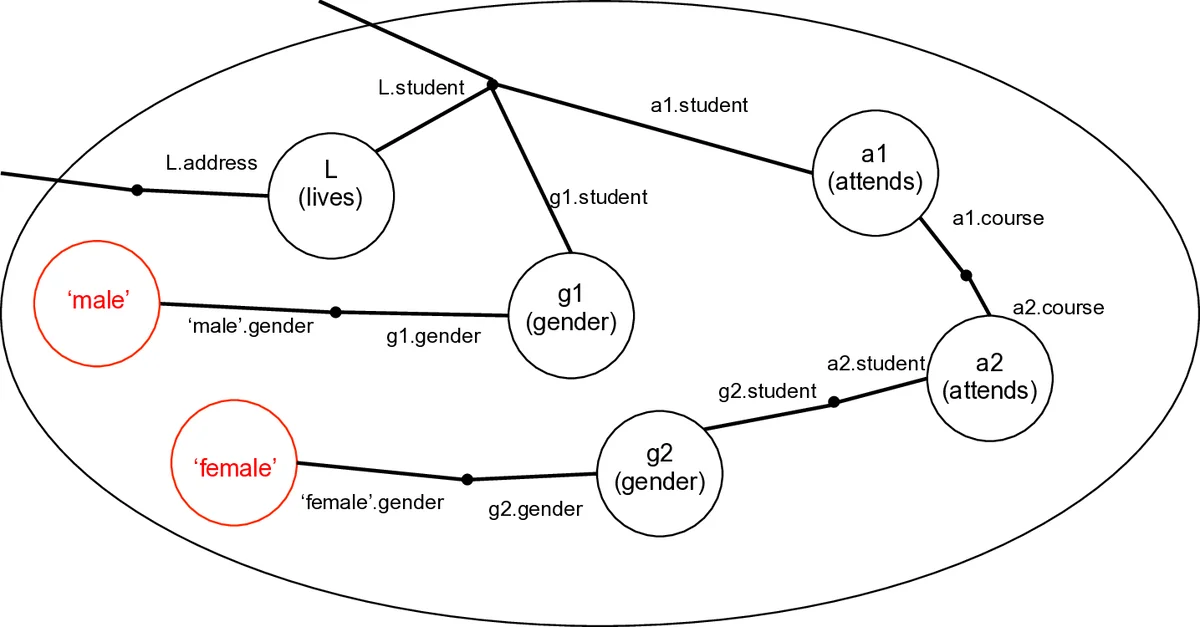
Wiring diagrams, as seen in digital circuits, can be nested hierarchically and thus have an aspect of self-similarity. We show that wiring diagrams form the morphisms of an operad $\mcT$, capturing this self-similarity. We discuss the algebra $\Rel$ of mathematical relations on $\mcT$, and in so doing use wiring diagrams as a graphical language with which to structure queries on relational databases. We give the example of circuit diagrams as a special case. We move on to show how plug-and-play devices and also recursion can be formulated in the operadic framework as well. Throughout we include many examples and figures.
💡 Research Summary
The paper develops a rigorous mathematical framework that treats wiring diagrams—common in digital circuits, database queries, and modular system design—as the morphisms of an operad. Starting from the classic notion of a symmetric colored operad, the authors define a singly‑typed wiring‑diagram operad S whose objects are finite sets (wires) and whose morphisms are cospans representing how inner “stars” (input collections of wires) are soldered onto a set of cables that connect to an outer star (output wires). Composition is given by pushouts of the intermediate cable sets, embodying the intuitive idea that “a wiring diagram of wiring diagrams is again a wiring diagram,” thereby capturing self‑similarity.
On this operad they build the relational algebra Rel, assigning to each object the set of binary relations on its wires. A morphism in S induces a new relation on the output by wiring together the input relations according to the cable connections. This construction mirrors conjunctive queries in relational databases; the authors illustrate it with three classic examples (pairs of integers whose product is 9, divisibility relations, and perfect squares).
The framework is then generalized to a typed operad T, where each wire carries a specific data type. All the relational S‑algebras extend to a single T‑algebra, allowing the modeling of typed database schemas and more sophisticated queries (including disjunctions). The authors discuss invariants of these algebras and conjecture that non‑trivial invariants do not exist, suggesting a high degree of flexibility.
Crucially, the paper shows that both S and T are closed operads. This closure enables the internal representation of higher‑order constructs: recursion is expressed by wiring a diagram into itself (the factorial function is given as a concrete example), and “plug‑and‑play” or hot‑plugging is modeled by dynamically inserting or replacing inner stars within an outer star. These ideas provide a unified categorical language for modular circuit design, dynamic system composition, and recursive algorithm specification.
Overall, the work bridges operad theory, relational database semantics, and circuit diagrammatics, offering a versatile graphical language that can be applied across computer science, engineering, and cognitive modeling. Future directions include richer type systems, connections to process algebras, and real‑time system applications.
Comments & Academic Discussion
Loading comments...
Leave a Comment