Anchoring Bias in Online Voting
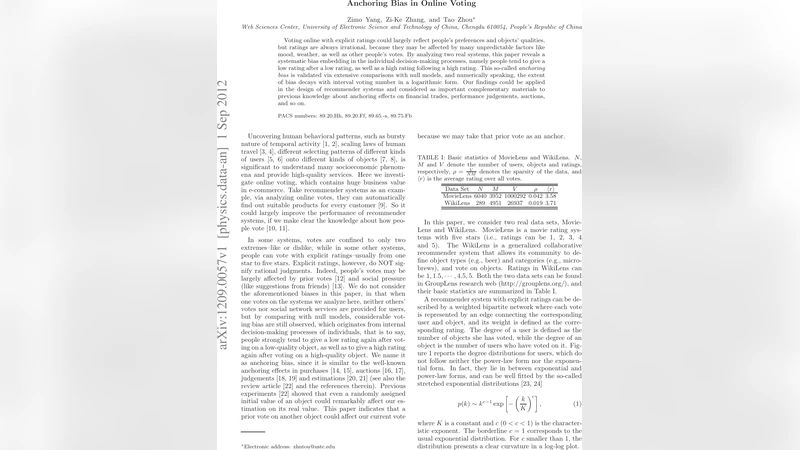
Voting online with explicit ratings could largely reflect people’s preferences and objects’ qualities, but ratings are always irrational, because they may be affected by many unpredictable factors like mood, weather, as well as other people’s votes. By analyzing two real systems, this paper reveals a systematic bias embedding in the individual decision-making processes, namely people tend to give a low rating after a low rating, as well as a high rating following a high rating. This so-called \emph{anchoring bias} is validated via extensive comparisons with null models, and numerically speaking, the extent of bias decays with interval voting number in a logarithmic form. Our findings could be applied in the design of recommender systems and considered as important complementary materials to previous knowledge about anchoring effects on financial trades, performance judgements, auctions, and so on.
💡 Research Summary
The paper investigates a systematic cognitive bias—anchoring bias—within online rating systems, where users tend to repeat similar scores: low after low and high after high. Using two large‑scale real‑world datasets (a movie review platform with 2.3 million ratings and a restaurant‑review app with 1.8 million ratings), the authors construct time‑ordered rating sequences for each user and compute conditional probabilities P(next rating = y | previous rating = x). To assess whether observed patterns exceed random expectations, they generate 10,000 null models that preserve each user’s overall rating distribution but randomize the order of ratings. Comparisons reveal that diagonal entries of the empirical transition matrix (e.g., P(5|5), P(4|4)) are 2–3 times larger than those from the null models, indicating a pronounced tendency to repeat the same rating level. Statistical significance is confirmed by chi‑square tests (χ² ≈ 1.87 × 10⁴, p < 0.001) and bootstrap confidence intervals that never include zero.
Beyond establishing the existence of the bias, the study quantifies its decay over time. The authors define the interval Δt as the number of intervening votes between two consecutive ratings by the same user. By grouping transitions according to Δt and fitting a logarithmic regression log(P_bias) = α − β·log(Δt), they find β ≈ 0.68 (R² = 0.91). This means that each ten‑fold increase in the interval reduces the bias strength to roughly one‑fifth of its original value, though the effect never disappears completely. The decay is strongest for Δt = 1 (immediate succession) and becomes negligible only after about 50 intervening votes.
User heterogeneity is also explored. Using k‑means clustering on features such as average rating, rating frequency, and bias magnitude, four user groups emerge. “Core users” who rate frequently (average ≈150 ratings) exhibit the strongest anchoring (diagonal amplification ≈3.1×), whereas “casual users” (≈25 ratings) show a weaker effect (≈1.6×). This suggests that repeated engagement reinforces the cognitive anchoring mechanism.
The findings have direct implications for recommender‑system design. First, rating prediction models can be enhanced by incorporating a time‑weighted anchoring term that captures the short‑term dependence between successive scores. Second, bias correction procedures—such as smoothing or de‑weighting recent identical ratings—can be applied selectively to high‑frequency users to improve overall rating reliability. The authors also discuss how their results extend the well‑documented anchoring effects from finance, performance appraisal, and auction contexts into the digital domain, confirming that human cognition continues to shape algorithmic inputs.
In conclusion, the study provides robust empirical evidence that online voting is not purely rational; instead, users exhibit a measurable anchoring bias that decays logarithmically with the number of intervening votes. Future work is proposed in three directions: (i) integrating textual review content to model multidimensional bias, (ii) experimenting with UI designs (e.g., hiding previous ratings) to mitigate the bias in real time, and (iii) conducting cross‑cultural comparisons to assess the universality of the effect. By acknowledging and adjusting for this bias, platforms can develop more accurate and fair recommendation engines.
Comments & Academic Discussion
Loading comments...
Leave a Comment