Fast Clustering with Lower Bounds: No Customer too Far, No Shop too Small
We study the \LowerBoundedCenter (\lbc) problem, which is a clustering problem that can be viewed as a variant of the \kCenter problem. In the \lbc problem, we are given a set of points P in a metric space and a lower bound \lambda, and the goal is to select a set C \subseteq P of centers and an assignment that maps each point in P to a center of C such that each center of C is assigned at least \lambda points. The price of an assignment is the maximum distance between a point and the center it is assigned to, and the goal is to find a set of centers and an assignment of minimum price. We give a constant factor approximation algorithm for the \lbc problem that runs in O(n \log n) time when the input points lie in the d-dimensional Euclidean space R^d, where d is a constant. We also prove that this problem cannot be approximated within a factor of 1.8-\epsilon unless P = \NP even if the input points are points in the Euclidean plane R^2.
💡 Research Summary
The paper studies the Lower‑Bounded Center (LBC) problem, a clustering variant of the classic k‑Center where the number of centers is unrestricted but each chosen center must serve at least λ points. Formally, given a point set P in a metric space and an integer λ, the goal is to select a subset C⊆P of centers and assign every point to its nearest center such that each center receives at least λ points, while minimizing the maximum assignment distance (the “price”). This model captures real‑world scenarios such as opening stores, wireless towers, or post offices where a location is viable only if it can attract a sufficient client base, yet the service distance to customers should be kept small.
Main Contributions
-
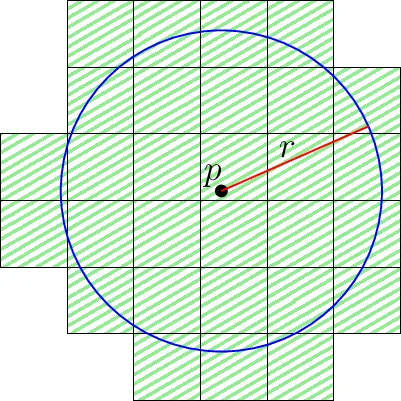
Fast Net Construction – The authors show that in constant‑dimensional Euclidean space ℝ^d (d fixed) an r‑net (a maximal set of points pairwise farther than r, covering all points within distance r) can be built in linear time O(n). The method uses a regular grid of side length Δ = r/(2√d) and hash‑based bucketing. Each grid cell can contain at most one net point, and checking the O(1) neighboring cells suffices to mark points within distance r. Consequently, not only the net but also the nearest‑net‑point for every input point can be obtained in O(n) time.
-
A 4‑Approximation in O(n^{4/3} polylog n) – By enumerating all O(n^2) pairwise distances (or using Chan’s distance‑selection algorithm to obtain medians in O(n^{4/3} polylog n) time), the algorithm performs a binary search on candidate radii. For each candidate x it builds Net(4x, P) and checks whether every net point has at least λ assigned points (a linear‑time verification). Lemma 3.4 proves that if α≥4, an α·r*‑net (where r* is the optimal radius) is always feasible, yielding a 4‑approximation. The overall running time is dominated by the distance‑selection step, giving O(n^{4/3} polylog n).
-
A (4+ε)‑Approximation in O(n log (n/ε)) – To avoid the quadratic dependence on distances, the authors employ a Well‑Separated Pair Decomposition (WSPD). The WSPD provides a compact set D of O(n) distances that “covers” the spectrum of possible optimal radii within a constant factor. A binary search over D, combined with the linear‑time net‑validation routine, narrows an active interval
Comments & Academic Discussion
Loading comments...
Leave a Comment