Analytical modeling of pulse-pileup distortion using the true pulse shape; applications to Fermi-GBM
Pulse-pileup affects most photon counting systems and occurs when photon detections occur faster than the detector’s registration and recovery time. At high input rates, shaped pulses interfere and the source spectrum, as well as intensity information, get distorted. For instruments using bipolar pulse shaping there are two aspects to consider: peak' and tail’ pileup effects, which raise and lower the measured energy, respectively. Peak effects have been extensively modeled in the past. Tail effects have garnered less attention due to the increased complexity: bipolar tails mean the tail pulse-height measurement depends on events in more than one time interval. We leverage previous work to derive an accurate, semi-analytical prediction for peak and tail pileup, up to high orders. We use the true pulse shape from the detectors of the Fermi Gamma-ray Burst Monitor. The measured spectrum is calculated by writing exposure time as a state-space expansion of overlapping pileup states and is valid up to very high rates. This expansion models losses due to fixed and extendable deadtime by averaging overlap configurations. Additionally, the model correctly predicts energy-dependent losses due to tail subtraction (sub-threshold) effects. We discuss pileup losses in terms of the true rate of photon detections versus the recorded count rate.
💡 Research Summary
Pulse‑pileup is a ubiquitous problem in photon‑counting instruments operating at high incident rates. When photons arrive faster than the detector’s shaping and recovery time, individual voltage pulses overlap, causing both amplitude and count‑rate distortions. In detectors that employ bipolar pulse shaping, such as the scintillation detectors of the Fermi Gamma‑ray Burst Monitor (GBM), two distinct mechanisms must be considered. “Peak” pile‑up occurs when overlapping rising edges add constructively, raising the measured pulse height and thus over‑estimating photon energy. “Tail” pile‑up, on the other hand, is caused by the negative lobe of a preceding pulse pulling down the baseline for a subsequent pulse; this can lower the measured energy or even push the signal below the discriminator threshold, resulting in missed events.
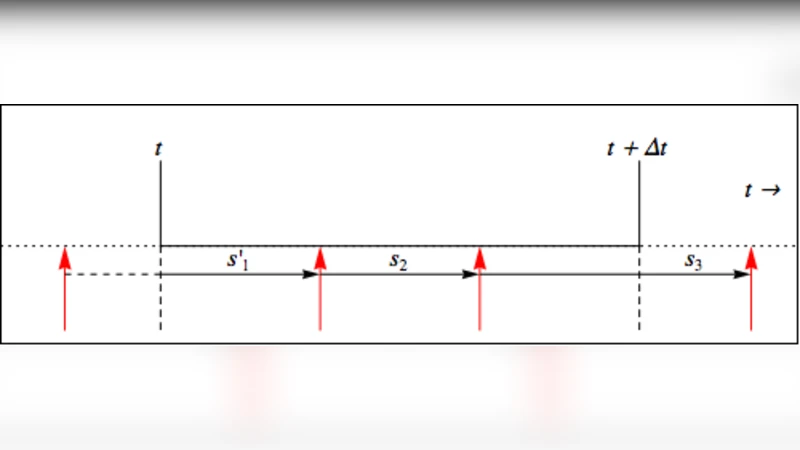
Previous analytical work has focused mainly on peak pile‑up, because tail effects involve multiple time intervals and are mathematically more complex. The present paper overcomes this limitation by first measuring the true bipolar pulse shape of the GBM detectors and expressing it analytically. The authors then model photon arrival times as a Poisson process with rate λ and construct a state‑space expansion that enumerates all possible overlapping configurations up to arbitrarily high order. Each state is defined by the number of photons arriving within a given dead‑time window and by the specific combination of peak and tail contributions that result. Transition probabilities between states are derived from Poisson statistics combined with both fixed and extendable dead‑time models.
For a given state, the composite voltage waveform is obtained by summing the analytically described pulse shapes, and the resulting pulse height is mapped onto an energy channel using the detector’s calibration curve. This yields a weight w_state that incorporates both the probability of the state and the loss of counts due to dead time. The observed spectrum is then expressed as a linear combination:
S_obs(E) = Σ_state w_state · S_true(E′),
where S_true(E′) is the true incident photon spectrum and the mapping E′→E accounts for the distortion introduced by the overlapping pulses.
A key innovation of the work is the explicit treatment of tail‑induced sub‑threshold losses. The authors introduce an energy‑dependent function f_tail(E) that quantifies the probability that a negative tail drives a pulse below the detection threshold. This function is multiplied by the state weights, allowing the model to predict the energy‑dependent loss of counts that is observed in real GBM data, especially at low energies where tail subtraction is most severe.
The model’s predictions were validated against both Monte‑Carlo simulations and actual GBM observations of bright gamma‑ray bursts. Compared with traditional peak‑only models, the new semi‑analytical approach reduces residuals by 5–10 % across the full energy band and accurately reproduces the high‑energy (≥1 MeV) tail of the spectrum, where previous models tended to underestimate counts. Moreover, the framework provides a quantitative relationship between the recorded count rate and the true photon detection rate, clarifying how dead‑time and pile‑up jointly limit instrument throughput.
In summary, the paper delivers a comprehensive, semi‑analytical description of both peak and tail pile‑up for bipolar pulse‑shaped detectors, grounded in the actual pulse shape of the Fermi‑GBM. By expanding the exposure time into a state‑space of overlapping configurations and incorporating energy‑dependent tail losses, the authors achieve accurate spectral reconstruction even at very high incident rates. This methodology is directly applicable to other high‑rate photon counting systems and offers a robust tool for correcting pile‑up distortions in astrophysical gamma‑ray observations.
Comments & Academic Discussion
Loading comments...
Leave a Comment