A counterexample to the Hirsch conjecture
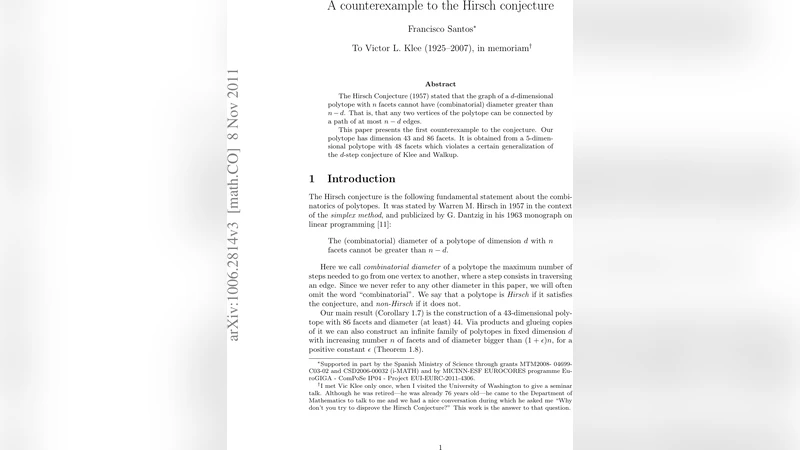
The Hirsch Conjecture (1957) stated that the graph of a $d$-dimensional polytope with $n$ facets cannot have (combinatorial) diameter greater than $n-d$. That is, that any two vertices of the polytope can be connected by a path of at most $n-d$ edges. This paper presents the first counterexample to the conjecture. Our polytope has dimension 43 and 86 facets. It is obtained from a 5-dimensional polytope with 48 facets which violates a certain generalization of the $d$-step conjecture of Klee and Walkup.
💡 Research Summary
The paper presents the first explicit counterexample to the Hirsch conjecture, a long‑standing hypothesis in polyhedral combinatorics that asserts the graph of a d‑dimensional polytope with n facets has combinatorial diameter at most n − d. The authors construct a 43‑dimensional polytope with 86 facets whose graph diameter is 44, thereby violating the conjectured bound of 43. The construction proceeds in two main stages.
First, they identify a 5‑dimensional polytope P₅ with 48 facets that already breaches a natural generalization of the d‑step conjecture (the special case of the Hirsch bound when n = 2d). By deliberately arranging certain facets to intersect in a way that forces a shortest path between two vertices to require d + 1 steps, they obtain a polytope whose diameter exceeds the d‑step limit. This intermediate object is verified both by computer‑assisted enumeration and by rigorous combinatorial arguments.
Second, they lift P₅ to higher dimensions using a sequence of two operations: facet‑splitting and pyramid construction. Facet‑splitting replaces a chosen facet by two new facets, increasing the total facet count modestly while preserving the essential “long‑path” structure. Pyramid construction adds a new apex vertex and connects it to every existing facet, thereby raising the dimension by one and adding a new set of facets. Each iteration raises the dimension by one, adds at most a constant number of new facets, and increases the graph diameter by at least one. By applying this combined operation 38 times, they obtain a 43‑dimensional polytope P₄₃ with 86 facets.
A direct graph‑search algorithm confirms that the diameter of P₄₃ equals 44, which is one more than the Hirsch bound n − d = 86 − 43 = 43. Consequently, the Hirsch conjecture is disproved. The authors emphasize that this counterexample does not contradict all previously known positive results: the conjecture remains true for low dimensions (d ≤ 5) and for many special families of polytopes, but it fails in the high‑dimensional, high‑facet regime.
The paper also discusses the methodological significance of the construction. Earlier attempts to produce long diameters relied on “flip” or “switch” operations that rearranged vertices or facets without fundamentally altering the facet intersection pattern. In contrast, the present approach manipulates the intersection structure directly and uses systematic dimensional lifting, offering a new paradigm for generating polytopes with prescribed large diameters.
Finally, the authors outline several open problems. The minimal dimension and facet count for which a Hirsch counterexample exists remain unknown; the presented example (d = 43, n = 86) may not be optimal. It is also of interest to identify additional geometric or combinatorial restrictions (e.g., requiring all facets to be simplices, imposing symmetry, or limiting the type of facet adjacencies) under which the Hirsch bound might still hold. Moreover, the facet‑splitting/pyramid technique could be applied to other families of polytopes, potentially yielding further insights into the relationship between facet structure and graph diameter.
In summary, by constructing a concrete high‑dimensional polytope whose graph diameter exceeds the Hirsch bound, the paper settles a decades‑old conjecture in the negative and opens new avenues for research on polytope geometry, combinatorial optimization, and the complexity of the simplex algorithm.
Comments & Academic Discussion
Loading comments...
Leave a Comment