Higher topological cyclic homology and the Segal conjecture for tori
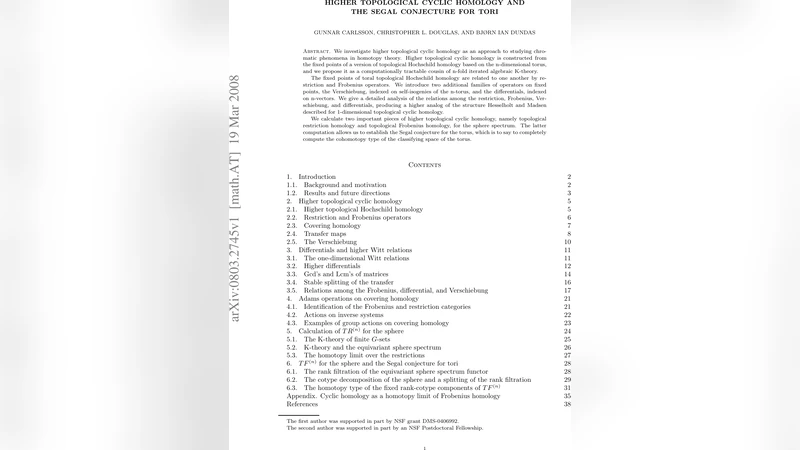
We investigate higher topological cyclic homology as an approach to studying chromatic phenomena in homotopy theory. Higher topological cyclic homology is constructed from the fixed points of a version of topological Hochschild homology based on the n-dimensional torus, and we propose it as a computationally tractable cousin of n-fold iterated algebraic K-theory. The fixed points of toral topological Hochschild homology are related to one another by restriction and Frobenius operators. We introduce two additional families of operators on fixed points, the Verschiebung, indexed on self-isogenies of the n-torus, and the differentials, indexed on n-vectors. We give a detailed analysis of the relations among the restriction, Frobenius, Verschiebung, and differentials, producing a higher analog of the structure Hesselholt and Madsen described for 1-dimensional topological cyclic homology. We calculate two important pieces of higher topological cyclic homology, namely topological restriction homology and topological Frobenius homology, for the sphere spectrum. The latter computation allows us to establish the Segal conjecture for the torus, which is to say to completely compute the cohomotopy type of the classifying space of the torus.
💡 Research Summary
The paper introduces higher topological cyclic homology (TCⁿ) as a new computational framework for studying chromatic phenomena in stable homotopy theory. Starting from the classical construction of topological Hochschild homology (THH) as A⊗S¹, the authors replace the circle by the n‑dimensional torus Tⁿ, defining higher THHⁿ(A)=A⊗Tⁿ for a connective commutative S‑algebra A. The fixed‑point spectra of THHⁿ under finite sub‑tori give rise to a rich system of operators: restriction maps R_α, Frobenius maps F_α, Verschiebung maps V_α (all indexed by self‑isogenies α of the p‑adic torus), and differentials d_v indexed by vectors v∈ℤ_pⁿ.
The central technical achievement is a complete description of the algebraic relations among these operators (Theorem 1.1 / Theorem 3.22). The relations generalize the well‑known Hesselholt–Madsen structure for 1‑dimensional TC. In particular:
- The multiplication μ intertwines V and F via μ(V_α∧1)=V_α μ(1∧F_α).
- The composite F_α V_β equals |gcd(α,β)| times a product of Verschiebung and Frobenius indexed by the least common multiple of the matrices.
- Differentials satisfy d_v F_α = F_α d_{αv} and V_α d_v = d_{αv} V_α, showing that they are derivations compatible with the isogeny action.
- A mixed relation F_α d_v V_β decomposes into a sum involving Bezout matrices, again reflecting the arithmetic of the underlying integer matrices.
These formulas endow the homotopy groups of the fixed‑point spectra with the structure of a multi‑graded, multi‑differential ring, which can be viewed as a higher‑dimensional Witt complex.
Having set up this algebraic machinery, the authors compute two fundamental pieces of TCⁿ for the sphere spectrum S. The topological restriction homology TRⁿ(S) is the homotopy limit over the restriction maps alone; it is identified as a wedge of spectra Y_O∧B(ℤ_pⁿ/O)_+ ranging over open subgroups O⊂ℤ_pⁿ. This description mirrors the classical description of THH fixed points for finite groups.
The more subtle object is topological Frobenius homology TFⁿ(S), the homotopy limit taken only over the Frobenius maps. The authors prove that TFⁿ(S)ₚ (the p‑completion) is equivalent to the p‑completed co‑homotopy spectrum F(BTⁿ_+, S), i.e. the co‑homotopy of the classifying space of the torus. They give an explicit decomposition of π_* TFⁿ(S)ₚ as a limit over GL_n(ℤ_p)‑orbits, involving rank‑k sub‑groups of C_p^∞ and their “cotype” data, together with the homotopy groups of Σ^∞S^k∧BT^k_+ modulo p. This calculation establishes the Segal conjecture for tori: the natural map from the Burnside ring of the torus to the stable co‑homotopy of its classifying space is a p‑adic completion isomorphism.
The paper concludes with several directions for future work: computing TCⁿ(F_p) for the Eilenberg–MacLane spectrum, formalizing the higher Witt complex into a Burnside‑Witt complex, and extending the Segal conjecture proof to arbitrary compact Lie groups via their maximal tori. Overall, the work provides a powerful new tool—higher topological cyclic homology—that is more amenable to computation than iterated algebraic K‑theory, retains natural symmetry from torus isogenies, and yields deep structural insights into chromatic homotopy theory.
Comments & Academic Discussion
Loading comments...
Leave a Comment