Core-Collapse Supernovae as Supercomputing Science: a status report toward 6D simulations with exact Boltzmann neutrino transport in full general relativity
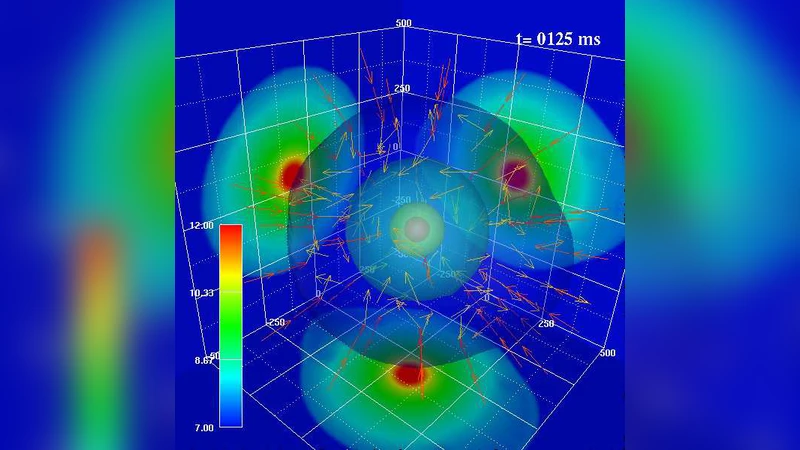
This is a status report on our endeavor to reveal the mechanism of core-collapse supernovae (CCSNe) by large-scale numerical simulations. Multi-dimensionality of the supernova engine, general relativistic magnetohydrodynamics, energy and lepton number transport by neutrinos emitted from the forming neutron star as well as nuclear interactions there, are all believed to play crucial roles in repelling infalling matter and producing energetic explosions. These ingredients are nonlinearly coupled with one another in the dynamics of core-collapse, bounce, and shock expansion. Serious quantitative studies of CCSNe hence make extensive numerical computations mandatory. Since neutrinos are neither in thermal nor in chemical equilibrium in general, their distributions in the phase space should be computed. This is a six dimensional (6D) neutrino transport problem and quite a challenge even for those with an access to the most advanced numerical resources such as the “K computer”. To tackle this problem, we have embarked on multi-front efforts. In particular we report in this paper our recent progresses in the treatments of multi-dimensional (multi-D) radiation-hydrodynamics. We are currently proceeding on two different paths to the ultimate goal; in one approach we employ an approximate but highly efficient scheme for neutrino transport and treat 3D hydrodynamics and/or general relativity rigorously; some neutrino-driven explosions will be presented and comparisons will be made between 2D and 3D models quantitatively; in the second approach, on the other hand, exact but so far Newtonian Boltzmann equations are solved in two and three spatial dimensions; we will show some demonstrative test simulations. We will also address the perspectives of exa-scale computations on the next generation supercomputers.
💡 Research Summary
This paper presents a status report on the authors’ ambitious program to uncover the core‑collapse supernova (CCSN) explosion mechanism through large‑scale, multi‑physics simulations. The authors emphasize that a realistic CCSN model must simultaneously treat three‑dimensional (3‑D) general‑relativistic magnetohydrodynamics (GR‑MHD), detailed neutrino radiation transport, and a sophisticated nuclear equation of state, all of which are nonlinearly coupled during collapse, bounce, and shock expansion. Because neutrinos are generally out of thermal and chemical equilibrium, their full phase‑space distribution—six dimensions (3 spatial + 3 momentum)—must be solved, a task that pushes even the most powerful supercomputers, such as the “K computer,” to their limits.
To address this challenge, the team pursues two complementary strategies. The first strategy adopts an approximate but highly efficient neutrino transport scheme (e.g., M1 closure, variable‑Eddington factor, or ray‑by‑ray methods) while solving the GR‑MHD equations rigorously in full 3‑D. Using this framework they have performed a series of simulations that compare 2‑D axisymmetric and fully 3‑D models. The results demonstrate that 3‑D turbulence, convection, and rotation substantially modify the neutrino heating geometry and can either aid or suppress shock revival, depending on the progenitor’s rotation rate and magnetic field strength. Quantitative diagnostics such as the net neutrino heating rate, lepton‑number flux, and explosion energy are presented, showing that modest changes in dimensionality lead to measurable differences in the explosion outcome.
The second strategy tackles the problem from the opposite extreme: solving the exact Boltzmann transport equation for neutrinos in Newtonian gravity, but in two and three spatial dimensions. This approach retains the full angular and energy dependence of the neutrino distribution function, thereby eliminating the approximations inherent in moment‑based schemes. The authors describe the implementation of a high‑order discretization on a massive 6‑D grid (e.g., 256³ spatial cells × 64³ momentum cells) and the use of advanced parallelization techniques—domain decomposition, asynchronous communication, GPU acceleration, and a hybrid Lagrangian‑Eulerian solver—to achieve acceptable performance on the K computer. Demonstrative test problems include a static neutrino sphere, a spherically symmetric collapse benchmark, and a fully 3‑D post‑bounce simulation. These tests reveal subtle angular effects on neutrino heating that are absent in moment closures, and they provide a benchmark for future code verification.
Finally, the paper looks ahead to the exascale era. Scaling studies indicate that the code can maintain >80 % parallel efficiency on more than one million cores, provided that memory bandwidth and interconnect latency are carefully managed. The authors discuss prospective adaptations for emerging architectures (ARM‑based CPUs, next‑generation GPUs, and even quantum accelerators) and outline a roadmap for integrating open‑source community contributions to ensure long‑term sustainability. In summary, the work delivers a clear picture of the trade‑offs between computational efficiency and physical fidelity, showcases concrete results from both approximate and exact transport methods, and sets a realistic agenda for achieving fully general‑relativistic, six‑dimensional neutrino radiation‑hydrodynamics on future exascale supercomputers.