Core compactness and diagonality in spaces of open sets
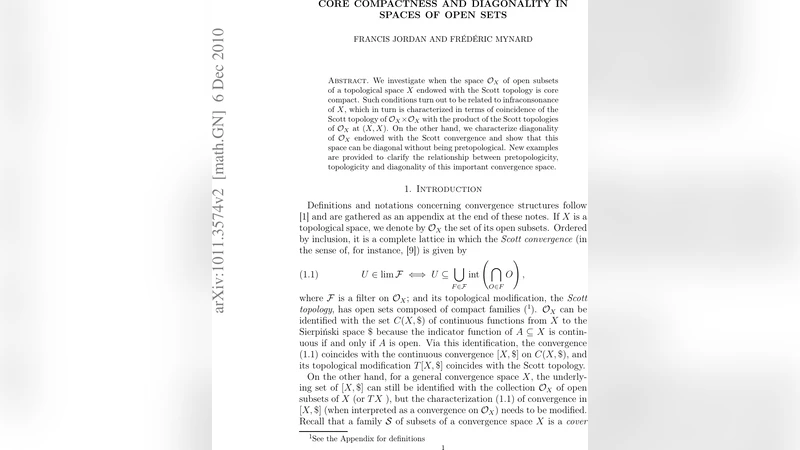
We investigate when the space $\mathcal O_X$ of open subsets of a topological space $X$ endowed with the Scott topology is core compact. Such conditions turn out to be related to infraconsonance of $X$, which in turn is characterized in terms of coincidence of the Scott topology of $\mathcal O_X\times\mathcal O_X$ with the product of the Scott topologies of $\mathcal O_X$ at $(X,X)$. On the other hand, we characterize diagonality of $\mathcal O_X$ endowed with the Scott convergence and show that this space can be diagonal without being pretopological. New examples are provided to clarify the relationship between pretopologicity, topologicity and diagonality of this important convergence space.
💡 Research Summary
The paper investigates two fundamental convergence‑theoretic properties of the space 𝒪_X of open subsets of a topological space X when it is equipped with the Scott topology: core compactness and diagonality. Core compactness of 𝒪_X is shown to be intimately linked with a property of X called infraconsonance. The authors prove that 𝒪_X is core compact if and only if X is infraconsonant. This equivalence is obtained by analysing the Scott topology on the product 𝒪_X × 𝒪_X and showing that at the distinguished point (X,X) the Scott topology coincides with the product of the Scott topologies on each factor. In other words, the local behaviour of the product lattice at (X,X) captures exactly the infraconsonance condition, providing a clean lattice‑theoretic characterisation of core compactness for the open‑set lattice.
The second part of the work turns to diagonality of 𝒪_X under the Scott convergence. A convergence space is diagonal if every filter that converges along the diagonal (i.e., a filter of pairs (U,U)) forces the original filter to converge in the whole space. While diagonal convergence is automatically satisfied in many pretopological or topological settings, the authors demonstrate that 𝒪_X can be diagonal without being pretopological. They construct explicit counter‑examples using spaces X that fail to be consonant or regular; in these examples the Scott convergence on 𝒪_X does not satisfy the usual pretopological axiom (every convergent filter is determined by a neighbourhood filter), yet the diagonal condition holds. This shows that diagonality is strictly weaker than pretopologicity.
A systematic comparison of the three notions—pretopologicity, topologicity, and diagonality—is provided. The classical implication chain “pretopological ⇒ topological ⇒ diagonal” is confirmed, but the reverse implications are disproved by the new examples. In particular, the paper exhibits (i) a space where 𝒪_X is diagonal but not pretopological, and (ii) a space where 𝒪_X is topological but fails to be diagonal, thereby clarifying the independence of these properties.
Beyond the intrinsic interest in the convergence structure of 𝒪_X, the results have broader implications for domain theory and the theory of function spaces. The lattice 𝒪_X, equipped with the Scott topology, is a canonical model for the space of continuous maps into the Sierpiński space, and core compactness of 𝒪_X corresponds to the exponentiability of X in the category of topological spaces. Likewise, diagonality influences the behaviour of product convergence and the preservation of limits in categorical constructions. By linking these convergence properties to concrete topological conditions on X (infraconsonance, consonance, regularity), the paper provides a toolbox for researchers working at the interface of general topology, domain theory, and theoretical computer science. The new examples enrich the catalogue of known behaviours and suggest further lines of inquiry, such as the exploration of other lattice‑theoretic conditions that may control pretopologicity or the development of refined convergence notions that sit between diagonality and pretopologicity. Overall, the work deepens our understanding of how the Scott topology on the open‑set lattice reflects and amplifies subtle features of the underlying space.
Comments & Academic Discussion
Loading comments...
Leave a Comment