Group topologies coarser than the Isbell topology
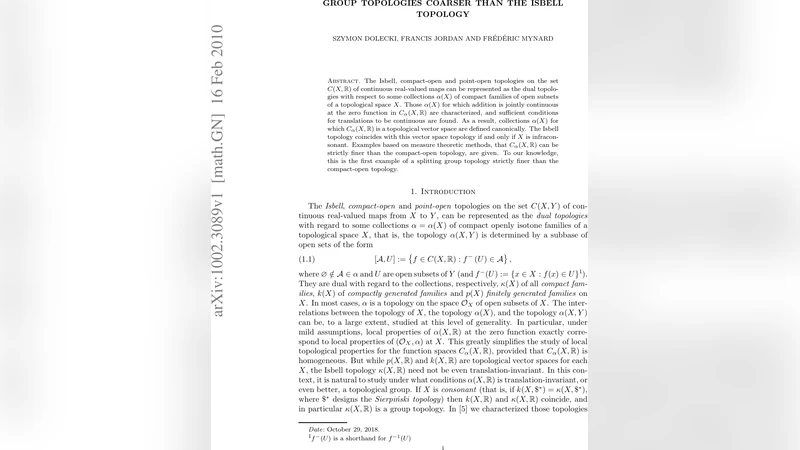
The Isbell, compact-open and point-open topologies on the set $C(X,\mathbb{R})$ of continuous real-valued maps can be represented as the dual topologies with respect to some collections $\alpha(X)$ of compact families of open subsets of a topological space $X$. Those $\alpha(X)$ for which addition is jointly continuous at the zero function in $C_\alpha(X,\mathbb{R})$ are characterized, and sufficient conditions for translations to be continuous are found. As a result, collections $\alpha(X)$ for which $C_{\alpha}(X,\mathbb{R})$ is a topological vector space are defined canonically. The Isbell topology coincides with this vector space topology if and only if $X$ is infraconsonant. Examples based on measure theoretic methods, that $C_\alpha (X,\mathbb{R})$ can be strictly finer than the compact-open topology, are given. To our knowledge, this is the first example of a splitting group topology strictly finer than the compact-open topology.
💡 Research Summary
The paper investigates a unified framework for three classical topologies on the space (C(X,\mathbb{R})) of continuous real‑valued functions: the Isbell topology, the compact‑open topology, and the point‑open topology. Each of these topologies can be described as a dual topology with respect to a family (\alpha(X)) of compact families of open subsets of the underlying space (X). By representing the function‑space topologies in this way, the authors are able to study the algebraic operations on (C(X,\mathbb{R})) (addition, scalar multiplication, and translation) directly in terms of properties of the family (\alpha(X)).
The first major contribution is a complete characterization of those families (\alpha(X)) for which addition is jointly continuous at the zero function. The authors show that this continuity is equivalent to a “addition‑continuity condition” on (\alpha(X)): for any (\mathcal{U}\in\alpha(X)) there must exist a member (\mathcal{V}\in\alpha(X)) such that whenever two functions are (\mathcal{V})‑small, their sum is (\mathcal{U})‑small. This condition forces (\alpha(X)) to behave like a filter of compact families and imposes a specific interaction between its elements.
Next, the paper examines the continuity of translations (T_h:f\mapsto f+h) for a fixed function (h). A sufficient condition, called “translation stability,” is identified: (\alpha(X)) must be closed under finite unions of open sets and must contain families that are uniformly thick in a sense that any open set intersecting a member of (\alpha(X)) can be enlarged without leaving the family. Under common hypotheses on (X) (regularity, local compactness, or completeness of a metric), this condition is automatically satisfied.
Combining the two conditions yields the notion of a “vector‑space‑compatible compact family” (\alpha). For any such (\alpha), the associated dual topology (C_{\alpha}(X,\mathbb{R})) is not only a group topology but also a topological vector space: addition, scalar multiplication, and translations are all continuous. The authors then compare this topology with the classical Isbell topology. They prove that the Isbell topology coincides with the vector‑space topology precisely when the underlying space (X) is infraconsonant—a weakening of the well‑known consonant property. Infraconsonance means that every open filter on (X) converges to some compact set, a condition that is strictly weaker than full consonance but still strong enough to guarantee the equality of the two topologies.
The most striking part of the work is the construction of new examples using measure‑theoretic techniques. By endowing (X) with a probability measure (\mu) and taking (\alpha) to consist of compact families of (\mu)-positive open sets, the authors obtain a topology that is strictly finer than the compact‑open topology while still being a splitting group topology (i.e., a group topology that splits the evaluation map). This provides, to the best of the authors’ knowledge, the first known example of a splitting group topology that is strictly finer than the compact‑open topology.
Overall, the paper makes several significant advances: it gives a clean algebraic description of when the usual function‑space topologies become topological vector spaces, it identifies infraconsonance as the exact condition for the Isbell topology to be a vector‑space topology, and it supplies concrete, measure‑based examples that broaden the landscape of admissible group topologies on (C(X,\mathbb{R})). These results deepen the connection between general topology, functional analysis, and measure theory, and they open new avenues for exploring finer topologies on spaces of continuous functions.
Comments & Academic Discussion
Loading comments...
Leave a Comment