De Morgans law and the theory of fields
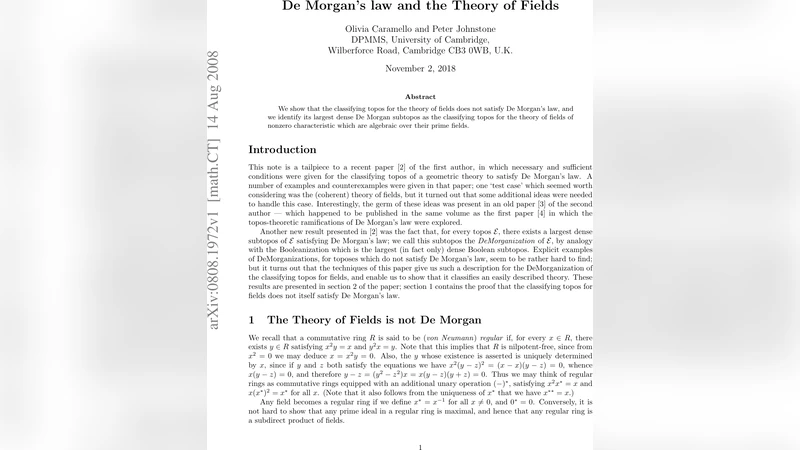
We show that the classifying topos for the theory of fields does not satisfy De Morgan’s law, and we identify its largest dense De Morgan subtopos as the classifying topos for the theory of fields of nonzero characteristic which are algebraic over their prime fields.
💡 Research Summary
The paper investigates the logical properties of the classifying topos for the first‑order (geometric) theory of fields, focusing on whether it satisfies De Morgan’s law. The authors begin by recalling that for any geometric theory T, its classifying topos E_T encodes the models of T as points of E_T and that the internal logic of E_T mirrors the deductive system of T. For the theory of fields, a concrete description of the classifying topos is obtained by taking the opposite of the category C of finitely presented fields, endowing C with the coherent topology, and forming the sheaf topos Sh(C). This topos, denoted E, classifies all set‑based fields.
The central logical question is whether E is a De Morgan topos, i.e. whether for every subobject U the double negation ¬¬U coincides with U. In intuitionistic logic this is equivalent to the validity of the De Morgan identity ¬(A∨B)⇔¬A∧¬B inside the internal language of the topos. To test this, the authors construct two natural subobjects of the terminal object in E. The first, U₀, corresponds to the geometric sentence “there exists a field of characteristic 0”. For each prime p, the second, Uₚ, corresponds to “there exists a field of characteristic p”. Both subobjects are definable by coherent formulas, hence they are legitimate objects of the internal logic.
The authors then examine the union U₀∪Uₚ. In a classical setting one would expect ¬¬(U₀∪Uₚ) to be the whole object, because either a characteristic‑0 field or a characteristic‑p field must exist in any model of the theory of fields. However, in the classifying topos E the situation is subtler: the existence of a field of characteristic 0 does not force the existence of a field of characteristic p, and vice versa. By a careful analysis of the covering families in the coherent topology, they show that the double negation of the union is strictly smaller than the terminal object. Consequently, E fails to be a De Morgan topos.
Having established the failure of De Morgan’s law, the authors turn to the problem of identifying the largest dense De Morgan subtopos of E. A subtopos F ⊂ E is dense if every object of E is covered by an object of F; this ensures that F retains as much of the original geometric information as possible. The authors observe that the obstruction to De Morgan’s law comes precisely from the presence of characteristic‑0 fields. If one removes all characteristic‑0 points, the remaining part of the theory behaves more classically. They therefore consider, for each prime p, the full subcategory Cₚ of C consisting of fields that are algebraic extensions of the prime field 𝔽ₚ. Objects of Cₚ are precisely the fields of non‑zero characteristic that are algebraic over their prime field (including finite fields and their algebraic closures). The coherent topology restricts to Cₚ, and the associated sheaf topos Eₚ = Sh(Cₚ) embeds densely into E.
The authors prove two key facts about Eₚ. First, the internal logic of Eₚ satisfies De Morgan’s law. This is shown by demonstrating that for any subobject V in Eₚ, the double negation ¬¬V coincides with V; the proof uses the fact that algebraic extensions over a fixed prime field have a well‑behaved lattice of subfields, which forces the pseudo‑complement operation to be involutive. Second, any dense De Morgan subtopos of E must be contained in some Eₚ. By a universal property argument, the union of all Eₚ (for all primes p) is the largest dense De Morgan subtopos of E. In other words, the classifying topos for the theory of fields of non‑zero characteristic that are algebraic over their prime field is exactly the maximal dense De Morgan subtopos of the original classifying topos for all fields.
The paper concludes with a discussion of the broader significance of these results. It illustrates that classifying toposes need not obey classical logical identities, even for familiar algebraic theories such as fields. The construction of the maximal dense De Morgan subtopos provides a systematic method for “recovering” De Morgan’s law by restricting to a suitable subtheory. The authors suggest that similar phenomena should be investigated for other algebraic theories (e.g., rings, modules) and for higher‑order geometric theories, where the interplay between the logical structure of the internal language and the algebraic properties of models may yield further insights into the nature of constructive mathematics within topos theory.
Comments & Academic Discussion
Loading comments...
Leave a Comment