De Morgan classifying toposes
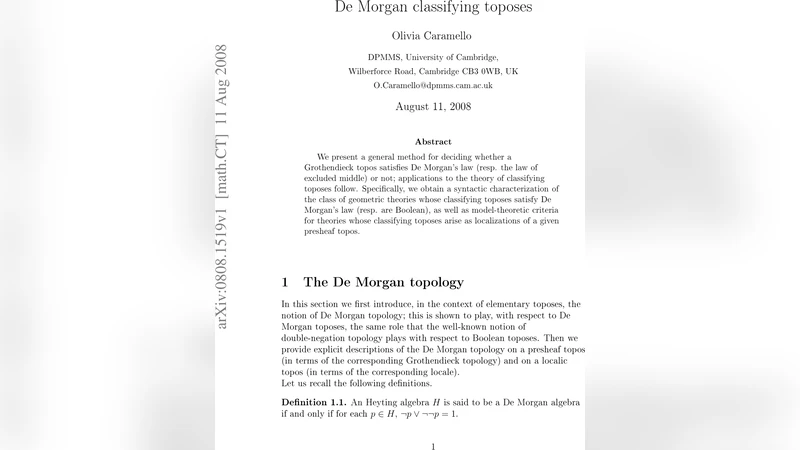
We present a general method for deciding whether a Grothendieck topos satisfies De Morgan’s law (resp. the law of excluded middle) or not; applications to the theory of classifying toposes follow. Specifically, we obtain a syntactic characterization of the class of geometric theories whose classifying toposes satisfy De Morgan’s law (resp. are Boolean), as well as model-theoretic criteria for theories whose classifying toposes arise as localizations of a given presheaf topos.
💡 Research Summary
The paper develops a systematic method for deciding whether a Grothendieck topos satisfies De Morgan’s law or the law of excluded middle (LEM), and then applies this method to the theory of classifying toposes. The authors begin by analysing the internal logic of a Grothendieck topos 𝔈 via its subobject classifier Ω. They introduce the notion of a “De Morgan morphism” on Ω, which captures the relationship between a subobject A, its complement ¬A, and its double complement ¬¬A. If Ω carries a De Morgan algebra structure, then 𝔈 is a De Morgan topos; if Ω is a complete Boolean algebra, then 𝔈 is Boolean and consequently satisfies LEM.
Having established these topos‑theoretic criteria, the paper translates them into syntactic conditions on geometric theories. For a geometric theory T with signature Σ, the classifying topos Sh(T) has a subobject classifier Ω_T. The authors define a “De Morgan theory” as one in which every geometric formula φ either satisfies φ ∨ ¬φ provably or yields a contradiction when combined with its negation. This syntactic property is shown to be equivalent to Ω_T being a De Morgan algebra, so Sh(T) is a De Morgan topos. Similarly, a “Boolean theory” is characterised by the provability of φ ∨ ¬φ for all φ, which forces Ω_T to be a Boolean algebra and makes Sh(T) a Boolean topos. Thus the logical behaviour of the classifying topos is completely captured by a purely syntactic description of the underlying theory.
The third major contribution concerns the relationship between classifying toposes and localisations of presheaf toposes. Given a small category C, the presheaf topos
Comments & Academic Discussion
Loading comments...
Leave a Comment