Functional Currents : a new mathematical tool to model and analyse functional shapes
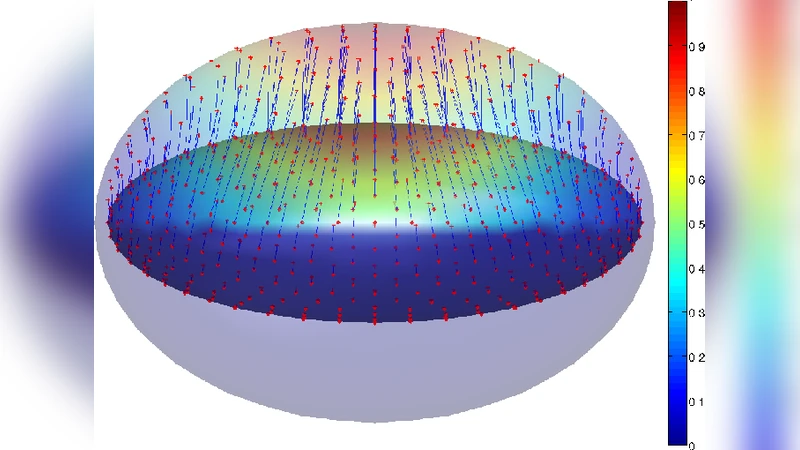
This paper introduces the concept of functional current as a mathematical framework to represent and treat functional shapes, i.e. sub-manifold supported signals. It is motivated by the growing occurrence, in medical imaging and computational anatomy, of what can be described as geometrico-functional data, that is a data structure that involves a deformable shape (roughly a finite dimensional sub manifold) together with a function defined on this shape taking value in another manifold. Indeed, if mathematical currents have already proved to be very efficient theoretically and numerically to model and process shapes as curves or surfaces, they are limited to the manipulation of purely geometrical objects. We show that the introduction of the concept of functional currents offers a genuine solution to the simultaneous processing of the geometric and signal information of any functional shape. We explain how functional currents can be equipped with a Hilbertian norm mixing geometrical and functional content of functional shapes nicely behaving under geometrical and functional perturbations and paving the way to various processing algorithms. We illustrate this potential on two problems: the redundancy reduction of functional shapes representations through matching pursuit schemes on functional currents and the simultaneous geometric and functional registration of functional shapes under diffeomorphic transport.
💡 Research Summary
The paper addresses a growing need in medical imaging and computational anatomy to handle data that couples a deformable geometric object with a signal defined on that object—a “geometrico‑functional” dataset. Classical mathematical currents have proven highly effective for representing pure shapes such as curves and surfaces, but they are intrinsically limited to geometry and cannot incorporate the additional functional information that modern applications demand.
To overcome this limitation the authors introduce functional currents, a novel mathematical construct that simultaneously encodes the geometry of a d‑dimensional sub‑manifold (M) and a signal (f:M\rightarrow N) taking values in a possibly different manifold (N). A functional current is defined by integrating a test form (\phi) over (M) while coupling the geometric d‑vector (the oriented volume element) with the differential of the signal. Formally, for a smooth compactly supported test function (\phi\in C_c^\infty(M\times N,\Lambda^d(T^*M)\otimes T^*N)) the functional current associated with ((M,f)) is
\