Deformed Toric Ideal Constraints for Stoichiometric Networks
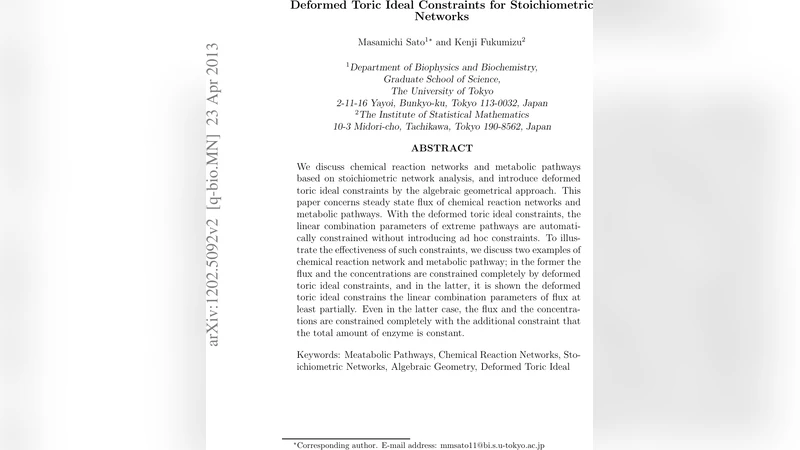
We discuss chemical reaction networks and metabolic pathways based on stoichiometric network analysis, and introduce deformed toric ideal constraints by the algebraic geometrical approach. This paper concerns steady state flux of chemical reaction networks and metabolic pathways. With the deformed toric ideal constraints, the linear combination parameters of extreme pathways are automatically constrained without introducing ad hoc constraints. To illustrate the effectiveness of such constraints, we discuss two examples of chemical reaction network and metabolic pathway; in the former the flux and the concentrations are constrained completely by deformed toric ideal constraints, and in the latter, it is shown the deformed toric ideal constrains the linear combination parameters of flux at least partially. Even in the latter case, the flux and the concentrations are constrained completely with the additional constraint that the total amount of enzyme is constant.
💡 Research Summary
The paper introduces a novel algebraic‑geometric framework for analyzing steady‑state fluxes in chemical reaction networks and metabolic pathways. Traditional stoichiometric network analysis represents the steady‑state condition as S·v = 0, where S is the stoichiometric matrix and v is the vector of reaction rates. The flux vector v is usually expressed as a non‑negative linear combination of extreme pathways (or elementary flux modes): v = ∑ α_i e_i, with the coefficients α_i treated as free parameters. While this representation captures the linear constraints imposed by mass balance, it ignores many hidden nonlinear constraints that arise from enzyme capacities, conserved moieties, thermodynamic feasibility, and other biochemical realities. Consequently, researchers often have to impose ad‑hoc bounds or additional equations to obtain biologically plausible solutions.
To address this gap, the authors bring in the concept of a deformed toric ideal (DTI). Starting from mass‑action kinetics, each reaction rate is written as a monomial v_j = k_j ∏ x_m^{σ_{mj}}, where k_j is the kinetic constant, x_m denotes metabolite concentrations, and σ_{mj} are the stoichiometric exponents. Collecting all such monomials yields a polynomial ideal I = ⟨v_j − k_j ∏ x_m^{σ_{mj}}⟩. The “deformation” refers to the fact that the kinetic constants appear as parameters within the ideal. By computing a Gröbner basis of I, the authors obtain a set of algebraic relations that must hold among the reaction rates, concentrations, and the α_i coefficients. In effect, the DTI translates the hidden nonlinear constraints into explicit polynomial equations on the α_i’s, thereby eliminating the need for arbitrary external restrictions.
Two illustrative examples demonstrate the power of this approach.
- Simple three‑reaction network – Consisting of three reactions and two metabolites, the DTI reduces to a single binomial relation α_1 α_2 α_3 − (k_1 k_2)/k_3 = 0. This equation uniquely determines the three α coefficients (up to the non‑negativity requirement) and consequently fixes all steady‑state fluxes and metabolite concentrations. In traditional extreme‑pathway analysis, the three α’s would be independent, and additional constraints would have to be guessed.
- Glycolytic‑like metabolic pathway – A more realistic pathway with multiple branching points yields a DTI comprising several multivariate polynomials. Some α_i remain free, but others are tightly coupled through the DTI equations. When the authors supplement the model with a biologically motivated conservation law (the total amount of enzyme is constant), the remaining degrees of freedom disappear, and the entire flux distribution and concentration profile become uniquely determined.
The key contributions of the paper are:
- Integration of algebraic geometry into stoichiometric analysis by defining and exploiting deformed toric ideals.
- Automatic generation of nonlinear constraints on extreme‑pathway coefficients, removing the need for arbitrary parameter bounds.
- Demonstration that biologically relevant constraints (e.g., enzyme conservation) naturally emerge from the DTI framework, leading to fully determined steady‑state solutions.
The authors also discuss computational aspects, noting that Gröbner‑basis calculations can become demanding for large‑scale networks. They suggest future work on algorithmic improvements, incorporation of experimental fluxomics data for model validation, and extension of the DTI concept to kinetic parameter estimation and metabolic engineering design problems. Overall, the study provides a rigorous mathematical bridge between linear stoichiometric methods and the inherently nonlinear nature of biochemical systems, offering a promising tool for systems biology, synthetic biology, and metabolic engineering.
Comments & Academic Discussion
Loading comments...
Leave a Comment