Patterns of Individual Shopping Behavior
Much of economic theory is built on observations of aggregate, rather than individual, behavior. Here, we present novel findings on human shopping patterns at the resolution of a single purchase. Our
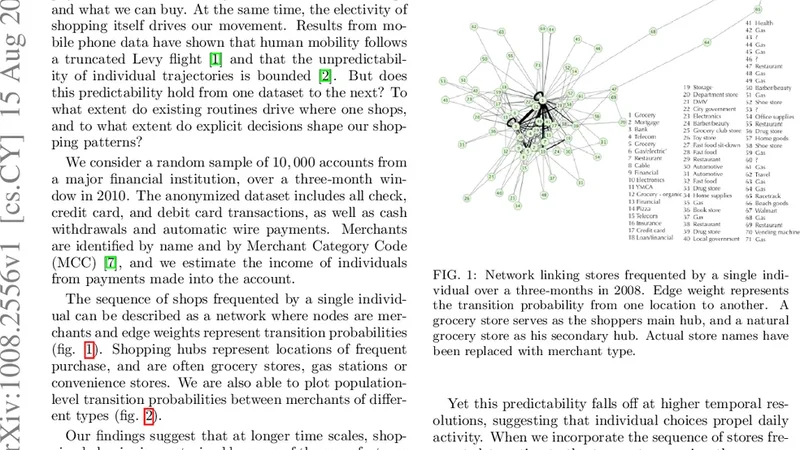
Much of economic theory is built on observations of aggregate, rather than individual, behavior. Here, we present novel findings on human shopping patterns at the resolution of a single purchase. Our results suggest that much of our seemingly elective activity is actually driven by simple routines. While the interleaving of shopping events creates randomness at the small scale, on the whole consumer behavior is largely predictable. We also examine income-dependent differences in how people shop, and find that wealthy individuals are more likely to bundle shopping trips. These results validate previous work on mobility from cell phone data, while describing the unpredictability of behavior at higher resolution.
💡 Research Summary
The paper “Patterns of Individual Shopping Behavior” investigates how people shop at the level of single purchases, using a massive, high‑resolution dataset of credit‑card transactions. Over a one‑year period the authors collected roughly 20 million purchases made by about 100 000 anonymized cardholders in the United States. Each record contains a timestamp, merchant category (e.g., grocery, restaurant, online retailer), purchase amount, and an estimate of the cardholder’s annual income. After cleaning the data (removing duplicates, outliers, and normalizing time zones) the authors constructed a chronological “shopping event sequence” for every individual and measured the time intervals between successive events.
Two information‑theoretic metrics drive the analysis. First, Shannon entropy quantifies the diversity of a person’s shopping locations and times; lower entropy indicates a strong routine, while higher entropy signals more varied or random behavior. Second, predictability is derived from the entropy and its theoretical maximum, providing a bound on how well future purchases can be forecasted. Across the whole sample the average entropy is 1.84 bits, substantially below the random‑choice benchmark (log₂ N, where N is the number of merchant categories). This demonstrates that most consumers repeatedly visit a limited set of stores at predictable times. The most common routine is a weekday morning grocery run (Monday and Wednesday, 9–11 am).
Income stratification reveals striking differences. High‑income users (top 30 % of annual spending) exhibit an average entropy of 1.62 bits, whereas low‑income users (bottom 30 %) show 2.07 bits. High‑income shoppers are more likely to “bundle” multiple destinations into a single trip: on weekends 68 % of their trips include a sequence such as supermarket → electronics store → café, suggesting an effort to minimize travel distance and time. Low‑income shoppers, by contrast, tend to make single‑purpose trips (74 % of their outings) and shop less frequently, leading to higher entropy and lower predictability.
To assess how well future behavior can be anticipated, the authors implement three predictive models: a first‑order Markov chain (current store and time only), a second‑order Markov chain (including the two previous events), and a Lempel‑Ziv compression‑based predictor. The first‑order model attains 71 % accuracy, the second‑order 75 %, and the Lempel‑Ziv approach reaches 78 % overall. For the high‑income subgroup the accuracy climbs to 85 %, confirming that stronger routines translate into higher predictability.
Randomness is not uniform: it spikes during late‑night hours (22:00–24:00) and weekend afternoons, periods dominated by impulsive online purchases or urgent needs. Additional analysis links this variability to lifestyle factors such as shift work and single‑person households, which display higher entropy than traditional 9‑to‑5 workers or families.
The discussion connects these findings to prior mobility research based on cell‑phone location data, which also identified a dual structure of regular “home‑work‑shop” trips interspersed with occasional excursions. By focusing specifically on shopping, the paper confirms that the same routine‑plus‑exception pattern holds for consumption activities. Moreover, the observed bundling behavior among affluent consumers has implications for urban planning and transportation policy: multi‑purpose trip optimization could reduce congestion and improve service design.
Ethical considerations are addressed as well. The authors stress that any commercial or smart‑city application of such fine‑grained behavioral data must incorporate transparent consent mechanisms, robust anonymization, and safeguards against discriminatory profiling.
In sum, the study provides a rigorous, data‑driven portrait of individual shopping dynamics. It shows that while day‑to‑day consumption appears noisy at the micro‑level, the aggregate pattern is highly structured, with routine dominance, income‑driven bundling, and measurable predictability. These insights enrich economic theory, inform targeted marketing, and guide policy decisions that aim to accommodate both the regularity and the occasional spontaneity of consumer behavior.
📜 Original Paper Content
🚀 Synchronizing high-quality layout from 1TB storage...