Nonsingular Efficient Modeling of Rotations in 3-space using three components
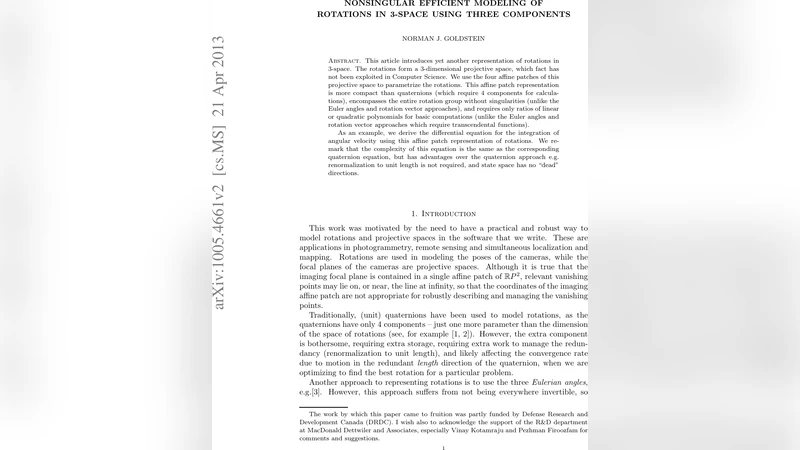
This article introduces yet another representation of rotations in 3-space. The rotations form a 3-dimensional projective space, which fact has not been exploited in Computer Science. We use the four affine patches of this projective space to parametrize the rotations. This affine patch representation is more compact than quaternions (which require 4 components for calculations), encompasses the entire rotation group without singularities (unlike the Euler angles and rotation vector approaches), and requires only ratios of linear or quadratic polynomials for basic computations (unlike the Euler angles and rotation vector approaches which require transcendental functions). As an example, we derive the differential equation for the integration of angular velocity using this affine patch representation of rotations. We remark that the complexity of this equation is the same as the corresponding quaternion equation, but has advantages over the quaternion approach e.g. renormalization to unit length is not required, and state space has no dead directions.
💡 Research Summary
The paper revisits the fundamental geometry of three‑dimensional rotations and proposes a representation that uses only three real parameters while avoiding the singularities and normalization steps that plague traditional methods. The key observation is that the rotation group SO(3) is diffeomorphic to the three‑dimensional real projective space RP³. RP³ can be covered by four affine patches, each obtained by fixing one homogeneous coordinate of a unit quaternion to 1 and treating the remaining three coordinates as free variables. By selecting any patch in which the fixed coordinate is non‑zero, a rotation can be encoded by a three‑component vector v = (x, y, z)ᵀ.
Within a chosen patch the rotation matrix R is expressed as a rational function of v:
R = 1/(1+‖v‖²)
Comments & Academic Discussion
Loading comments...
Leave a Comment