On the Generalized Hermite-Based Lattice Boltzmann Construction, Lattice Sets, Weights, Moments, Distribution Functions and High-Order Models
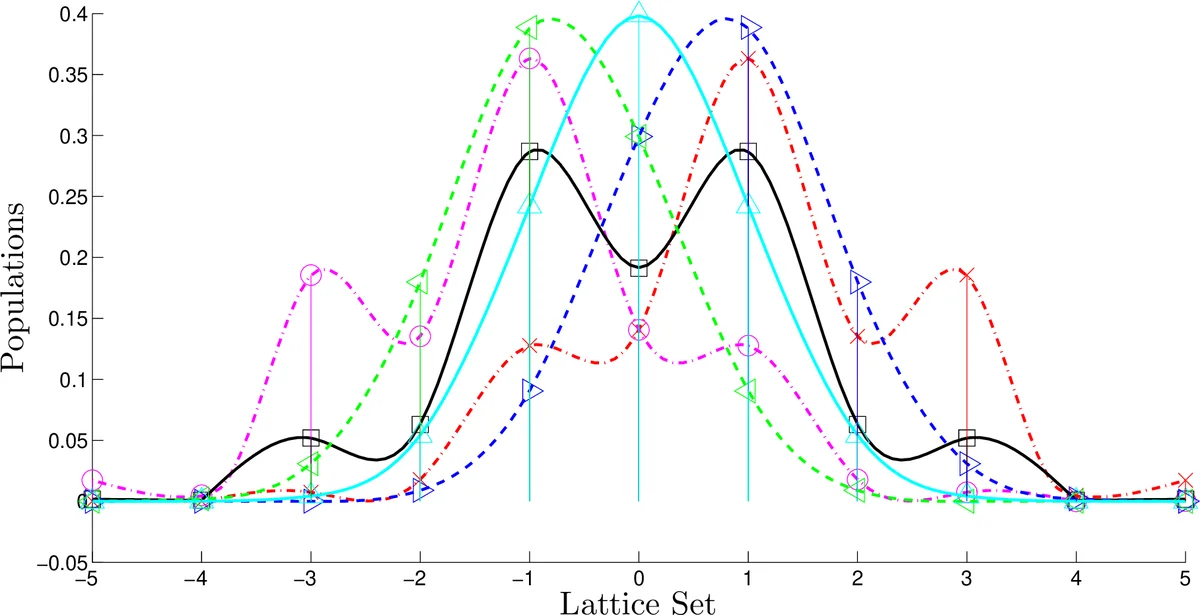
The influence of the use of the generalized Hermite polynomial on the Hermite-based lattice Boltzmann (LB) construction approach, lattice sets, the thermal weights, moments and the equilibrium distribution function (EDF) are addressed. A new moment system is proposed. The theoretical possibility to obtain a high-order Hermite-based LB model capable to exactly match some first hydrodynamic moments thermally 1) on-Cartesian lattice, 2) with thermal weights in the EDF, 3) whilst the highest possible hydrodynamic moments that are exactly matched are obtained with the shortest on-Cartesian lattice sets with some fixed real-valued temperatures, is also analyzed. Keywords: Lattice Boltzmann, fluid dynamics, kinetic theory, distribution function
💡 Research Summary
The paper investigates how the use of generalized Hermite polynomials, characterized by a continuous parameter μ, influences the construction of Hermite‑based lattice Boltzmann (LB) models, the choice of lattice sets, the thermal weights, the moment system, and the equilibrium distribution function (EDF). Traditional LB schemes rely on the classical Hermite expansion of the Maxwell‑Boltzmann (MB) distribution, which limits them to isothermal or low‑order thermal models. When higher‑order moments are required, existing approaches often resort to off‑Cartesian velocity sets, additional finite‑difference correction terms, or entropic formulations that compromise the core LB principle of exact locality and simplicity.
The authors introduce the generalized Hermite polynomials H⁽μ⁾ₙ(x) originally defined by Szegő, which are built from generalized Laguerre polynomials and Whittaker‑M functions. By defining a generalized exponential e_μ(x) = (2x)^{−½−μ} W_{−½, μ}(2x), they obtain a generating function that reduces to the classical exponential when μ = 0. Consequently, the moment hierarchy derived from e_μ(x) becomes a μ‑dependent extension of the MB moments, allowing the temperature θ and flow velocity u to appear in a more flexible, nonlinear fashion.
A central contribution is the derivation of thermal weights that together with the discrete velocities form a generalized Hermite quadrature. Equation (9)–(12) provide a set of n_q + 1 algebraic constraints linking the weights W_i, the lattice velocities c_i, the temperature θ, and the parameter μ. For a one‑dimensional D1Q_nq model the authors obtain closed‑form expressions (11a, 11b) that explicitly show how each weight depends on θ and μ, and how the symmetry parameter z = (n_q − 1)/2 governs the maximal absolute velocity in the set. The formulation is readily extensible to two‑ and three‑dimensional lattices by taking tensor products of the one‑dimensional weights.
The paper then addresses a fundamental question: can a high‑order Hermite‑based LB model be constructed that (i) operates on a Cartesian lattice (i.e., all c_i are integers), (ii) uses thermal weights directly in the EDF, and (iii) matches the first (z + 1) hydrodynamic moments exactly while employing the shortest possible lattice set? By analysing the moment matching conditions, the authors demonstrate that for a given order z the minimal on‑Cartesian set {0, ±1, …, ±z} (e.g., D1Q5 with {0, ±1, ±2}) can indeed satisfy the moment constraints provided that μ is chosen away from the singular values μ = ½ − n (n ∈ ℕ). This result eliminates the need for off‑Cartesian velocities or ad‑hoc interpolation schemes, thereby preserving the locality and parallel efficiency that are hallmarks of LB methods.
A noteworthy practical implication concerns boundary treatment. Because the EDF is written as f_i^{eq}=ρ W_i
Comments & Academic Discussion
Loading comments...
Leave a Comment