Operator algebra of foliations with projectively invariant transverse measure
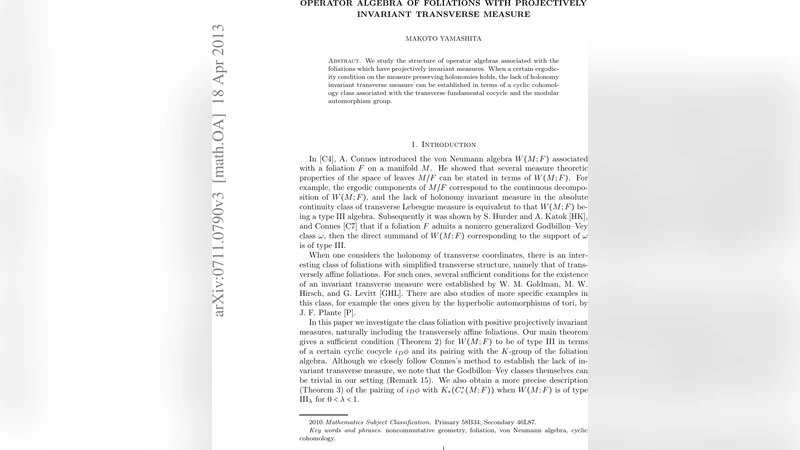
We study the structure of operator algebras associated with the foliations which have projectively invariant measures. When a certain ergodicity condition on the measure preserving holonomies holds, the lack of holonomy invariant transverse measure can be established in terms of a cyclic cohomology class associated with the transverse fundamental cocycle and the modular automorphism group.
💡 Research Summary
The paper investigates the operator‑algebraic structure associated with foliations that admit a projectively invariant transverse measure. A transverse measure μ is called projectively invariant if, for each holonomy transformation γ, the push‑forward satisfies γ∗μ = c(γ)·μ where c(γ) is a positive scalar. The function c:Hol(𝔽)→ℝ₊ is a group homomorphism and plays the role of a modular function. The authors begin by formalising this notion and by emphasizing that, unlike a genuinely invariant transverse measure, a projectively invariant one does not give rise to a trace on the leafwise C∗‑algebra.
Next, they construct the leafwise C∗‑algebra C∗(M,𝔽) and its von Neumann envelope W∗(M,𝔽). Because μ is only projectively invariant, these algebras carry a natural one‑parameter modular automorphism group σt determined by the modular function c. This situation is precisely the setting of Tomita‑Takesaki theory: the modular flow σt encodes the failure of μ to be invariant.
The central technical device is the transverse fundamental cocycle τ0, an n‑dimensional cyclic cocycle on C∗(M,𝔽) that encodes the transverse geometry of the foliation. By coupling τ0 with the modular flow, the authors produce a higher‑dimensional cyclic cocycle τ, representing a class
Comments & Academic Discussion
Loading comments...
Leave a Comment