Fast simulation method for parameter reconstruction in optical metrology
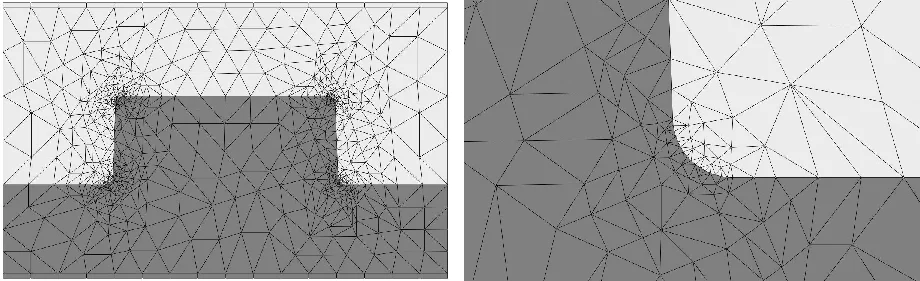
A method for automatic computation of parameter derivatives of numerically computed light scattering signals is demonstrated. The finite-element based method is validated in a numerical convergence study, and it is applied to investigate the sensitivity of a scatterometric setup with respect to geometrical parameters of the scattering target. The method can significantly improve numerical performance of design optimization, parameter reconstruction, sensitivity analysis, and other applications.
💡 Research Summary
The paper presents a fast and accurate computational approach for optical metrology, focusing on the automatic evaluation of parameter derivatives of light‑scattering signals obtained from rigorous finite‑element method (FEM) simulations. Starting from the frequency‑domain Maxwell equations, the authors formulate a weak problem that leads to a sparse linear system A Eₕ = f, where A is the FEM stiffness matrix and f contains the source terms. By factorizing A once (using a direct LU decomposition) they obtain the inverse A⁻¹, which can be reused for any number of incident fields (different polarizations, wavelengths, angles) without recomputing the factorization.
The key theoretical contribution is the derivation of analytical expressions for the sensitivity of the computed field with respect to any geometric or material parameter pᵢ:
∂_{pᵢ}Eₕ = A⁻¹
Comments & Academic Discussion
Loading comments...
Leave a Comment