Replacement of fixed sets for compact group actions: The 2rho theorem
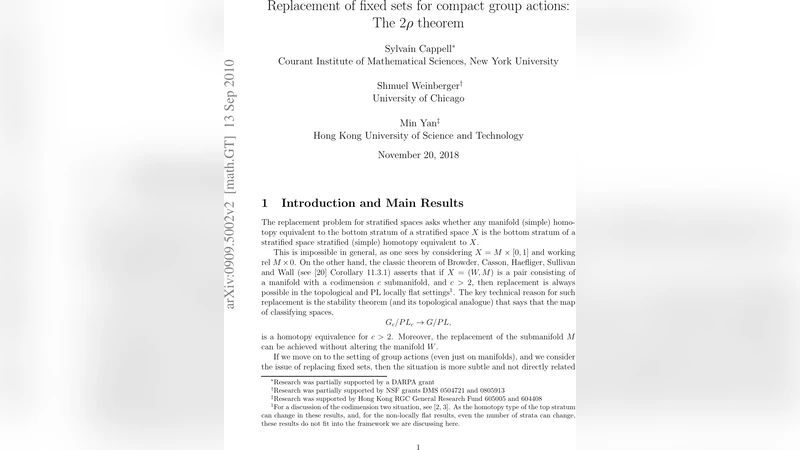
If M and N are equivariantly homotopy equivalent G-manifolds, then the fixed sets M^G and N^G are also homotopy equivalent. The replacement problem asks the converse question: If F is homotopy equivalent to the fixed set M^G, is F = N^G for a G-manifold equivariantly homotopy equivalent to M? We prove that for locally linear actions on topological or PL manifolds by compact Lie groups, the replacement is always possible if the normal bundle of the fixed set is twice of a complex bundle over a 1-skeleton of the fixed set. Moreover, we also study some specific examples, where the answer to the replacement problem ranges from always possible to the rigidity.
💡 Research Summary
The paper addresses the “fixed‑set replacement problem” for actions of compact Lie groups on topological or PL manifolds. Given two G‑manifolds M and N that are equivariantly homotopy equivalent, their fixed sets M^G and N^G are automatically homotopy equivalent. The converse question asks: if a space F is homotopy equivalent to the fixed set of M, can one find a G‑manifold N, equivariantly homotopy equivalent to M, whose fixed set is exactly F? The authors provide a comprehensive answer under a geometric condition on the normal bundle of the fixed set.
The central result, called the “2ρ theorem,” states that if the normal bundle ν of the fixed set M^G is isomorphic to twice a complex bundle ξ (i.e., ν ≅ 2ξ) over the 1‑skeleton of M^G, then such a replacement is always possible. The hypothesis is natural for locally linear actions: near each fixed point the representation splits as a trivial part plus a complex representation, and the complex part yields a complex bundle whose double gives the normal bundle. Because the condition only needs to hold over the 1‑skeleton, it is automatically satisfied for fixed sets of dimension ≤1, making the theorem particularly powerful in low‑dimensional situations.
The proof proceeds in several stages. First, the authors replace the original normal bundle by the prescribed complex double using PL surgery and virtual bundle techniques. This replacement is performed cell‑by‑cell, inserting a unit disk bundle of ξ into each handle of the fixed set. Second, they construct a G‑invariant tubular neighbourhood of the fixed set that is modeled on the representation V = V^G ⊕ V^⊥, where V^⊥ carries the complex structure coming from ξ. The neighbourhood therefore looks like D^{2k} × D^{n‑2k}, with the first factor a complex disk bundle. Third, they glue this modified neighbourhood back into the original manifold, using Mayer–Vietoris arguments to ensure that the resulting space N inherits a locally linear G‑action and remains equivariantly homotopy equivalent to M. By construction, the fixed set of N is precisely the prescribed space F.
The paper also explores a spectrum of examples that illustrate both the flexibility granted by the 2ρ condition and the rigidity that appears when it fails. For circle actions (G = S^1) on 4‑manifolds with a 2‑dimensional fixed surface, the normal bundle often cannot be expressed as twice a complex line bundle; in these cases the replacement problem is obstructed, demonstrating rigidity. In contrast, for finite cyclic groups Z/p the complexification of the normal bundle is always possible, so the replacement is universally achievable. The authors further discuss higher‑dimensional scenarios where the normal bundle may admit a spin structure but no complex structure; here the 2ρ hypothesis is violated and the fixed set cannot be altered without changing the equivariant homotopy type.
Additional corollaries include: (1) any fixed set of dimension ≤1 automatically satisfies the 2ρ condition; (2) the theorem holds equally in the purely topological category and in the PL category, showing that the result does not depend on a specific smooth structure; (3) the equivariant homotopy class of the original G‑manifold is preserved under replacement, confirming that the operation is a genuine “fixed‑set surgery” rather than a change of overall homotopy type.
In summary, the authors prove that for locally linear actions of compact Lie groups, the existence of a complex bundle whose double equals the normal bundle of the fixed set (the 2ρ condition) guarantees that any space homotopy equivalent to the fixed set can be realized as the fixed set of an equivariantly homotopy equivalent G‑manifold. The paper delineates the boundary between flexible replacement and rigidity, providing concrete examples and a clear set of criteria that can be applied in future studies of equivariant topology, transformation groups, and surgery theory.
Comments & Academic Discussion
Loading comments...
Leave a Comment