Monomial Testing and Applications
In this paper, we devise two algorithms for the problem of testing $q$-monomials of degree $k$ in any multivariate polynomial represented by a circuit, regardless of the primality of $q$. One is an $O^(2^k)$ time randomized algorithm. The other is an $O^(12.8^k)$ time deterministic algorithm for the same $q$-monomial testing problem but requiring the polynomials to be represented by tree-like circuits. Several applications of $q$-monomial testing are also given, including a deterministic $O^*(12.8^{mk})$ upper bound for the $m$-set $k$-packing problem.
💡 Research Summary
The paper addresses the fundamental problem of detecting a q‑monomial of degree k in a multivariate polynomial that is given by an arithmetic circuit. A q‑monomial is a monomial in which each variable’s exponent lies between 1 and q‑1; when q = 2 this coincides with a multilinear monomial. Prior work on monomial testing relied on the fact that Z_q is a field, which holds only for prime q, and therefore could not handle composite moduli. The authors overcome this limitation by introducing a two‑stage transformation that reduces q‑monomial detection to multilinear monomial detection, a problem for which powerful algebraic techniques already exist.
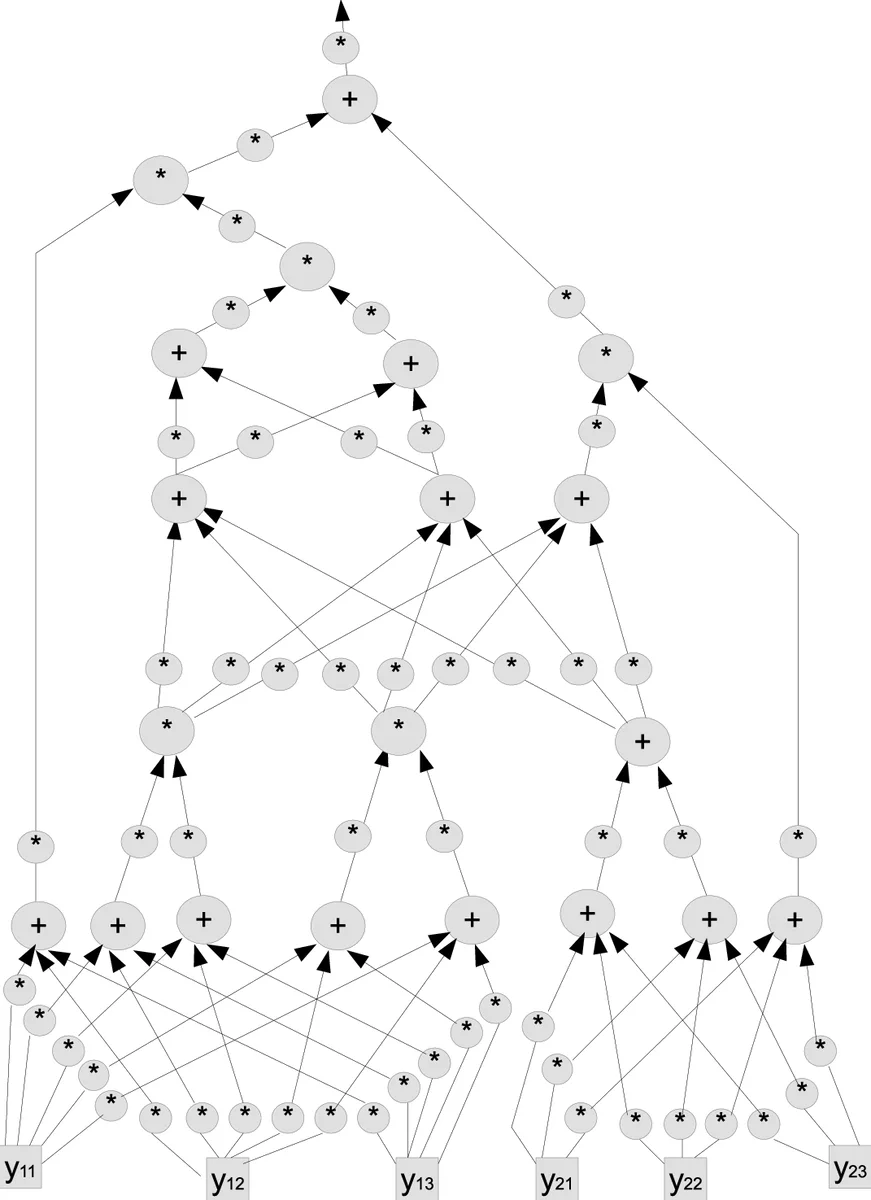
The first stage is a circuit reconstruction. Starting from the original circuit C (with +‑gates of unbounded fan‑in and ×‑gates of fan‑in 2), each +‑gate and each terminal node is duplicated so that every outgoing edge has its own copy. Then, for every edge a new ×‑gate is inserted that multiplies the signal by a fresh auxiliary variable z_i. The resulting circuit C′ computes the same polynomial as C, but every computation path now carries a unique product of z‑variables. If the original polynomial contains a monomial π of degree k, then C′ contains a term α·π where α is a multilinear monomial in the z‑variables of degree at most t·k+1 (t is the length of the longest root‑to‑leaf path in C).
The second stage replaces each original variable x_i by a weighted linear combination of q‑1 fresh variables y_{i1},…,y_{i(q‑1)}. Concretely, x_i is substituted by Σ_{j=1}^{q‑1} y_{ij}·z_{ij}, where each new z_{ij} is again an auxiliary variable attached to a newly introduced ×‑gate. After this substitution the circuit becomes C″, which computes a polynomial G(z, y). The crucial property proved is that G contains a multilinear monomial in the y‑variables (of degree k) if and only if the original polynomial contains a q‑monomial of degree k. Moreover, the coefficient of that y‑monomial is itself a multilinear monomial in the z‑variables, and if the original polynomial has no q‑monomials then G contains no multilinear y‑monomial at all.
With this reduction in hand, the authors apply two different algebraic testing frameworks. The randomized algorithm follows the group‑algebra method of Koutis and Williams: the y‑variables are assigned independent random 0/1 values, while each z‑variable is mapped to a random vector in Z_2^k. The evaluation of G under this random assignment yields a non‑zero value with probability at least 1/2 whenever a multilinear y‑monomial exists, which translates to the existence of a q‑monomial. The total running time is O*(2^k), i.e., polynomial in the circuit size multiplied by 2^k, improving upon the previous best O*(7.15^k) for tree‑like circuits and extending the result to arbitrary circuits.
The deterministic algorithm derandomizes the above process. It replaces the random hash functions used for the z‑variables with a family of perfect hash functions (as constructed by Chen et al.) that exhaustively enumerate all possible assignments of the z‑variables in a structured way. The detection of a multilinear y‑monomial is then performed using the Raz‑Shpilka deterministic polynomial identity testing algorithm for non‑commutative circuits. Because the analysis relies on the fact that each gate’s fan‑out is at most one, the method applies to tree‑like circuits and achieves a running time of O*(12.8^k). This is a substantial improvement over earlier deterministic bounds (which were roughly O*(c^k) for c≈20).
The paper further demonstrates the utility of these algorithms through several applications. First, it shows how the q‑monomial framework can be used to test for non‑simple k‑paths in graphs, reproducing the known O*(2^k) randomized bound. Second, it tackles the generalized m‑set k‑packing problem by encoding each set as a variable and looking for a q‑monomial that corresponds to a packing of size k; applying the deterministic O*(12.8^k) algorithm yields an overall deterministic bound of O*(12.8^{mk}), which the authors claim is the best known deterministic bound for this problem. Third, the technique is adapted to the P₂‑packing problem, again obtaining improved deterministic runtimes.
In summary, the paper makes three major contributions: (1) it provides a unified reduction from q‑monomial testing (for any integer q≥2) to multilinear monomial testing; (2) it delivers a randomized O*(2^k) algorithm for general circuits and a deterministic O*(12.8^k) algorithm for tree‑like circuits; (3) it leverages these algorithms to obtain improved deterministic upper bounds for several classic combinatorial problems, most notably the m‑set k‑packing problem. The work not only broadens the theoretical understanding of monomial testing beyond prime moduli but also offers practical algorithmic tools that could be extended to other algebraic settings.
Comments & Academic Discussion
Loading comments...
Leave a Comment