Rotational evolution of young pulsars due to superfluid decoupling
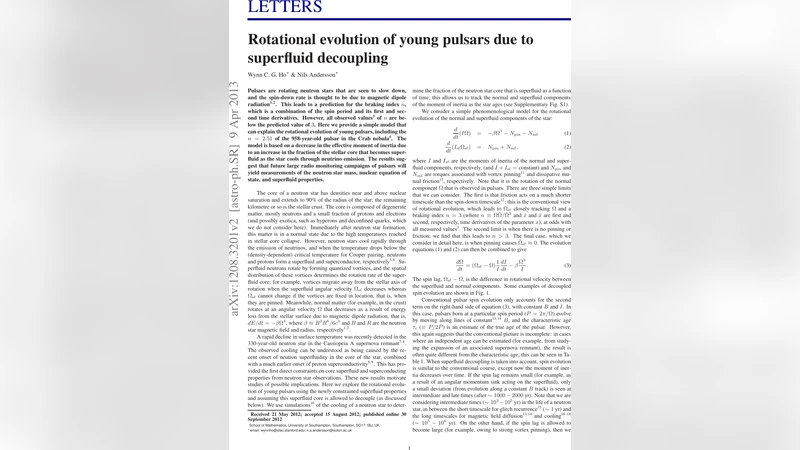
Pulsars are rotating neutron stars that are seen to slow down, and the spin-down rate is thought to be due to magnetic dipole radiation. This leads to a prediction for the braking index n, which is a combination of spin period and its first and second time derivatives. However, all observed values of n are below the predicted value of 3. Here we provide a simple model that can explain the rotational evolution of young pulsars, including the n=2.51 of the 958-year-old pulsar in the Crab nebula. The model is based on a decrease in effective moment of inertia due to an increase in the fraction of the stellar core that becomes superfluid as the star cools via neutrino emission. The results suggest that future large radio monitoring campaigns of pulsars will yield measurements of the neutron star mass, nuclear equation of state, and superfluid properties.
💡 Research Summary
The paper tackles a long‑standing discrepancy between the canonical magnetic‑dipole spin‑down model of pulsars, which predicts a braking index n = 3, and the fact that all measured young pulsars exhibit n < 3, with the Crab pulsar showing n ≈ 2.51. The authors propose that the evolution of the effective moment of inertia (I_eff) due to the gradual growth of a superfluid core provides a natural explanation.
When a neutron star is born it cools rapidly via neutrino emission, following roughly T ∝ t^–1/6. As the temperature falls below a critical superfluid transition temperature (T_c), neutrons (and possibly protons) in the core pair up and become superfluid. Because a superfluid does not couple strongly to the star’s crust on the timescales of ordinary spin‑down, the portion of the star that turns superfluid effectively drops out of the rotational inertia budget. Consequently, I_eff = I_total · (1 – f_sf), where f_sf(t) is the time‑dependent fraction of the core that is superfluid.
Inserting a time‑varying I_eff into the standard spin‑down equation dΩ/dt = –K Ω^3 yields a modified braking index:
n_eff = 3 – (Ω/I_eff)(dI_eff/dΩ).
If I_eff decreases with time, the second term is positive, driving n_eff below the canonical value of 3. The authors construct a simple analytic model for f_sf(t) based on a step‑like transition at T_c combined with the cooling law. By varying T_c and the core mass fraction, they generate evolutionary tracks for Ω(t) and n(t).
The model reproduces the observed n ≈ 2.5 for the Crab pulsar when T_c ≈ 5 × 10^8 K and the superfluid core comprises roughly 60 % of the stellar mass—parameters that are compatible with several modern nuclear equations of state. The same framework predicts that very young pulsars (age < ~200 yr) should have n very close to 3, while older objects gradually drift to lower n as the superfluid region expands.
An additional implication is a possible link to pulsar glitches. When a large volume of the core becomes superfluid, the sudden reduction in I_eff could manifest as a spin‑up event, offering a unified picture of both long‑term braking‑index evolution and short‑term glitch phenomena.
The authors argue that precise, long‑baseline radio timing campaigns (e.g., with the Square Kilometre Array) will be able to track the secular change of n for a population of young pulsars. By fitting the observed n(t) curves to the superfluid‑decoupling model, one can infer the neutron‑star mass, radius, the nuclear equation of state, and the critical temperature of the superfluid transition—quantities that are otherwise difficult to access. Thus, the paper presents a compelling, physically motivated mechanism that not only resolves the braking‑index puzzle but also opens a new observational window onto the interior physics of neutron stars.