Automatic Ordinals
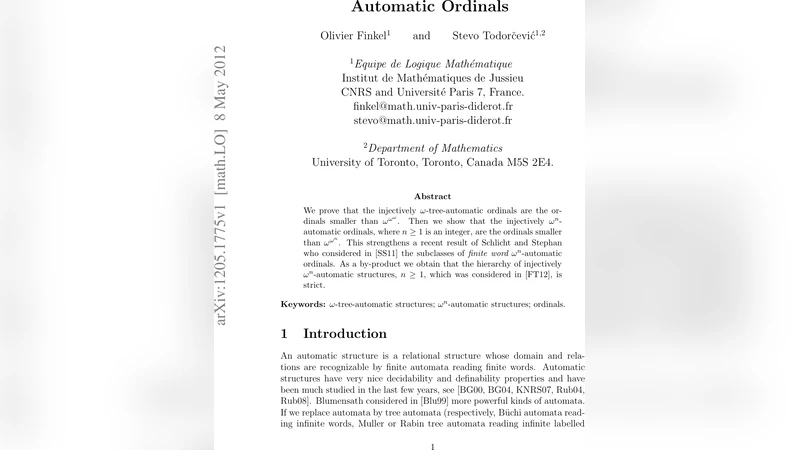
We prove that the injectively omega-tree-automatic ordinals are the ordinals smaller than $\omega^{\omega^\omega}$. Then we show that the injectively $\omega^n$-automatic ordinals, where $n>0$ is an integer, are the ordinals smaller than $\omega^{\omega^n}$. This strengthens a recent result of Schlicht and Stephan who considered in [Schlicht-Stephan11] the subclasses of finite word $\omega^n$-automatic ordinals. As a by-product we obtain that the hierarchy of injectively $\omega^n$-automatic structures, n>0, which was considered in [Finkel-Todorcevic12], is strict.
💡 Research Summary
The paper investigates the expressive power of injective automatic presentations of well‑ordered sets, focusing on two families of structures: ω‑tree‑automatic and ωⁿ‑automatic (for any positive integer n). An automatic structure is one whose domain and relations can be recognized by finite automata; in the ω‑tree‑automatic case the automata operate on infinite binary trees (Büchi tree automata), while ωⁿ‑automatic structures are defined via automata reading words of length ωⁿ. The “injective” requirement means that each element of the structure is represented by a unique word or tree, which simplifies many decidability arguments and allows a precise correspondence between the size of the automaton’s state space and the complexity of the represented order.
The first main theorem establishes that the class of injective ω‑tree‑automatic ordinals coincides exactly with the ordinals below ω^{ω^ω}. The proof proceeds in two directions. For the upper bound, the authors develop a pumping lemma for Büchi tree automata that shows any ω‑tree‑automatic presentation must repeat states along sufficiently deep branches. If an ordinal α ≥ ω^{ω^ω} were presented, its Cantor normal form would contain an exponent at least ω^ω, forcing the automaton to require more distinct states than any finite automaton can provide, leading to a contradiction. For the lower bound, they construct, for every α < ω^{ω^ω}, a systematic coding of α into a binary tree where each level encodes a term of the Cantor expansion. By assigning a distinct automaton state to each exponent level and using the injective mapping, they obtain an ω‑tree‑automatic presentation of α.
The second theorem generalizes this result to the hierarchy of injective ωⁿ‑automatic ordinals. It shows that for any integer n > 0, the ordinals that admit an injective ωⁿ‑automatic presentation are precisely those below ω^{ωⁿ}. The argument is inductive on n. The base case n = 1 (injective ω‑automatic ordinals) is already known to be bounded by ω^{ω}. Assuming the claim for n‑1, the authors simulate an ω^{n‑1}‑automatic presentation inside an ω‑tree‑automatic one, then add an extra “ω‑layer” to encode the additional exponent. This construction respects injectivity by allocating disjoint state sets to each layer and preserving the regularity of the encoding. Consequently, any ordinal < ω^{ωⁿ} can be represented, while any ordinal ≥ ω^{ωⁿ} would require an exponent of size at least ωⁿ, which cannot be captured by a finite‑state ωⁿ‑automaton.
Together, these two results settle the exact ordinal bounds for injective automatic presentations in both the tree‑based and word‑based settings. As a corollary, the hierarchy of injective ωⁿ‑automatic structures (n > 0) is strict: increasing n strictly enlarges the class of ordinals (and hence structures) that can be presented. This answers an open question left by Finkel and Todorcevic (2012) concerning the strictness of the ωⁿ‑automatic hierarchy.
The paper also discusses the relationship with non‑injective automatic presentations. While non‑injective presentations can sometimes encode larger ordinals, they lose the clean correspondence between automaton size and order complexity, making decidability results more fragile. Injectivity thus provides a robust framework for analyzing the limits of automaticity.
Finally, the authors point out potential applications. Knowing the exact ordinal bound for a given automatic presentation informs the design of model‑checking algorithms for infinite‑state systems, especially those that can be modeled as well‑ordered structures (e.g., priority queues, termination proofs). The strict hierarchy suggests that higher‑order automatic presentations may be required for systems whose state spaces grow beyond ω^{ωⁿ} for any fixed n, motivating further research into more powerful automata models such as ω^{ω}‑tree automata or higher‑dimensional automatic structures.
Comments & Academic Discussion
Loading comments...
Leave a Comment