Optimization of Neutrino Oscillation Parameters using Differential Evolution
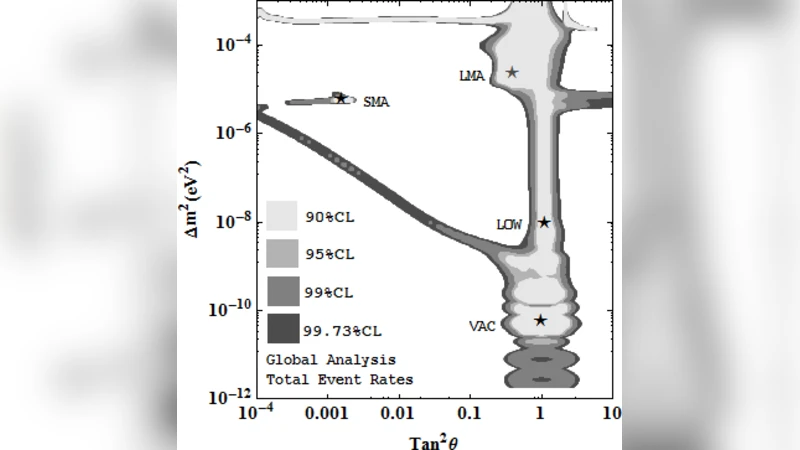
We combine Differential Evolution, a new technique, with the traditional grid based method for optimization of solar neutrino oscillation parameters $\Delta m^2$ and $\tan^{2}\theta$ for the case of two neutrinos. The Differential Evolution is a population based stochastic algorithm for optimization of real valued non-linear non-differentiable objective functions that has become very popular during the last decade. We calculate well known chi-square ($\chi^2$) function for neutrino oscillations for a grid of the parameters using total event rates of chlorine (Homestake), Gallax+GNO, SAGE, Superkamiokande and SNO detectors and theoretically calculated event rates. We find minimum $\chi^2$ values in different regions of the parameter space. We explore regions around these minima using Differential Evolution for the fine tuning of the parameters allowing even those values of the parameters which do not lie on any grid. We note as much as 4 times decrease in $\chi^2$ value in the SMA region and even better goodness-of-fit as compared to our grid-based results. All this indicates a way out of the impasse faced due to CPU limitations of the larger grid method.
💡 Research Summary
The paper presents a hybrid optimization strategy that combines a traditional grid‑search with the Differential Evolution (DE) algorithm to determine the solar neutrino oscillation parameters Δm² and tan²θ in a two‑flavor framework. First, the authors construct a 101 × 101 logarithmic grid covering the full phenomenologically relevant ranges (Δm² ≈ 10⁻¹³–10⁻³ eV², tan²θ ≈ 10⁻⁴–10). For each grid point they compute a χ² statistic that quantifies the deviation between theoretical event rates (derived from the Standard Solar Model BS05(OP) and oscillation probabilities) and the measured total rates from six experiments: Homestake (Cl), Gallium+GNO, SAGE, Super‑Kamiokande, and SNO (charged‑current and neutral‑current). The χ² incorporates both experimental (statistical and systematic) and theoretical uncertainties via a full error matrix.
The grid analysis reproduces the four classic solution regions—Large Mixing Angle (LMA), Small Mixing Angle (SMA), LOW, and Vacuum (VAC)—with the global minimum located in the LMA region (Δm² ≈ 2.5 × 10⁻⁵ eV², tan²θ ≈ 0.398), consistent with previous global fits that include SNO data. However, the authors acknowledge that a finite grid resolution limits the ability to explore the parameter space finely, especially near the minima, and that increasing the grid density would be computationally prohibitive.
To overcome this limitation, the authors apply Differential Evolution, a population‑based stochastic optimizer well suited for non‑linear, non‑differentiable objective functions. They initialize a population of 20 candidate vectors (each vector containing the two parameters) randomly within the bounds of each solution region. The mutation strategy employed is DE/best/2/bin, where the current best individual is perturbed by a weighted sum of two difference vectors (scale factor F). Crossover is performed with probability Cr, and selection retains the trial vector only if it yields a lower χ². The algorithm is iterated for 10–50 generations, effectively performing a continuous local search around the grid minima.
The DE refinement yields a substantial reduction in χ² values, most dramatically in the SMA region where χ² drops from ≈ 7.78 (grid) to ≈ 1.27 after DE—a factor of four improvement. In the LMA region the χ² reduction is modest (0.808 → 0.804), but the corresponding goodness‑of‑fit (g.o.f.) improves from 93.77 % to over 94 %. Similar modest gains are observed in the LOW and VAC regions. Importantly, DE allows the parameters to take values off the discrete grid, uncovering better fits that would be missed by a coarse grid alone.
The authors conclude that DE provides an efficient and robust means to fine‑tune neutrino oscillation parameters without the need for an excessively dense grid, thereby alleviating CPU constraints that have traditionally limited global analyses. They suggest that the method can be readily extended to more complex scenarios, such as three‑flavor oscillations or analyses that include spectral and time‑dependent data, where the dimensionality of the parameter space and the computational burden are even greater. The study demonstrates that stochastic evolutionary algorithms can complement classical techniques, delivering higher precision in parameter estimation for neutrino physics.
Comments & Academic Discussion
Loading comments...
Leave a Comment