The number of Huffman codes, compact trees, and sums of unit fractions
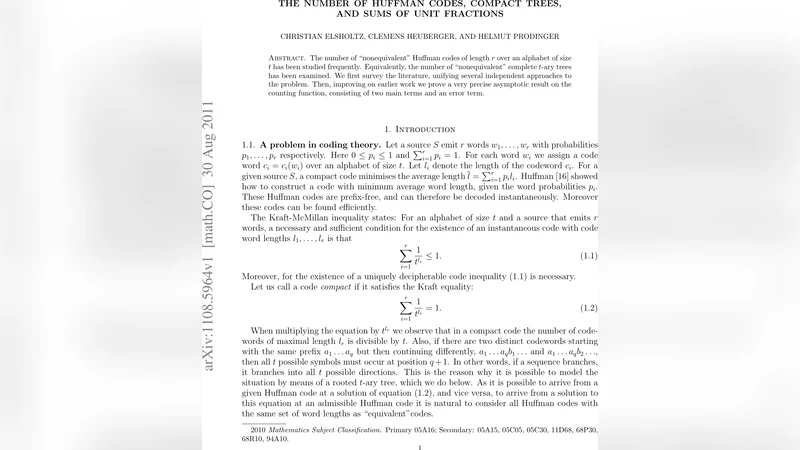
The number of “nonequivalent” Huffman codes of length r over an alphabet of size t has been studied frequently. Equivalently, the number of “nonequivalent” complete t-ary trees has been examined. We first survey the literature, unifying several independent approaches to the problem. Then, improving on earlier work we prove a very precise asymptotic result on the counting function, consisting of two main terms and an error term.
💡 Research Summary
The paper investigates the enumeration of “nonequivalent” Huffman codes of length r over an alphabet of size t, which is equivalently the counting of complete t‑ary rooted trees (often called compact trees). The authors first present a unifying framework that brings together several disparate definitions found in the literature. Four equivalent formulations are described:
- A number‑theoretic definition based on the Kraft‑McMillan equality written as a sum of unit fractions: find non‑negative integers x₁ ≤ … ≤ x_r such that Σ_{i=1}^r 1/t^{x_i}=1.
- “Huffman sequences” where a_i denotes the number of codewords of length i, and the weighted sum Σ a_i/t^i equals 1.
- Canonical rooted t‑ary trees, where a_i is the number of leaves at depth i; the tree must be full (every internal node has exactly t children) and satisfy Σ a_i/t^i=1.
- Bounded‑degree sequences (b_i) describing the number of internal nodes at each level, obeying b_i ≤ t·b_{i‑1} and a linear relation linking leaves and internal nodes.
The paper proves that all four viewpoints count the same combinatorial objects, establishing a solid foundation for further analysis.
The literature review summarizes earlier asymptotic results: Boyd (1975), Komlós‑Moser‑Nemetz (1984), and Flajolet‑Prodinger (1987) gave leading‑order estimates for the binary case (t=2) of the form f_2(r)≈R·ρ^r with constants R≈0.14185 and ρ≈1.794147. For general t, only coarse bounds were known, typically of the form f_t(r)≈K_t·ρ_t^n where r=1+n(t‑1) and ρ_t→2 as t grows.
The main contribution is a refined asymptotic expansion that includes two dominant terms and an exponentially smaller error term: \
Comments & Academic Discussion
Loading comments...
Leave a Comment