K-theory, Cyclic Cohomology and Pairings for Quantum Heisenberg Manifolds
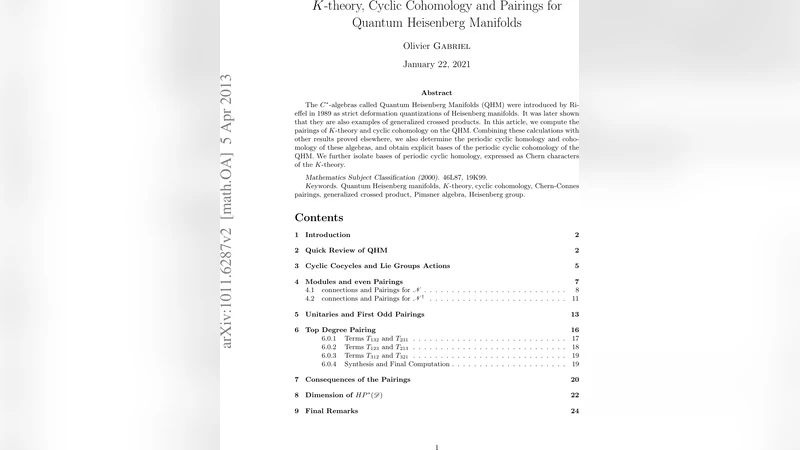
The C*-algebras called Quantum Heisenberg Manifolds (QHM) were introduced by Rieffel in 1989 as strict deformation quantizations of Heisenberg manifolds. In this article, we compute the pairings of K-theory and cyclic cohomology on the QHM. Combining these calculations with other results proved elsewhere, we also determine the periodic cyclic homology and cohomology of these algebras, and obtain explicit bases of the periodic cyclic cohomology of the QHM. We further isolate bases of periodic cyclic homology, expressed as Chern characters of the K-theory.
💡 Research Summary
The paper investigates the interplay between K‑theory and cyclic (co)homology for the C*‑algebras known as Quantum Heisenberg Manifolds (QHM), which were introduced by Rieffel as strict deformation quantizations of classical Heisenberg manifolds. The authors first recall the construction of QHM: for a positive integer (c) and non‑zero real parameters (\mu,\nu), the algebra (A_{\mu,\nu}^{c}) is generated by three unitary elements subject to Heisenberg‑type commutation relations that encode the central extension of the Heisenberg group. Earlier work established that the K‑groups are both rank‑three free abelian groups, (K_{0}(A)\cong\mathbb Z^{3}) and (K_{1}(A)\cong\mathbb Z^{3}), with explicit generators given by three projections (p_{1},p_{2},p_{3}) and three unitaries (u_{1},u_{2},u_{3}).
The second part of the paper constructs explicit cyclic cocycles. Using Connes’ non‑commutative differential calculus, the authors define three 1‑cocycles (\varphi_{i}) (derived from the canonical trace (\tau) composed with the derivations (\delta_{i}) associated to the Heisenberg Lie algebra) and three 2‑cocycles (\psi_{i}) (essentially (\tau\circ\delta_{j}\circ\delta_{k}) for distinct indices). These cocycles satisfy the Hochschild and cyclic coboundary conditions and thus represent classes in the periodic cyclic cohomology groups (HP^{0}(A)) and (HP^{1}(A)).
The core of the work is the explicit computation of the Chern‑Connes pairings \
Comments & Academic Discussion
Loading comments...
Leave a Comment