An ErdH{o}s--Ko--Rado theorem for matchings in the complete graph
We consider the following higher-order analog of the Erd\H{o}s–Ko–Rado theorem. For positive integers r and n with r<= n, let M^r_n be the family of all matchings of size r in the complete graph K_{2n}. For any edge e in E(K_{2n}), the family M^r_n(e), which consists of all sets in M^r_n containing e, is called the star centered at e. We prove that if r<n and A is an intersecting family of matchings in M^r_n, then |A|<=|M^r_n(e)|$, where e is an edge in E(K_{2n}). We also prove that equality holds if and only if A is a star. The main technique we use to prove the theorem is an analog of Katona’s elegant cycle method.
💡 Research Summary
The paper presents a higher‑order analogue of the classic Erdős–Ko–Rado (EKR) theorem, focusing on matchings in the complete graph K₂ₙ. For positive integers r and n with r ≤ n, let Mₙʳ denote the family of all r‑matchings (sets of r pairwise disjoint edges) in K₂ₙ. For any edge e, the subfamily Mₙʳ(e) consisting of all r‑matchings that contain e is called a star centered at e. The main result (Theorem 1.2) states that when r < n, any intersecting family A ⊆ Mₙʳ (i.e., any two matchings in A share at least one edge) satisfies |A| ≤ |Mₙʳ(e)|, and equality holds if and only if A is a star.
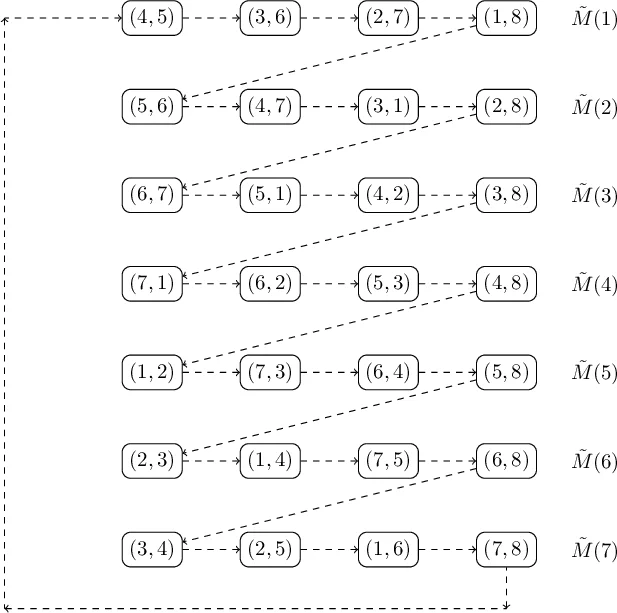
The proof adapts Katona’s elegant cycle method to the setting of graph matchings. The authors first construct a rooted Baranyai partition of K₂ₙ: the edge set of K₂ₙ can be partitioned into (2n − 1) perfect matchings, each rooted at a distinguished vertex. For each permutation σ of the vertex set, they define a rooted order B_σ consisting of the (2n − 1) perfect matchings arranged according to σ, and then create a cyclic ordering ψ_σ of all edges by concatenating the matchings in a fixed reverse order. Two crucial properties are established:
- Shift invariance (Claim 2.1): Rotating σ by a cyclic shift c yields the same cyclic order up to a relabeling of the parts, i.e., ψ_{σ_c} is equivalent to ψ_σ.
- Matching intervals (Claim 2.2): Any consecutive block of at most n − 1 edges in ψ_σ forms a matching. This follows from the structure of the Baranyai partition and guarantees that intervals of length r (with r ≤ n − 1) correspond to legitimate r‑matchings.
Using these cyclic orders, a matching A is said to be compatible with σ if A appears as a consecutive interval in ψ_σ. Let A_σ be the set of matchings in the family A that are compatible with σ. Katona’s double‑counting argument shows that for any σ, |A_σ| ≤ r, with equality only when all compatible matchings share a common edge (i.e., A_σ is a star).
The authors then compute, for a fixed matching A, the number q_A of permutations σ for which A is compatible. By separating the cases where the root vertex σ(2n) belongs to the vertex set of A or not, they derive an exact formula: \
Comments & Academic Discussion
Loading comments...
Leave a Comment