Bounding the fractional chromatic number of $K_Delta$-free graphs
King, Lu, and Peng recently proved that for $ Delta geq 4$, any $K_ Delta$-free graph with maximum degree $ Delta$ has fractional chromatic number at most $ Delta- tfrac{2}{67}$ unless it is isomorphi
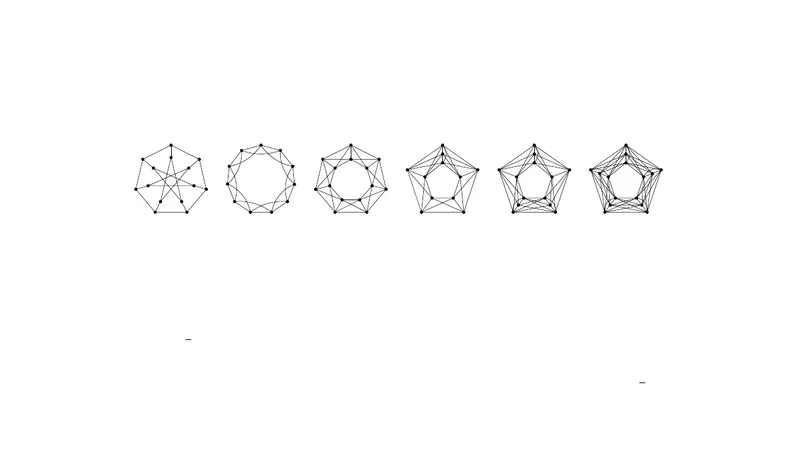
King, Lu, and Peng recently proved that for $\Delta\geq 4$, any $K_\Delta$-free graph with maximum degree $\Delta$ has fractional chromatic number at most $\Delta-\tfrac{2}{67}$ unless it is isomorphic to $C_5\boxtimes K_2$ or $C_8^2$. Using a different approach we give improved bounds for $\Delta\geq 6$ and pose several related conjectures. Our proof relies on a weighted local generalization of the fractional relaxation of Reed’s $\omega$, $\Delta$, $\chi$ conjecture.
💡 Research Summary
The paper addresses the longstanding problem of bounding the fractional chromatic number χ_f of graphs that are free of a complete subgraph K_Δ while having maximum degree Δ. The authors build on the recent result of King, Lu, and Peng, which established that for Δ ≥ 4 every K_Δ‑free graph satisfies χ_f ≤ Δ − 2/67, with the only extremal examples being C₅ ⊠ K₂ and C₈². While that result is sharp for Δ = 4, the bound becomes relatively weak as Δ grows.
To improve the bound for larger degrees, the authors introduce a “weighted local generalization” of the fractional relaxation of Reed’s ω‑Δ‑χ conjecture. The core idea is to assign a weight w(v)∈
📜 Original Paper Content
🚀 Synchronizing high-quality layout from 1TB storage...