Weakly-coupled systems in quantum control
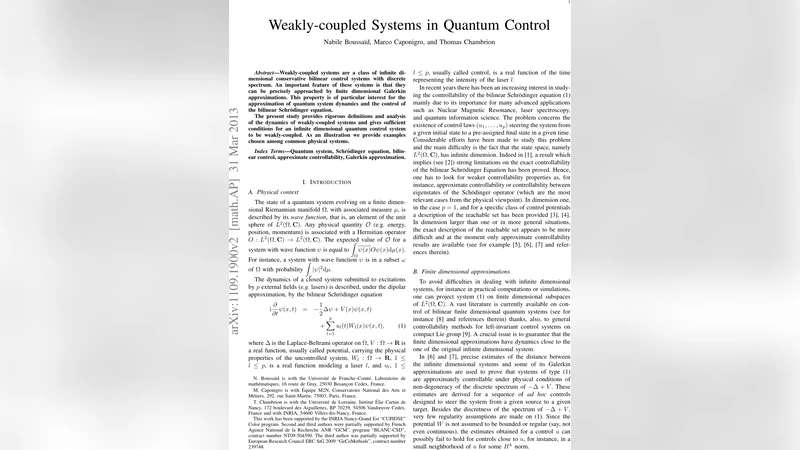
This paper provides rigorous definitions and analysis of the dynamics of weakly-coupled systems and gives sufficient conditions for an infinite dimensional quantum control system to be weakly-coupled. As an illustration we provide examples chosen among common physical systems.
💡 Research Summary
The paper introduces and rigorously studies a class of infinite‑dimensional quantum control systems called “weakly‑coupled” systems. Starting from the bilinear Schrödinger equation that models a quantum particle on a manifold Ω under p external fields (lasers), the authors rewrite the dynamics in an abstract operator form dψ/dt = (A + Σₗ uₗ(t) Bₗ) ψ on a separable Hilbert space H = L²(Ω,ℂ). Here A is a skew‑adjoint operator with purely discrete spectrum (−iλ_j) and the Bₗ are symmetric (real‑valued) multiplication operators representing the control potentials.
Weak coupling definition.
A (p+1)-tuple (A, B₁,…,B_p) is said to be k‑weakly‑coupled (k>0) if for every control vector u∈ℝ^p the domains of |A|^{k/2} and |A+ΣuₗBₗ|^{k/2} coincide, and there exists a constant C such that for all ψ in D(|A|^{k}) and each l,
|⟨|A|^{k} ψ, Bₗ ψ⟩| ≤ C |⟨|A|^{k} ψ, ψ⟩|.
The coupling constant c_k(A,B₁,…,B_p) is the supremum of the left‑hand side divided by the energy term on the right. This quantifies how “weak” the control operators are relative to the free Hamiltonian A.
Main analytical results.
-
Energy growth bound (Proposition 2). If the L¹‑norm of the control vector is bounded by K, then for any initial state ψ₀∈D(|A|^{k/2}) the k/2‑norm of the solution satisfies
‖Υ_u(T) ψ₀‖{k/2} ≤ exp(c_k K) ‖ψ₀‖{k/2} for all T≥0.
Thus the expected energy grows at most exponentially with the total control effort, and the exponent is precisely the coupling constant. -
Good Galerkin approximation (Theorem 4). Assume, in addition to weak coupling, that each Bₗ is bounded from D(|A|^{r/2}) to H with a bound d‖·‖{r/2} for some 0≤r<k. Then for any ε>0, any finite set of initial states {ψ_j}⊂D(|A|^{k/2}), and any control with L¹‑norm ≤K, there exists a truncation dimension N such that the finite‑dimensional Galerkin system (obtained by projecting A and Bₗ onto the span of the first N eigenvectors of A) satisfies
‖Υ_u(t) ψ_j – X_u^{(N)}(t,0) π_N ψ_j‖{s/2} < ε for all t≥0 and all j, where 0≤s<k.
The proof uses a variation‑of‑constants formula, Lemma 3 (which controls the tail of the solution in high‑energy modes), and an interpolation argument to pass from s=0 to any s<k.
These results guarantee that weakly‑coupled systems can be approximated arbitrarily well by finite‑dimensional bilinear systems, both in the state trajectory and in the energy norm. Consequently, tools from finite‑dimensional geometric control theory become applicable to the infinite‑dimensional quantum setting.
Examples and physical relevance.
-
Compact manifolds (Section III). When Ω is a compact Riemannian manifold, A = –i(–½Δ+V) satisfies the spectral assumptions, and if the control potentials Wₗ are continuous (hence bounded) the operators Bₗ are bounded on D(|A|^{1/2}). Thus the system is 2‑weakly‑coupled. This covers many standard quantum particles in bounded domains with smooth potentials.
-
Tri‑diagonal systems (Section IV). The authors consider a class where A is diagonal in the eigenbasis and each Bₗ has non‑zero entries only on the first sub‑ and super‑diagonals. Such a structure appears in rotational dynamics of molecules, quantum dots, and tight‑binding lattice models. They show that for these systems Bₗ are bounded on D(|A|^{1/2}) (or higher), yielding weak coupling with k=2 or k=4 depending on the regularity of the coefficients. The tri‑diagonal form also enables explicit estimates of transition probabilities between eigenstates, confirming that high‑energy transitions are strongly suppressed.
Control design implications.
Section IV‑D presents a Lyapunov‑based open‑loop control law for weakly‑coupled systems. By choosing a Lyapunov function that measures the distance to a target eigenstate and defining the control as uₗ(t)=−k⟨ψ, Bₗ ψ⟩, the derivative of the Lyapunov function is non‑positive, guaranteeing convergence to the target. The convergence proof relies on the energy bound (Proposition 2) to keep the trajectory within the domain where the weak‑coupling estimates hold, and on the Galerkin approximation theorem to justify numerical implementation.
Overall significance.
The paper bridges a gap between infinite‑dimensional quantum control theory and practical, computable methods. By identifying a structural condition (weak coupling) that ensures both bounded energy growth and accurate finite‑dimensional approximations, the authors provide a rigorous foundation for:
- Designing control laws using finite‑dimensional geometric techniques.
- Performing reliable numerical simulations with guaranteed error bounds.
- Understanding why many physically relevant quantum systems (smooth potentials, compact domains, or tri‑diagonal couplings) naturally satisfy the weak‑coupling condition.
These contributions have direct relevance to quantum information processing, high‑precision spectroscopy, and molecular control, where one often needs to steer high‑dimensional quantum states while keeping computational costs manageable. The work also opens avenues for extending weak‑coupling analysis to open quantum systems, stochastic controls, and time‑varying Hamiltonians.
Comments & Academic Discussion
Loading comments...
Leave a Comment