Detecting Overlapping Temporal Community Structure in Time-Evolving Networks
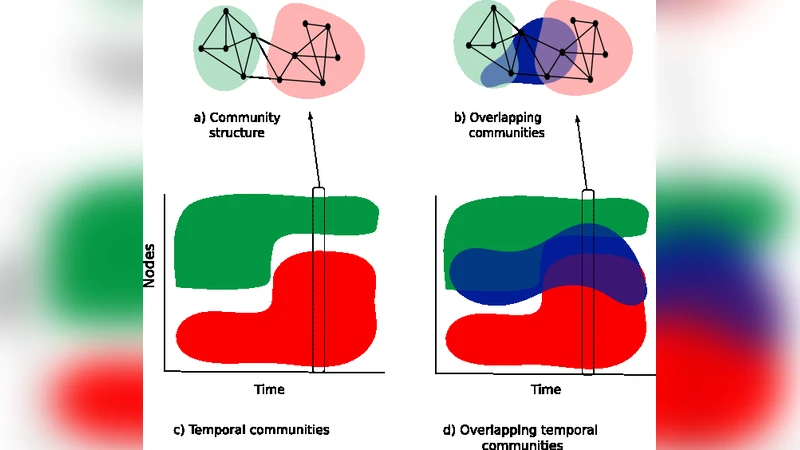
We present a principled approach for detecting overlapping temporal community structure in dynamic networks. Our method is based on the following framework: find the overlapping temporal community structure that maximizes a quality function associated with each snapshot of the network subject to a temporal smoothness constraint. A novel quality function and a smoothness constraint are proposed to handle overlaps, and a new convex relaxation is used to solve the resulting combinatorial optimization problem. We provide theoretical guarantees as well as experimental results that reveal community structure in real and synthetic networks. Our main insight is that certain structures can be identified only when temporal correlation is considered and when communities are allowed to overlap. In general, discovering such overlapping temporal community structure can enhance our understanding of real-world complex networks by revealing the underlying stability behind their seemingly chaotic evolution.
💡 Research Summary
The paper introduces a principled framework for detecting overlapping temporal communities (OTC) in dynamic networks. The authors model each network snapshot by an adjacency matrix A_t and represent a cover (a collection of possibly overlapping communities) with a symmetric matrix Y_t where Y_t(i,j) counts the number of communities that contain both nodes i and j. This “cover matrix” can be factorized as Y_t = U_t U_t^T, with U_t a binary assignment matrix, but the combinatorial nature of U_t makes direct optimization intractable.
To overcome this, the authors propose a convex relaxation: they replace the rank constraint on Y_t (which equals the number of communities) with a trace‑norm penalty ‖Y_t‖_* . The trace norm is the tightest convex surrogate for rank, turning the original NP‑hard problem into a tractable convex program that can be solved with standard first‑order methods (e.g., ADMM).
The objective consists of two parts. The snapshot quality function f_A(Y) is defined as a weighted L1 distance between Y and A:
f_A(Y) = –∑{i,j} C{ij} |Y_{ij} – A_{ij}|,
where the weights C_{ij}=|A_{ij} – (k_i k_j)/(2M)| mimic the modularity term and penalize both false positives and false negatives while discouraging degenerate solutions such as a separate community for every edge.
Temporal smoothness is enforced by a distance term d_{t+1,t}(Y_{t+1},Y_t) = ∑{i,j} A{t+1,ij} A_{t,ij} max(Y_{t+1,ij} – Y_{t,ij},0). This measures how much the similarity assigned to edges that persist across consecutive snapshots can increase, and a global bound δ is imposed to keep the evolution gradual.
The full optimization problem is:
max_{Y_1,…,Y_T} ∑{t=1}^T f{A_t}(Y_t)
subject to d_{t+1,t}(Y_{t+1},Y_t) ≤ δ for t=1,…,T−1,
Y_t ∈ ConvexHull{covers} (realized via the trace‑norm relaxation).
The authors provide a theoretical guarantee under a planted community model: if a community persists for m snapshots and its size K satisfies K ≥ p·n·m (p a constant), then with high probability the convex program recovers the true cover exactly. This result highlights that more temporal observations allow detection of smaller, yet stable, communities—something static or non‑overlapping methods cannot achieve.
Empirical evaluation includes synthetic benchmarks (stochastic block models with overlapping blocks and temporally evolving planted partitions) and real‑world data sets such as mobile phone call logs, online social networks, and vehicular communication traces. Across all experiments, the proposed method outperforms baseline approaches (static overlapping detection, evolutionary clustering without overlap, and greedy heuristics) in terms of precision, recall, and normalized mutual information, especially when communities are small or when the network is noisy.
Beyond detection, the paper discusses practical applications. In wireless sensor or ad‑hoc networks, knowledge of persistent overlapping communities can guide distributed data replication, reducing average access latency. Overlapping temporal communities also serve as natural relay groups for disruption‑tolerant routing, improving delivery ratios under intermittent connectivity. Finally, the extracted OTC structure can be used to build realistic mobility models for protocol simulation, capturing both the fluidity of contacts and the stability of underlying social groups.
In summary, the work delivers (1) a novel quality function and smoothness metric that handle overlaps, (2) a convex relaxation based on the trace norm that yields an efficiently solvable program with provable recovery guarantees, and (3) extensive experimental validation demonstrating the advantage of exploiting both overlap and temporal continuity in community detection. This contribution advances the state of the art in network science and opens new avenues for designing robust, socially‑aware communication systems.
Comments & Academic Discussion
Loading comments...
Leave a Comment