A United Model for the cosmic ray energy spectra and anisotropy in the energy range 100 - 100 000 GeV
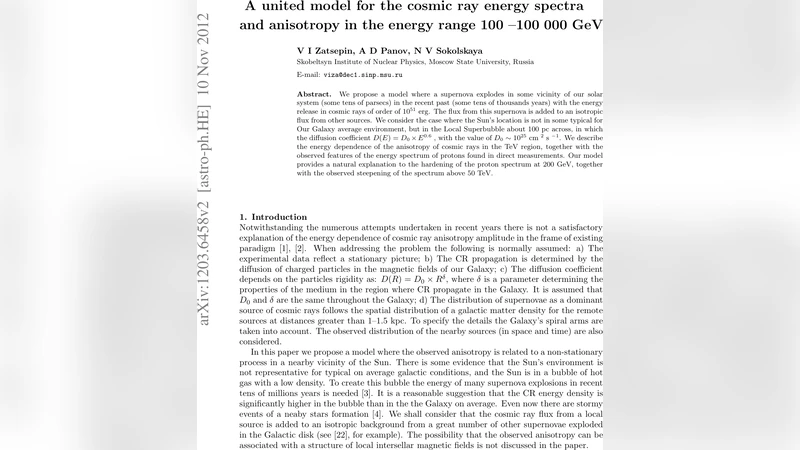
We propose a model where a supernova explodes in some vicinity of our solar system (some tens of parsecs) in the recent past (some tens of thousands years) with the energy release in cosmic rays of order of $ 10 ^ {51} $ erg. The flux from this supernova is added to an isotropic flux from other sources. We consider the case where the Sun’s location is not in some typical for Our Galaxy average environment, but in the Local Superbubble about 100 pc across, in which the diffusion coefficient $D (E) = D_0 \times E ^ {0.6} $, with the value of $ D_0 \sim 10 ^ {25} cm^ 2 s^ {-1} $. We describe the energy dependence of the anisotropy of cosmic rays in the TeV region, together with the observed features of the energy spectrum of protons found in direct measurements. Our model provides a natural explanation to the hardening of the proton spectrum at 200 GeV, together with the observed steepening of the spectrum above 50 TeV.
💡 Research Summary
The paper puts forward a unified scenario in which a single, relatively recent supernova that exploded within a few tens of parsecs of the Sun dominates the local cosmic‑ray (CR) population in the 100 GeV–100 TeV range. The authors assume that the Sun resides inside the Local Superbubble, a low‑density cavity about 100 pc across, where the diffusion coefficient is significantly reduced compared with the Galactic average: D(E)=D₀ E^{0.6} with D₀≈10^{25} cm² s⁻¹ (versus the typical ≈10^{28} cm² s⁻¹). This slower diffusion reflects a suppressed level of magnetic turbulence inside the bubble.
The total CR flux is modeled as the sum of an isotropic background component (N_bg) produced by the ensemble of distant Galactic sources, and a local component (N_loc) injected by the nearby supernova. The source is assumed to have released ∼10^{51} erg in CRs with an initial power‑law spectrum Q(E)∝E^{-γ}, where γ≈2.2. After propagation in the bubble, the local spectrum becomes N_loc∝E^{-(γ+0.6)} because the diffusion coefficient adds an extra 0.6 power of energy to the effective steepening.
Key free parameters are the supernova age (t≈3×10⁴–1×10⁵ yr) and distance (r≈30–100 pc). Using the standard anisotropy expression δ≈(3D/c)·(∇N/N), the authors calculate the energy‑dependent dipole amplitude. At low energies (≲1 TeV) the background dominates, yielding a nearly isotropic flux (δ∼10^{-4}). In the 10–100 TeV band the gradient produced by the local source becomes significant, raising δ to the observed level of ∼10^{-3}. Above ∼100 TeV the faster diffusion of the highest‑energy particles reduces the gradient, causing the anisotropy to fall again. This behavior reproduces the measurements from Tibet‑ASγ, IceCube, ARGO‑YBJ and other experiments.
Spectrally, the local component adds a hard contribution that becomes comparable to the softer background (∝E^{-2.7}) around 200 GeV, naturally explaining the “hardening” reported by AMS‑02, PAMELA and other space‑borne detectors. At energies above ∼50 TeV the local flux steepens sharply because the high‑energy particles have diffused away more efficiently, leading to the observed “steepening” or cutoff in the proton spectrum measured by CREAM, NUCLEON and recent balloon experiments. Thus a single set of parameters (t, r, D₀) simultaneously accounts for both spectral features and the anisotropy energy dependence.
The authors compare their model with alternative explanations such as multiple nearby supernovae, a nearby pulsar wind nebula, or non‑linear diffusion models. They argue that the single‑source hypothesis requires fewer adjustable parameters and still fits the full suite of data. However, the assumption of a dramatically reduced diffusion coefficient inside the Local Superbubble remains a critical uncertainty, as direct measurements of the magnetic turbulence spectrum in this region are lacking. The paper also notes that independent astronomical evidence (e.g., remnants, X‑ray or gamma‑ray signatures, neutron star identification) would be essential to confirm the proposed supernova’s age and distance.
In conclusion, the study presents a coherent picture in which a recent, nearby supernova embedded in the Local Superbubble can explain the observed proton spectrum hardening at ∼200 GeV, the steepening above ∼50 TeV, and the energy‑dependent dipole anisotropy from TeV to 100 TeV. Future high‑precision anisotropy measurements, detailed mapping of the local magnetic environment, and targeted searches for the putative supernova remnant are identified as the next steps to test and refine this model.