Bicentennial of the Great Poncelet Theorem (1813-2013): Current Advances
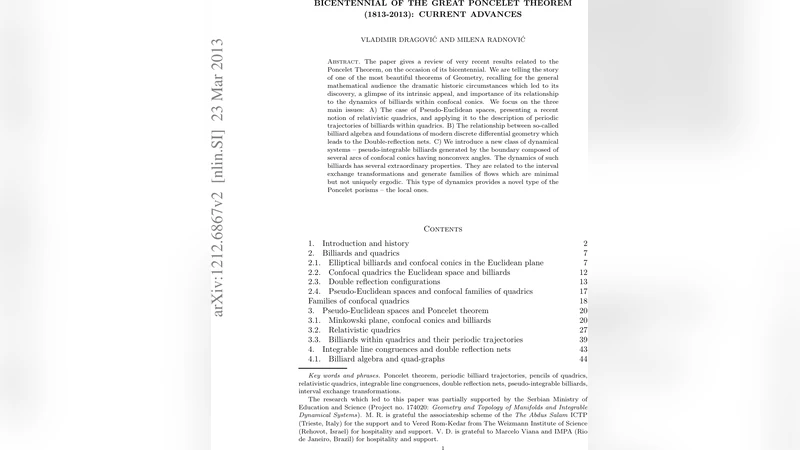
The paper gives a review of very recent results related to the Poncelet Theorem, on the occasion of its bicentennial. We are telling the story of one of the most beautiful theorems of Geometry, recalling for the general mathematical audience the dramatic historic circumstances which led to its discovery, a glimpse of its intrinsic appeal, and importance of its relationship to the dynamics of billiards within confocal conics. We focus on the three main issues: A) The case of Pseudo-Euclidean spaces, presenting a recent notion of relativistic quadrics, and applying it to the description of periodic trajectories of billiards within quadrics. B) The relationship between so-called billiard algebra and foundations of modern discrete differential geometry which leads to the Double-reflection nets. C) We introduce a new class of dynamical systems – pseudo-integrable billiards generated by the boundary composed of several arcs of confocal conics having nonconvex angles. The dynamics of such billiards has several extraordinary properties. They are related to the interval exchange transformations and generate families of flows which are minimal but not uniquely ergodic. This type of dynamics provides a novel type of the Poncelet porisms – the local ones.
💡 Research Summary
The paper commemorates the bicentennial of the Poncelet theorem by surveying a cluster of very recent developments that extend the classical result in three distinct directions. After a concise historical introduction that recalls the dramatic circumstances of the theorem’s discovery in 1813 and its lasting appeal to geometers, the authors focus on three main themes.
-
Pseudo‑Euclidean (relativistic) quadrics. By moving from the usual Euclidean space to a three‑dimensional space with Lorentzian signature ((+,-,-)), the authors introduce the notion of relativistic quadrics. These are second‑order surfaces whose focal structure interacts with the light cone, leading to two families (time‑like and space‑like). The classical billiard reflection law is reformulated to respect the causal structure, and a “relativistic Poncelet porism” is proved: for suitable parameter ranges there exist closed billiard trajectories that return to the starting point after a fixed number of reflections, exactly as in the original theorem but now constrained by the speed‑of‑light limit. This result bridges the geometry of conics with special‑relativistic optics and suggests applications to wave propagation in anisotropic media.
-
Billiard algebra and discrete differential geometry. The second part interprets the billiard reflection operator as an element of a non‑commutative algebra. By composing two independent reflections one obtains a double‑reflection net: an integrable discrete surface whose vertices satisfy two simultaneous tangency conditions with respect to two distinct quadrics. The net provides a natural discretisation of curvature and topological invariants, offering a new computational framework for digital surface reconstruction and for the study of “plastic deformations” in discrete geometry. The authors demonstrate that the algebraic structure underlying the net is compatible with the well‑known “billiard algebra” and that the net can be generated algorithmically from initial data on a lattice.
-
Pseudo‑integrable billiards with non‑convex angles. The most novel contribution concerns billiard tables whose boundary consists of several arcs of confocal conics meeting at angles larger than (\pi). Such tables are not convex, and the resulting dynamics cannot be described by the usual integrable billiard theory. By encoding the motion as an interval exchange transformation (IET), the authors show that the system is minimal (every orbit is dense) but not uniquely ergodic (there exist distinct invariant probability measures). This leads to the definition of local Poncelet porisms: closed trajectories that exist only in neighbourhoods of the non‑convex vertices, while globally the system lacks a universal period. The paper proves the existence of families of such local porisms and analyses their stability under perturbations of the boundary.
The three themes are tightly interwoven. Both relativistic quadrics and the pseudo‑integrable tables rely on a generalized focal structure of confocal conics, while the double‑reflection net supplies a discrete analogue of the continuous billiard dynamics that appears in the first two sections. The authors conclude by outlining future research directions: extending relativistic porisms to higher‑dimensional pseudo‑Riemannian manifolds, exploring quantum analogues of the billiard algebra, and investigating ergodic properties of non‑convex billiards in the context of Teichmüller dynamics. Overall, the paper not only celebrates a historic theorem but also demonstrates how its core ideas continue to inspire rich, interdisciplinary mathematics at the interface of geometry, dynamical systems, and mathematical physics.