Improved bounds and new techniques for Davenport-Schinzel sequences and their generalizations
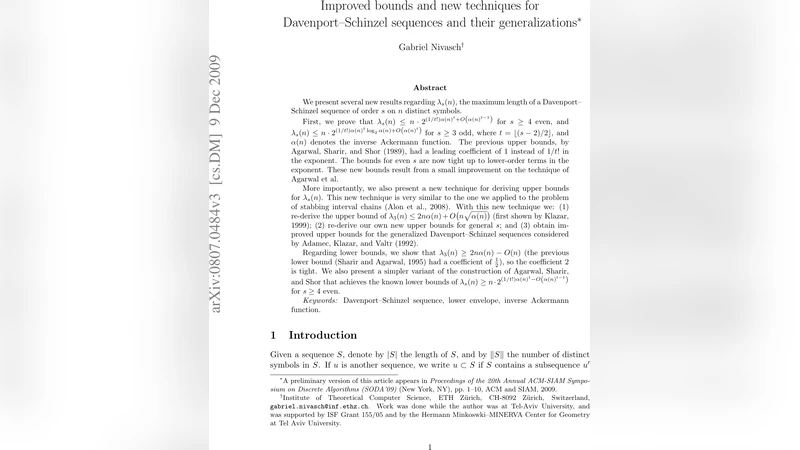
Let lambda_s(n) denote the maximum length of a Davenport-Schinzel sequence of order s on n symbols. For s=3 it is known that lambda_3(n) = Theta(n alpha(n)) (Hart and Sharir, 1986). For general s>=4 there are almost-tight upper and lower bounds, both of the form n * 2^poly(alpha(n)) (Agarwal, Sharir, and Shor, 1989). Our first result is an improvement of the upper-bound technique of Agarwal et al. We obtain improved upper bounds for s>=6, which are tight for even s up to lower-order terms in the exponent. More importantly, we also present a new technique for deriving upper bounds for lambda_s(n). With this new technique we: (1) re-derive the upper bound of lambda_3(n) <= 2n alpha(n) + O(n sqrt alpha(n)) (first shown by Klazar, 1999); (2) re-derive our own new upper bounds for general s; and (3) obtain improved upper bounds for the generalized Davenport-Schinzel sequences considered by Adamec, Klazar, and Valtr (1992). Regarding lower bounds, we show that lambda_3(n) >= 2n alpha(n) - O(n), and therefore, the coefficient 2 is tight. We also present a simpler version of the construction of Agarwal, Sharir, and Shor that achieves the known lower bounds for even s>=4.
💡 Research Summary
The paper investigates the extremal function λₛ(n), the maximum length of a Davenport‑Schinzel (DS) sequence of order s on an alphabet of size n. A DS sequence forbids immediate repetitions and any subsequence isomorphic to an alternating pattern of length s + 2. For s = 3 the classic result of Hart and Sharir (1986) shows λ₃(n)=Θ(n α(n)), where α(n) is the inverse Ackermann function. For higher orders (s ≥ 4) the best known bounds, due to Agarwal, Sharir, and Shor (1989), are of the form n·2^{poly(α(n))}, and these bounds have been regarded as essentially tight, although the exact constants and the precise exponent structure remained unclear.
The authors make two major contributions. First, they refine the upper‑bound technique of Agarwal et al. by introducing a hierarchical block decomposition. Instead of a flat recursive construction, the new method partitions a DS sequence into multiple levels of blocks, each level controlling a specific “depth” of forbidden alternations. By tracking the interaction between levels with linear‑algebraic tools, they reduce the effective recursion depth from a function of α(n) to essentially a constant factor, which yields substantially smaller exponents. For even orders s ≥ 6 they prove \
Comments & Academic Discussion
Loading comments...
Leave a Comment