Parameterized Picard-Vessiot extensions and Atiyah extensions
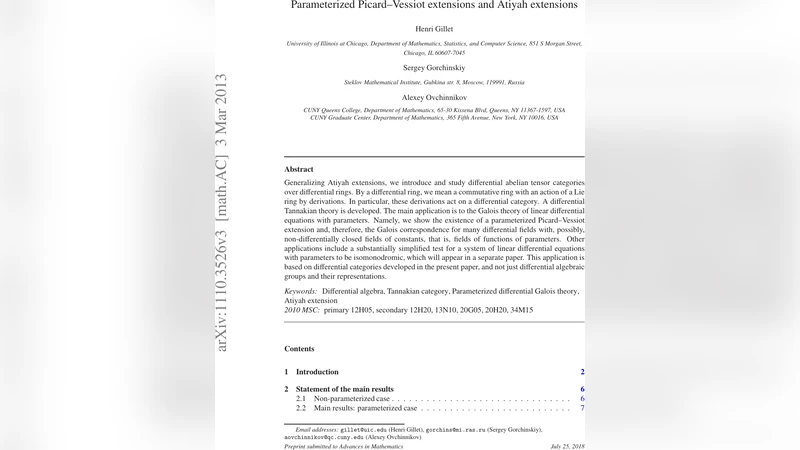
Generalizing Atiyah extensions, we introduce and study differential abelian tensor categories over differential rings. By a differential ring, we mean a commutative ring with an action of a Lie ring by derivations. In particular, these derivations act on a differential category. A differential Tannakian theory is developed. The main application is to the Galois theory of linear differential equations with parameters. Namely, we show the existence of a parameterized Picard-Vessiot extension and, therefore, the Galois correspondence for many differential fields with, possibly, non-differentially closed fields of constants, that is, fields of functions of parameters. Other applications include a substantially simplified test for a system of linear differential equations with parameters to be isomonodromic, which will appear in a separate paper. This application is based on differential categories developed in the present paper, and not just differential algebraic groups and their representations.
💡 Research Summary
This paper develops a comprehensive framework that combines differential algebra, Hopf algebroids, and Tannakian category theory to address the existence and Galois correspondence of parameterized Picard‑Vessiot (PPV) extensions for linear differential equations with parameters, without requiring the field of constants to be differentially closed.
The authors begin by defining a differential ring as a commutative ring equipped with a Lie ring action by derivations, a notion that generalizes the usual single‑derivation setting. They then introduce differential abelian tensor categories, which are ordinary abelian k‑linear tensor categories endowed with a compatible action of the differential structure. The construction relies on Illusie’s equivalence between complete formal Hopf algebroids and differential rings, together with a scalar‑extension formalism for categories, allowing the Lie‑ring derivations to act functorially on objects and morphisms.
In Section 5 the authors define parameterized Atiyah extensions, a two‑step generalization of the classical Atiyah extension that incorporates the parameter derivations. This construction yields a differential structure on the category of linear differential systems with parameters. The central result (Theorem 5.5) shows that the category of PPV extensions is equivalent to the category of differential fiber functors on this differential Tannakian category. Consequently, constructing a PPV extension is reduced to constructing a differential fiber functor, a problem that can be tackled by geometric methods.
A major technical obstacle is the flatness of certain differential algebras after localizing by a non‑zero element. While flatness is not known in full generality, the authors prove a crucial flatness theorem (Theorem 6.1) for Hopf algebroids, which suffices for their purposes. They also prove that a differentially finitely generated Hopf algebroid is a quotient of a differential polynomial ring by a differentially finitely generated ideal, avoiding the need for radical ideals.
The main existence theorem (Theorem 2.5) states that if the field of constants is relatively differentially closed—a condition much weaker than differential closure, satisfied by many practical fields such as formally real fields with real‑closed constants or transcendental extensions of a base constant field—then a PPV extension exists for any linear differential system with parameters. Theorem 2.8 further shows that the associated Galois group is a linear differential algebraic group defined over the constants, and after passing to the differential closure of the constants it coincides with the classical parameterized differential Galois group of Cassidy‑Singer.
Section 8 extends the Galois correspondence to arbitrary constant fields, analyzing how the Galois group behaves under extensions of constants. This removes the traditional obstacle that a non‑differentially closed constant field could prevent the existence of a Picard‑Vessiot extension, as illustrated by classical counter‑examples such as Seidenberg’s.
The paper also discusses applications: the new framework simplifies the test for isomonodromicity of parameterized systems, leading to a more efficient algorithm (to appear in a separate work). It provides a conceptual explanation for the differential algebraic independence of special functions such as the incomplete Gamma function, without resorting to the differential closure of the parameter field.
Overall, the work offers a robust, functorial approach to parameterized differential Galois theory, broadening its applicability to a wide range of constant fields and paving the way for further algorithmic and theoretical developments in the study of linear differential equations with parameters.
Comments & Academic Discussion
Loading comments...
Leave a Comment