Nonequilibrium growth of patchy-colloid networks on substrates
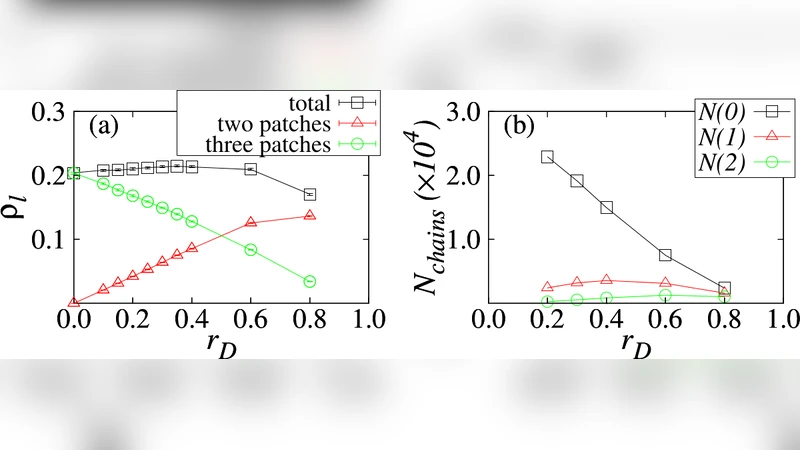
Patchy colloids with highly directional interactions are ideal building blocks to control the local arrangements resulting from their spontaneous self-organization. Here we propose their use, combined with substrates and nonequilibrium conditions, to obtain structures, different from those of equilibrium thermodynamic phases. Specifically, we investigate numerically the irreversible adhesion of three-patch colloids near attractive substrates, and analyze the fractal network of connected particles that is formed. The network density profile exhibits three distinct regimes, with different structural and scaling properties, which we characterize in detail. The adsorption of a mixture of three- and two-patch colloids is also considered. An optimal fraction of two-patch colloids is found where the total density of the film is maximized, in contrast to the equilibrium gel structures where a monotonic decrease of the density has been reported.
💡 Research Summary
This paper investigates the irreversible adsorption of patchy colloids onto attractive substrates under nonequilibrium conditions, focusing on the formation of fractal networks and their structural properties. Using Monte‑Carlo simulations, the authors model three‑patch colloids that diffuse near a flat, uniformly attractive surface. When a diffusing particle contacts an already adsorbed particle, it forms a permanent bond using any available patch; once a bond is created it cannot break, mimicking strong directional interactions such as DNA‑mediated or covalent links. The resulting network exhibits three distinct vertical regimes. Near the substrate (regime I) particles are densely packed in a quasi‑two‑dimensional layer with an average coordination number close to three and a fractal dimension D_f≈2. In the intermediate region (regime II) the growth front becomes irregular; the coordination number drops, the fractal dimension decreases to D_f≈1.7–1.8, and the density follows a power‑law decay ρ(z)∝z^{‑α} with α≈0.8. Farther from the surface (regime III) the supply of free particles is exhausted, the network thins into filamentous branches, D_f falls below 1.5, and the density decays more steeply, ρ(z)∝z^{‑β} with β≈1.5. These scaling exponents are sensitive to the angular restriction of the patches and to the strength of the substrate attraction, indicating that fine‑tuning of experimental parameters can steer the morphology of the deposited film.
The authors extend the study to binary mixtures of two‑patch and three‑patch colloids. Two‑patch particles tend to form linear chains, which can either facilitate early nucleation on the substrate or interrupt network connectivity, depending on their proportion. Simulations reveal an optimal two‑patch fraction f≈0.3 at which the overall film density reaches a maximum. Below this value the addition of two‑patch particles enhances nucleation and increases packing; above it, excessive linear chains fragment the network and reduce density. This non‑monotonic behavior contrasts sharply with equilibrium gelation, where increasing the fraction of low‑valence particles always lowers the gel density.
The work highlights the potential of nonequilibrium self‑assembly of patchy colloids on patterned or uniform substrates to generate novel porous materials with controllable fractal architecture. While the model assumes permanently fixed bonds and a perfectly smooth substrate—limitations that omit bond breakage, surface heterogeneity, and external fields—the findings provide a clear roadmap for experimental realization. Future directions suggested include incorporating reversible bonding, substrate patterning, and flow‑driven transport to further expand the design space for functional colloidal networks.