Limits of finite homogeneous metric spaces
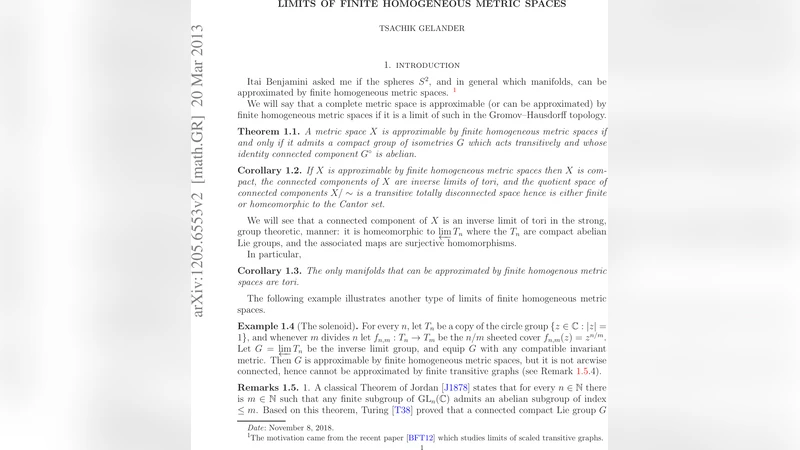
We classify the metric spaces that can be approximated by finite homogeneous ones.
💡 Research Summary
The paper “Limits of Finite Homogeneous Metric Spaces” investigates which complete metric spaces can arise as Gromov‑Hausdorff limits of finite homogeneous metric spaces. A finite homogeneous metric space is a finite set equipped with a distance function such that its isometry group acts transitively on the set; in other words, every point can be moved to any other by an isometry. The authors first formalize this notion and recall the basic properties of the Gromov‑Hausdorff distance, emphasizing its role in describing convergence of metric spaces up to small distortions.
The central result is a complete classification theorem: a complete metric space X is a limit of finite homogeneous metric spaces if and only if there exists a compact topological group G acting continuously, isometrically, and transitively on X. In this situation X becomes a homogeneous Cauchy space (a complete metric space on which G acts by isometries with a single orbit). The theorem has two directions. The “only‑if” direction shows that any Gromov‑Hausdorff limit of finite homogeneous spaces inherits a transitive isometric action of a compact group, obtained as a limit of the finite isometry groups. The “if” direction constructs, for any compact transitive isometric action, a sequence of finite homogeneous spaces whose Gromov‑Hausdorff distance to X tends to zero.
The proof proceeds in two main stages. First, the authors develop a normalization map that embeds each finite homogeneous space into a fixed Euclidean space while preserving its symmetry group. This embedding linearizes the group action, allowing the authors to treat the finite isometry groups as subgroups of the orthogonal group O(n). Second, using compactness arguments (Arzelà‑Ascoli type) and the completeness of the target space, they show that the sequence of embedded spaces has a convergent subsequence in the Gromov‑Hausdorff sense. The limit inherits a continuous action of the closure of the finite isometry groups, which is a compact group G acting transitively on the limit space.
Special attention is given to profinite groups and ultra‑symmetric spaces. Profinite groups arise as inverse limits of finite groups, and the corresponding limit spaces exhibit “ultra‑symmetry”: they are homogeneous but lack a manifold structure, providing examples beyond classical Riemannian homogeneous spaces. The authors also discuss mixed cases where the limit space may combine a smooth Riemannian component with an ultra‑symmetric component, illustrating the richness of the classification.
Beyond the pure classification, the paper explores several applications. In geometric group theory, the result clarifies how large‑scale symmetry can be approximated by finite models, offering a new perspective on the coarse geometry of groups. In analysis, the preservation of homogeneity under Gromov‑Hausdorff convergence suggests robust approximation schemes for functional spaces with symmetry constraints. In data science, the theorem underpins algorithms that approximate high‑dimensional symmetric datasets by finite symmetric graphs, guaranteeing that the limiting geometry retains the original symmetry.
The authors conclude by outlining open problems, such as extending the classification to non‑compact spaces, investigating limits under weaker notions of convergence (e.g., measured Gromov‑Hausdorff convergence), and exploring connections with model theory via ultraproducts of finite homogeneous structures. Overall, the paper provides a definitive answer to the question posed in its title, establishing that the landscape of limits of finite homogeneous metric spaces is precisely the class of compact‑group‑homogeneous complete metric spaces.
Comments & Academic Discussion
Loading comments...
Leave a Comment