Localization techniques in circle-equivariant KK-theory
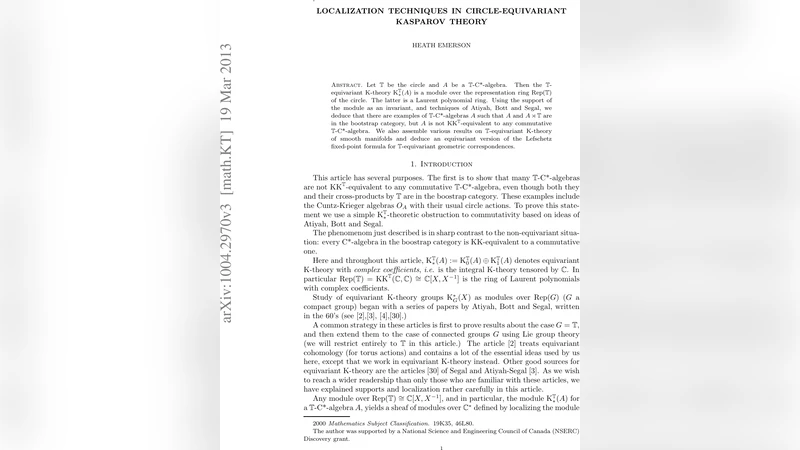
Let T be the circle and A be a T-C*-algebra. Then the T-equivariant K-theory of A is a module over the representation ring of the circle. The latter is a Laurent polynomial ring. Using the support of the module as an invariant, and techniques of Atiyah, Bott and Segal, we deduce that there are examples of T-C*-algebras A not KK^T-equivalent to any commutative T-C*-algebra. This is in contrast to the non-equivariant situation, in which any C*-algebra in the boostrap category is KK-equivalent to a commutative one. Our examples arise from dynamics, and include Cuntz-Krieger algebras with their usual circle actions. Using similar techniques, we also prove an equivariant version of the Lefschetz fixed-point formula. This is a special case of a result with Ralf Meyer that applies to general compact connected groups. The Lefschetz theorem equates the module trace of the module map of the T-equivariant K-theory of a smooth compact manifold induced by an equivariant self-correspondence of the manifold, with an appropriate Kasparov product; the Kasparov product is the T-equivariant index of the Dirac operator on a suitable `coincidence manifold’ of the correspondence. Finally, we prove several results related to localization and the Kunneth and universal coefficient theorems, and give an essentially complete description of the T-equivariant K-theory of compact spaces, by combining localization techniques of Atiyah and Segal and results of Paul Baum and Alain Connes for equivariant K-theory of finite group actions.
💡 Research Summary
The paper investigates the structure of circle‑equivariant KK‑theory by exploiting the fact that for a C*‑algebra A with a continuous action of the circle T≈S¹, the equivariant K‑theory K_T^*(A) is naturally a module over the representation ring R(T)=ℤ
Comments & Academic Discussion
Loading comments...
Leave a Comment