Stochastic Combinatorial Optimization via Poisson Approximation
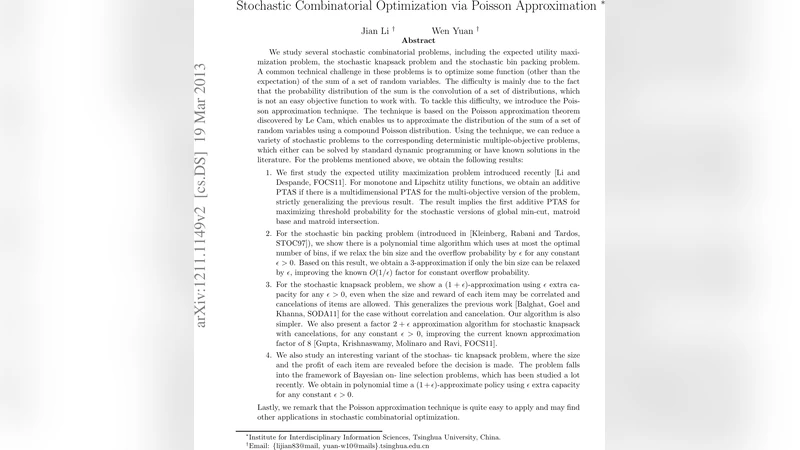
We study several stochastic combinatorial problems, including the expected utility maximization problem, the stochastic knapsack problem and the stochastic bin packing problem. A common technical challenge in these problems is to optimize some function of the sum of a set of random variables. The difficulty is mainly due to the fact that the probability distribution of the sum is the convolution of a set of distributions, which is not an easy objective function to work with. To tackle this difficulty, we introduce the Poisson approximation technique. The technique is based on the Poisson approximation theorem discovered by Le Cam, which enables us to approximate the distribution of the sum of a set of random variables using a compound Poisson distribution. We first study the expected utility maximization problem introduced recently [Li and Despande, FOCS11]. For monotone and Lipschitz utility functions, we obtain an additive PTAS if there is a multidimensional PTAS for the multi-objective version of the problem, strictly generalizing the previous result. For the stochastic bin packing problem (introduced in [Kleinberg, Rabani and Tardos, STOC97]), we show there is a polynomial time algorithm which uses at most the optimal number of bins, if we relax the size of each bin and the overflow probability by eps. For stochastic knapsack, we show a 1+eps-approximation using eps extra capacity, even when the size and reward of each item may be correlated and cancelations of items are allowed. This generalizes the previous work [Balghat, Goel and Khanna, SODA11] for the case without correlation and cancelation. Our algorithm is also simpler. We also present a factor 2+eps approximation algorithm for stochastic knapsack with cancelations. the current known approximation factor of 8 [Gupta, Krishnaswamy, Molinaro and Ravi, FOCS11].
💡 Research Summary
The paper tackles a fundamental obstacle in stochastic combinatorial optimization: the difficulty of optimizing functions that depend on the sum of many random variables. The distribution of such a sum is a convolution of the individual distributions, which is typically intractable for algorithmic purposes. To overcome this, the authors employ Le Cam’s Poisson approximation theorem, which allows the sum of (approximately) independent random variables to be approximated by a compound Poisson distribution. By carefully bounding the approximation error in terms of the individual means and variances, they obtain a clean, parameter‑light representation of the original distribution that can be manipulated analytically.
The first application is the Expected Utility Maximization (EUM) problem introduced by Li and Despande (FOCS’11). The authors assume the utility function is monotone and Lipschitz continuous. They show that if a multidimensional PTAS exists for the corresponding deterministic multi‑objective version, then an additive PTAS (with error ε) can be achieved for the stochastic version as well. The key insight is that the Poisson‑approximated sum yields a distribution whose expected utility can be expressed as a linear combination of the underlying means; the Lipschitz property then guarantees that the error introduced by the approximation does not exceed ε. This result strictly generalizes the earlier work, which required more restrictive structural assumptions.
The second focus is the Stochastic Bin Packing (SBP) problem, originally studied by Kleinberg, Rabani, and Tardos (STOC’97). The authors prove that, by allowing a slack of ε in both bin capacity and overflow probability, one can compute a packing that uses exactly the optimal number of bins in polynomial time. The Poisson approximation converts each item’s size distribution into a single parameter λ, and the compound Poisson model captures the total load in a bin. The algorithm then simply checks whether the λ‑based load stays within the relaxed capacity, guaranteeing that the probability of overflow stays below ε. This yields a “capacity‑plus‑ε, probability‑plus‑ε” scheme that matches the optimal bin count, a stronger guarantee than previous approximation ratios.
The third contribution concerns the Stochastic Knapsack (SK) problem, now allowing arbitrary correlation between an item’s size and reward, and permitting item cancellations. Prior work (Balghat, Goel, Khanna, SODA’11) achieved a (1+ε)‑approximation only under independence and without cancellations, using a fairly involved dynamic‑programming approach. By applying the Poisson approximation to the total size of a selected set of items, the authors reduce the problem to a linear program that optimizes expected reward subject to an ε‑slack capacity constraint. The LP solution is then rounded via a sampling procedure that respects the compound Poisson distribution, yielding a (1+ε)‑approximation even with correlations. Moreover, they present a simpler algorithm that attains a factor (2+ε) approximation when cancellations are allowed, improving upon the previous best factor of 8 (Gupta et al., FOCS’11).
Across all three problems, the paper demonstrates a unified design pattern: (1) replace the exact sum distribution with a compound Poisson surrogate; (2) express the objective (utility, overflow probability, or reward) in terms of the surrogate’s parameters; (3) invoke existing deterministic PTAS or LP techniques on this simplified model; (4) translate the solution back to the original stochastic setting while controlling the total error to be within ε. This “structural approximation” viewpoint not only yields tighter approximation guarantees but also simplifies algorithmic implementations.
The broader significance lies in showing that Poisson approximation, traditionally a tool for probabilistic analysis, can serve as a powerful algorithmic primitive for stochastic optimization. It opens the door to handling more complex dependence structures (e.g., limited correlations) and operational constraints such as cancellations, while preserving near‑optimal performance. Future work may explore extensions to higher‑dimensional Poisson approximations, tighter error bounds for strongly dependent variables, or applications to stochastic scheduling, network design, and cloud resource allocation.